
Welopōʻai Triple-Star System Found 28 Light-Years Away Defies Models
Astronomers have discovered Welopōʻai, a rare triple-star system located 28 light-years from Earth featuring two white dwarfs and a red dwarf.

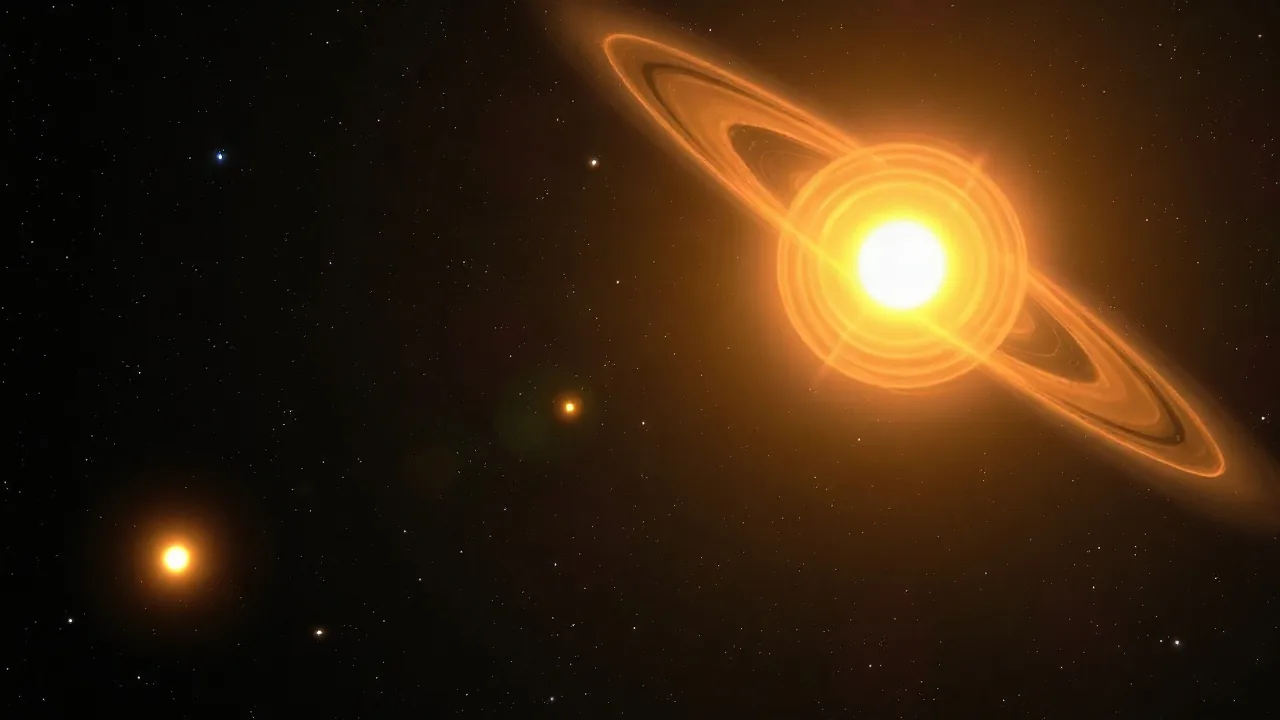
Astronomers have discovered a remarkable triple-star system just 28 light-years from Earth that challenges current understandings of how stars live, die, and interact as they evolve. Named Welopōʻai, the unusual configuration was found by an international team of scientists led by the Trottier Institute for Research on Exoplanets (IREx) at Université de Montréal. The findings are detailed in a study published in Astronomy & Astrophysics.
The system contains two white dwarfs—the extremely dense remnants of sunlike stars that have exhausted their fuel—and a red dwarf, which is a star much dimmer than the sun. The team initially stumbled upon the setup while searching for planets around the red dwarf.
“We were actually looking for planets,” explained IREx researcher Étienne Artigau, the study's lead author. “Instead, we found something much more surprising.”
The discovery began using the SPectropolarimètre InfraROUge (SPIRou) instrument at the Canada-France-Hawaii Telescope on Maunakea, Hawaii. While measuring tiny changes in stellar velocity to detect exoplanets, scientists noticed that a nearby red dwarf exhibited velocity variations of nearly 16 kilometers per second (10 miles per second), which was more than 1,000 times larger than expected. Following years of follow-up observations, the team determined the unseen companion possessed a mass greater than half that of the sun.
“The unusual combination of high mass and very low brightness left only one plausible explanation: It was the remnant of a dead star,” explained Charles-Antoine Parent, an undergraduate student at Université Laval and co-author of the study. “The most likely explanation was a white dwarf, although a neutron star or even a black hole couldn't be ruled out.”
Unraveling a Cosmic Mystery
To confirm the findings, the researchers used the Gemini North telescope on Maunakea, deploying high-resolution images from its ʻAlopeke instrument to directly detect the faint white dwarf companion. A second, much more distant white dwarf was already known to be part of the system. This means a red dwarf and a white dwarf orbit closely together, while the second white dwarf orbits that pair. No comparable system is known to exist within 100 light-years of Earth.
Before transforming into a white dwarf, the newly identified companion was a star roughly 40% more massive than the sun. As it expanded into a giant, reaching several hundred times its original size, a dramatic interaction with the nearby red dwarf seemed inevitable. In many similar systems, the expanding star engulfs its companion or causes them to merge. Yet, the red dwarf survived in a wide, stable orbit.
“This system should not exist,” said Patrick Dufour, a Université de Montréal professor who specializes in white dwarfs and co-authored the study. “We have no clean explanation for how it got here. That is the question driving our next observations.”
The name Welopōʻai was selected through A Hua He Inoa, a program of the ʻImiloa Astronomy Center of Hawaiʻi, combining “welo” (an inherited or family trait) and “pō'ai” (an orbit or circular path) to evoke a “path of family traits.”