
Africa's Kafue Rift Shows Signs of New Continental Break
Scientists are observing early signs of a potential continental rift forming along the Kafue Rift in sub-Saharan Africa. New geochemical data suggests mantle fluids are surfacing, hinting at the birth of a new tectonic plate boundary.

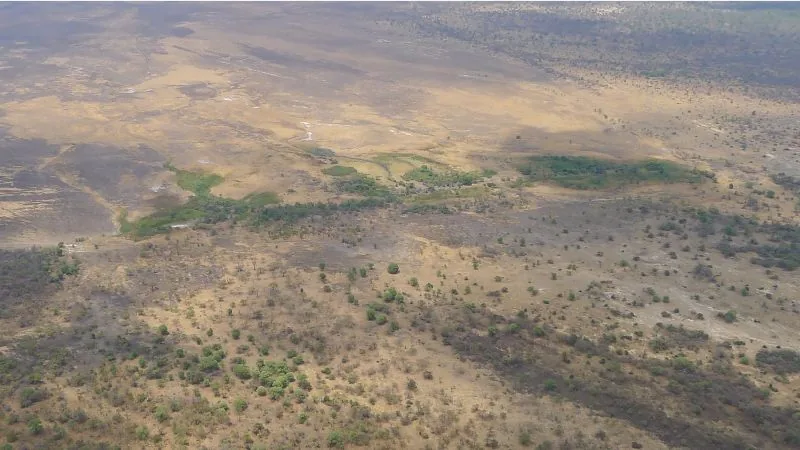
Scientists believe they may be witnessing the nascent stages of a significant geological event: the potential formation of a new continental rift in sub-Saharan Africa, which could eventually lead to the continent splitting apart over millions of years. The process appears to be centered along the Kafue Rift, a feature that forms part of a vast 1,500-mile rift system stretching from Tanzania to Namibia. Rifts are essentially cracks in the Earth's crust that can cause land to sink and trigger seismic activity. While thousands of rifts exist globally, many are dormant, but geologists have recently noted renewed activity along the Kafue Rift, a feature previously considered inactive.
Evidence gathered over the past few decades, including faint earthquakes detected by sensitive instruments, elevated underground temperatures, and subtle ground-level changes observed by satellites, has fueled suspicions that this geological feature is becoming tectonically active. A recent study published in Frontiers in Earth Science adds a crucial new dimension to this evidence by providing the first geochemical data from the area. Rūta Karolytė, the study's lead author, stated, "We have the first geochemical data from this area. That's quite a different line of evidence that really strengthens the idea that we have rift activity in the area." The findings could offer a rare glimpse into the fundamental question of how new tectonic plate boundaries emerge.
Geochemical Clues Point to Mantle Activity
To investigate, Karolytė and her team collected samples from hot springs and geothermal wells in Zambia, situated above the suspected rift zone. Their analysis focused on the ratio of helium-3 to helium-4 isotopes. The presence of higher-than-usual concentrations of helium-3 in the samples suggests a connection with the Earth's mantle, the deep layer beneath the crust. "We found more helium-3 than you'd normally find in the crust, which is generally a signal of mantle fluids coming up into the water," Karolytė explained. She noted that this is a preliminary finding, as samples were taken from only six specific sites. Importantly, two hot springs located approximately 60 miles away from the suspected rift showed no similar helium-3 anomaly, reinforcing the localized nature of this mantle-fluid upwelling. This geochemical signature is considered a key indicator that tectonic plates are beginning to stretch and separate.
The formation of a new plate boundary is a slow process. Tectonic plates, massive slabs of rock, constantly move over the Earth's mantle. Their interactions at boundaries have shaped continents and driven geological phenomena like earthquakes and volcanic eruptions for millions of years. The East African Rift, a much older and well-established rift system, serves as an example of such a process, already featuring volcanoes and significant seismic activity. If the Kafue Rift develops into a new plate boundary, it could take several million years, with estimates ranging from two to twenty million years. "At the fastest, it could happen in a couple of million years. At the slowest, it could take 10 or 20 million years," said study coauthor Mike Daly, a visiting professor at the University of Oxford. He elaborated on the potential progression: "The southern part of Africa would break off, but before that, you would start to see a lot more earthquakes, and some volcanic activity with lava flowing out. You would start to have deep rifts, and water would start to stagnate in it, so you’d get lakes as you get in East Africa today, and ultimately you’d get the sea."
While the ultimate continental split is a distant prospect, there are nearer-term economic implications for Zambia. The region's geothermal potential could be harnessed for energy production, and the extraction of valuable helium, in high demand for medical and technological applications, is also a possibility. To validate these initial findings, researchers are expanding their sampling efforts across a broader area along the suspected rift.
Experts like Estella Atekwana, a professor at the University of California, Davis, acknowledge the significance of the geochemical evidence, calling it a "strong confirmation" of fluid flow from the mantle through newly forming rift zones. However, she also emphasizes the need for more extensive data across the entire proposed boundary to determine if the mantle signal is consistent. "This is one important line of evidence, not the final word. It supports the hypothesis of early-stage rifting, but confirming a new plate boundary requires a full plate-boundary-scale test," she stated. Folarin Kolawole, an assistant professor at Columbia University, highlighted the potential continental fragmentation implications: "The key significance of a new plate boundary in southwestern Africa is that we now have an established pathway for the continent to break up from eastern Africa all the way through Botswana and Namibia to the Atlantic Ocean." While the dramatic reshaping of Africa is not imminent, scientists are poised to witness and study the birth of a new tectonic plate boundary as it unfolds over geological time.