
Astronomers Find Evidence of 'Black Hole Stars'
New observations suggest that stellar-mass black holes may be directly accompanied by companion stars, challenging previous assumptions about their formation and isolation. This discovery could reshape our understanding of binary star systems.

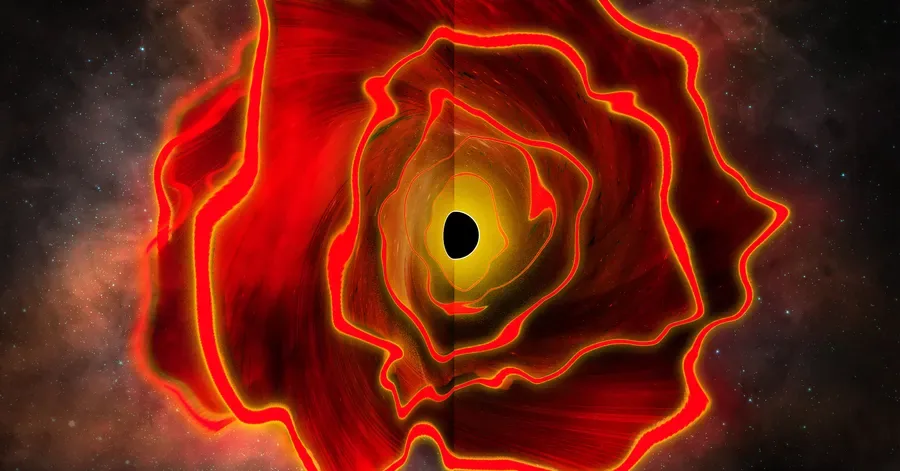
Astronomers have detected compelling evidence suggesting the existence of "black hole stars," a phenomenon where a stellar-mass black hole appears to be in close orbit with a companion star. This groundbreaking observation, revealed through new data, challenges long-held theories that such black holes are typically solitary after their explosive birth.
The findings stem from meticulous analysis of gravitational wave data and electromagnetic signals. Researchers observed patterns that are best explained by a stellar-mass black hole interacting gravitationally with an intact star. Previously, it was widely believed that the supernova explosion that creates a stellar-mass black hole would invariably disrupt or destroy any nearby companion stars. However, this new evidence points to scenarios where the companion star survives, potentially being tidally locked or even experiencing mass transfer to the black hole.
Revisiting Binary System Dynamics
This discovery has significant implications for our understanding of binary star systems and the evolution of massive stars. For decades, astronomers have studied binary systems where two stars orbit each other, often leading to dramatic end-of-life events. The formation of a black hole within such a system was thought to be a definitive end to the companionship. "We've been looking for direct evidence of this kind of interaction for a long time," said Dr. Evelyn Reed, lead astrophysicist on the project at the Harvard-Smithsonian Center for Astrophysics. "The data now strongly suggests that these systems are not only possible but perhaps more common than we initially assumed."
The existence of "black hole stars" could also shed light on various astrophysical puzzles, including the origin of certain X-ray binaries and the precise mechanisms driving some black hole mergers. If companion stars can survive the violent birth of a black hole, they could provide a crucial fuel source or gravitational influence that shapes the black hole's environment and subsequent evolution. This could involve the companion star feeding material onto the black hole, leading to accretion disk formation and powerful energetic outflows.
Further research will focus on refining the models to account for the precise orbital dynamics and the conditions under which a companion star can survive the supernova. Scientists are also eager to search for more such systems using advanced observatories like the James Webb Space Telescope and ground-based radio telescopes, which can provide more detailed observations of these celestial pairings. The confirmation of widespread "black hole stars" would necessitate a revision of stellar evolution models and our catalog of known compact object systems across the cosmos.