
August Solar Eclipse: Path, Viewing Tips, and Scientific Insights
A total solar eclipse will grace the skies on August 12, visible in parts of Greenland, Iceland, Spain, and Portugal. The event offers a unique chance for scientific observation and public wonder.

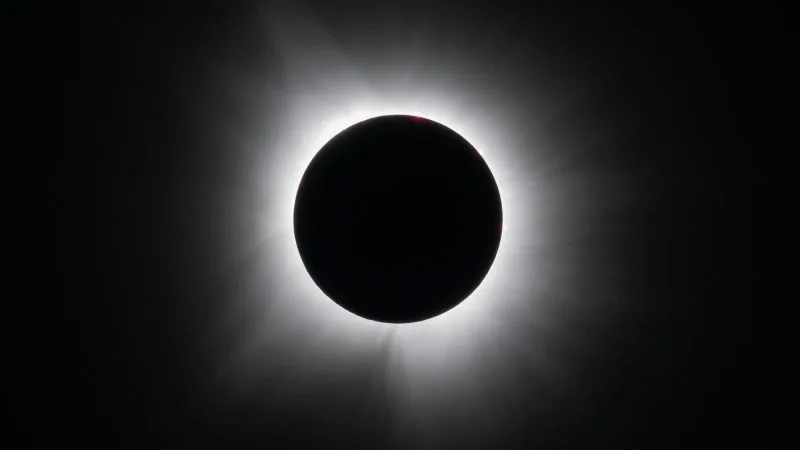
A rare total solar eclipse is set to captivate sky-gazers on August 12, marking the first such celestial event in over two years. This astronomical phenomenon occurs when the Moon positions itself directly between the Sun and Earth, casting a shadow that completely obscures the Sun's light for viewers within a specific path on our planet. According to NASA, the path of totality will offer a direct view of the Sun's corona for lucky observers in select regions of Greenland, Iceland, northern Spain, and northeastern Portugal.
For those outside this narrow band, a partial eclipse—where only a portion of the Sun is covered—will be visible across wider swaths of Europe, Africa, and North America. While a total solar eclipse was last seen across Mexico, the United States, and Canada in April 2024, the upcoming event is particularly notable for mainland Europe. It represents the first total solar eclipse observable from mainland Spain since 1905 and is part of a trio of solar eclipses the country will experience before 2028, as reported by the European Space Agency (ESA). Carole Mundell, the ESA’s director of science, emphasized the profound experience, stating, "A total solar eclipse is one of those rare moments when millions of people can look up together and feel both wonder and curiosity. It is a shared moment that connects us to the Universe and reminds us that the desire to explore and understand is one of humanity’s greatest strengths."
Understanding the Eclipse's Path and Timing
The path of totality for the August eclipse is remarkably narrow, stretching approximately 5,157 miles (8,300 kilometers). The celestial journey begins over the Arctic coastline around 1 p.m. ET, tracing a course near the North Pole before traversing Greenland, Iceland, Portugal, and culminating in northern Spain. Observers in Greenland can expect over two minutes of totality, while those in northern Spain might witness around 20 seconds, weather permitting. Inclement weather remains the primary challenge for optimal viewing. The eclipse will track over regions like Galicia and the Balearic Islands in Spain as sunset approaches, potentially accelerating the transition from day to night, according to the Spanish Scientific and Advisory Committee for the Trio of Eclipses. Resources like Time and Date's website can provide precise timing for specific locations. For those unable to witness the event directly, the ESA will offer a livestream from Spain’s Astrophysical Observatory of Javalambre in Teruel.
Looking ahead, the next total solar eclipse is slated for August 2, 2027, passing over southern Spain, North Africa, Saudi Arabia, and Yemen. The United States will not experience another total solar eclipse until March 30, 2033, exclusively visible from Alaska. A broader view for the contiguous United States will have to wait until August 22, 2044, with totality over North Dakota and Montana. A full coast-to-coast eclipse across the Lower 48 states is not anticipated until August 12, 2045, with its path arcing over states from California to Florida.
Safe viewing practices are paramount. It is never safe to look directly at the Sun without specialized eye protection, except during the brief period of totality. As soon as sunlight begins to reappear, certified eclipse glasses or handheld solar viewers must be used. Similarly, telescopes, binoculars, or cameras require solar filters identical in protection to eclipse glasses. Standard sunglasses are insufficient and do not meet the necessary safety standards. Damaged or scratched viewing equipment should be discarded. NASA also cautions against using optical devices like cameras or telescopes while wearing eclipse glasses, as concentrated solar rays can damage the equipment's filters.
Solar eclipses provide invaluable scientific research opportunities, particularly for studying the Sun's corona and atmospheric phenomena. During the upcoming August event, high-altitude balloons are scheduled to capture detailed images of the eclipse and the lunar shadow. A key objective is to replicate a famous 1919 experiment that measured the bending of starlight by the Sun's gravity, providing early confirmation of Albert Einstein's theory of general relativity, notes the Spanish Scientific and Advisory Committee for the Trio of Eclipses. The ESA encourages public participation through citizen science initiatives, such as building instruments to monitor atmospheric changes during the eclipse. As Mundell of the ESA stated, "We use moments like this to bring space science and technology closer to society, to inspire future generations and bring people across Europe together through the excitement of discovery."