
Aurora Borealis May Dazzle 20 States Tuesday Night
Northern Lights are expected to be visible across a wide swathe of the U.S. Tuesday night. Geomagnetic storms driven by solar activity could push the aurora as far south as 20 states.

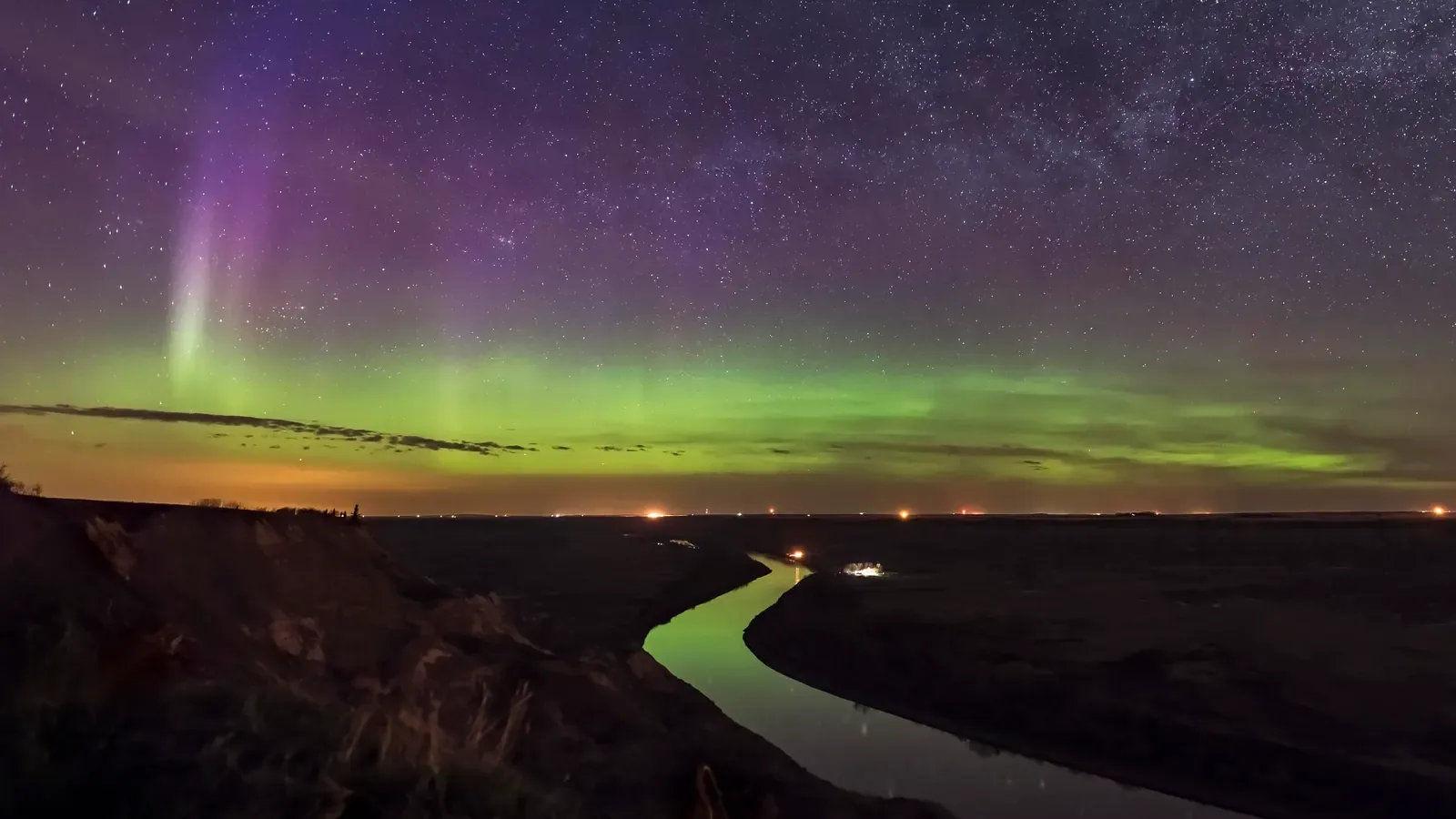
Skywatchers across the United States have a chance to witness the spectacular display of the Aurora Borealis Tuesday night, September 8, into Wednesday, September 9. Several solar eruptions that occurred on September 5 and 6 are projected to reach Earth, potentially triggering geomagnetic storms. The intensity of these storms remains a subject of varying forecasts, with potential for the aurora to be visible in approximately 20 states.
The United Kingdom's Met Office suggests a possibility of G2 (Moderate) geomagnetic storming, which could extend the aurora's reach significantly southward. This forecast indicates that the display might be observable in states ranging from the Pacific Northwest to the Northeast. In contrast, NOAA's current forecast predicts G1 (Minor) geomagnetic storm conditions, which would typically limit visibility to more northern latitudes. The timing of the peak activity is anticipated around midnight UTC on September 9, which translates to approximately 8 p.m. EDT on September 8.
Solar Activity Drives Aurora Forecasts
Earth is already experiencing altered conditions due to a stream of faster solar wind emanating from a coronal hole on the sun. This stream alone has the potential to generate G1 geomagnetic storm conditions. The main uncertainty lies in the interaction of multiple Coronal Mass Ejections (CMEs) that were ejected from the sun earlier this week. The Met Office anticipates up to three CMEs could interact with Earth, leading to a broad chance of G2 storming. However, NOAA's latest outlook is more conservative, projecting a maximum Kp index of 5, consistent with G1 storm conditions, through September 10.
Visibility under G1 conditions typically includes states like Alaska, North Dakota, Maine, Minnesota, Vermont, Montana, New Hampshire, South Dakota, Washington, Wisconsin, and Michigan. However, if the G2 scenario predicted by the Met Office materializes, the aurora could extend south to Oregon, Wyoming, Nebraska, Iowa, Illinois, Indiana, Ohio, Pennsylvania, and New York. The exact southern limit of the display is contingent not only on the strength of the incoming solar wind but also on the orientation of its magnetic field as it interacts with Earth's magnetosphere. Observers are advised to monitor conditions closely, as the southern extent remains a possibility rather than a certainty.
For those eager to capture the celestial show, optimal viewing conditions involve dark, clear skies away from urban light pollution. At lower latitudes, the aurora is often best seen near the northern horizon. Even faint displays can sometimes be detected using smartphone cameras, particularly in low-light or night modes. Using a tripod and experimenting with longer exposures can reveal subtle colors and structures. September is generally a favorable month for aurora viewing due to the Russell–McPherron effect, a phenomenon where Earth's magnetic field orientation around the equinoxes facilitates more effective interaction with the solar wind, increasing the likelihood of geomagnetic activity and aurora displays.