
Aurora Borealis Possible in 19 US States Monday Night
The Northern Lights could be visible in parts of 19 US states Monday night into Tuesday. A solar storm, triggered by a coronal mass ejection, may bring the aurora to the northern horizon.

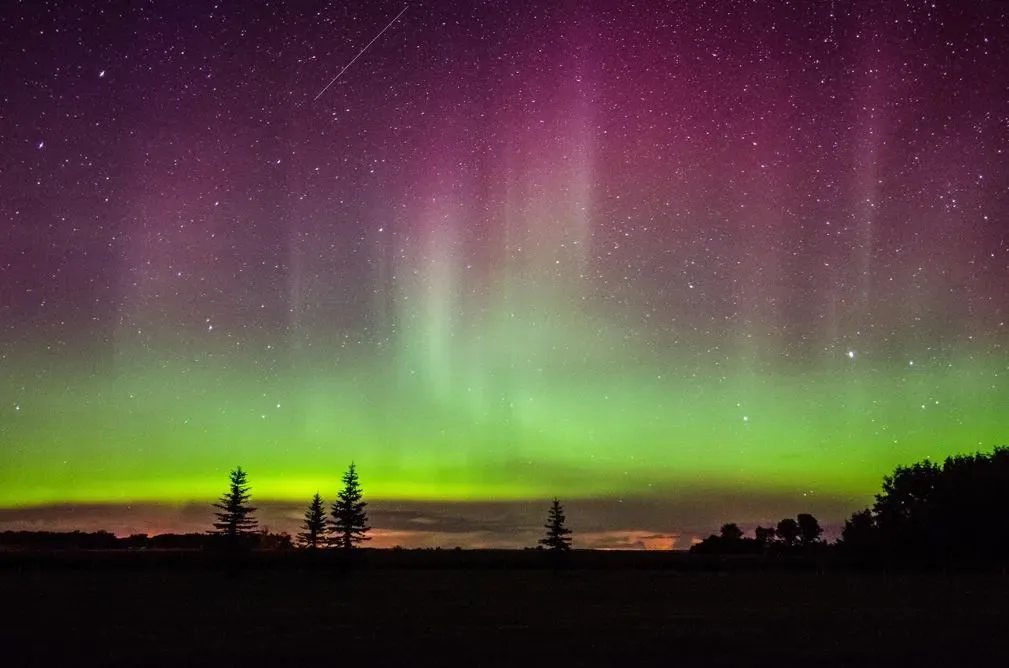
The mesmerizing spectacle of the Aurora Borealis, also known as the Northern Lights, may grace the skies across 19 U.S. states Monday night, June 29, into the early hours of Tuesday, June 30. This potential celestial display is attributed to a coronal mass ejection (CME) – a powerful burst of charged particles from the sun – that was released on June 26 and is expected to reach Earth.
NASA models indicate that the CME could trigger a G2-class geomagnetic storm. While not considered a major aurora event, such conditions can elevate the visibility of the aurora to latitudes much further south than typically observed. Residents in northern states, particularly those near the Canadian border, are advised to look towards the northern horizon for any signs of the aurora.
The states with the best chance of witnessing the phenomenon include the northern portions of Washington, Idaho, Montana, North Dakota, Minnesota, Wisconsin, Michigan, and Maine. There is also a possibility of glimpsing the aurora in Oregon, Wyoming, Nebraska, Iowa, Illinois, Indiana, Ohio, New York, Vermont, and New Hampshire. However, the long daylight hours following the recent summer solstice and the rise of the full Strawberry Moon on Monday evening might make spotting the aurora more challenging.
Understanding Geomagnetic Storms and Auroras
Geomagnetic storms are disturbances in Earth's magnetosphere caused by the interaction of the solar wind with the planet's magnetic field. When a CME or a high-speed solar wind stream hits Earth, it can cause fluctuations in the magnetic field. These storms are classified on a scale from G1 (minor) to G5 (extreme). A G1 or G2 storm, as is currently forecast, is unlikely to cause widespread disruptions but can enhance aurora visibility. The Kp-index, which measures geomagnetic activity, is expected to reach levels of KP 4 or KP 5, conditions that have historically brought visible auroras to the far northern U.S. even outside of major solar events. Aurora watchers are encouraged to find locations away from bright lights and consider using long-exposure settings on cameras or smartphones, as they can often detect fainter auroral displays before the human eye.
The underlying cause of the aurora lies in the sun's constant stream of charged particles, known as the solar wind. As these particles travel through space, they can collide with Earth's magnetic field. While the magnetosphere largely protects the planet, some particles are channeled along magnetic field lines towards the polar regions. Upon entering the upper atmosphere, these energetic particles interact with oxygen and nitrogen atoms, exciting them and causing them to release energy in the form of visible light. Different atmospheric gases and altitudes produce the varied colors seen in the aurora, with green and pink being the most common.
Space weather forecasts, such as those provided by the National Oceanic and Atmospheric Administration (NOAA) and the UK Met Office, indicate that enhanced conditions are expected to persist into July 1. The NOAA forecast predicts the arrival of the CME to potentially spark a G1-class geomagnetic storm. The UK Met Office offers a slightly more energetic outlook, suggesting a chance of G2 Moderate Storms, especially if a particularly dense magnetic cloud accompanies the CME. Space weather conditions are dynamic and can change rapidly, with forecasts being updated regularly to reflect the latest observations and models.