
BepiColombo Mission Arrives at Mercury After Long Journey
The BepiColombo mission, a joint effort by ESA and JAXA, is set to begin its arrival phase at Mercury on September 3, 2026. The spacecraft will separate and enter orbit around the planet.

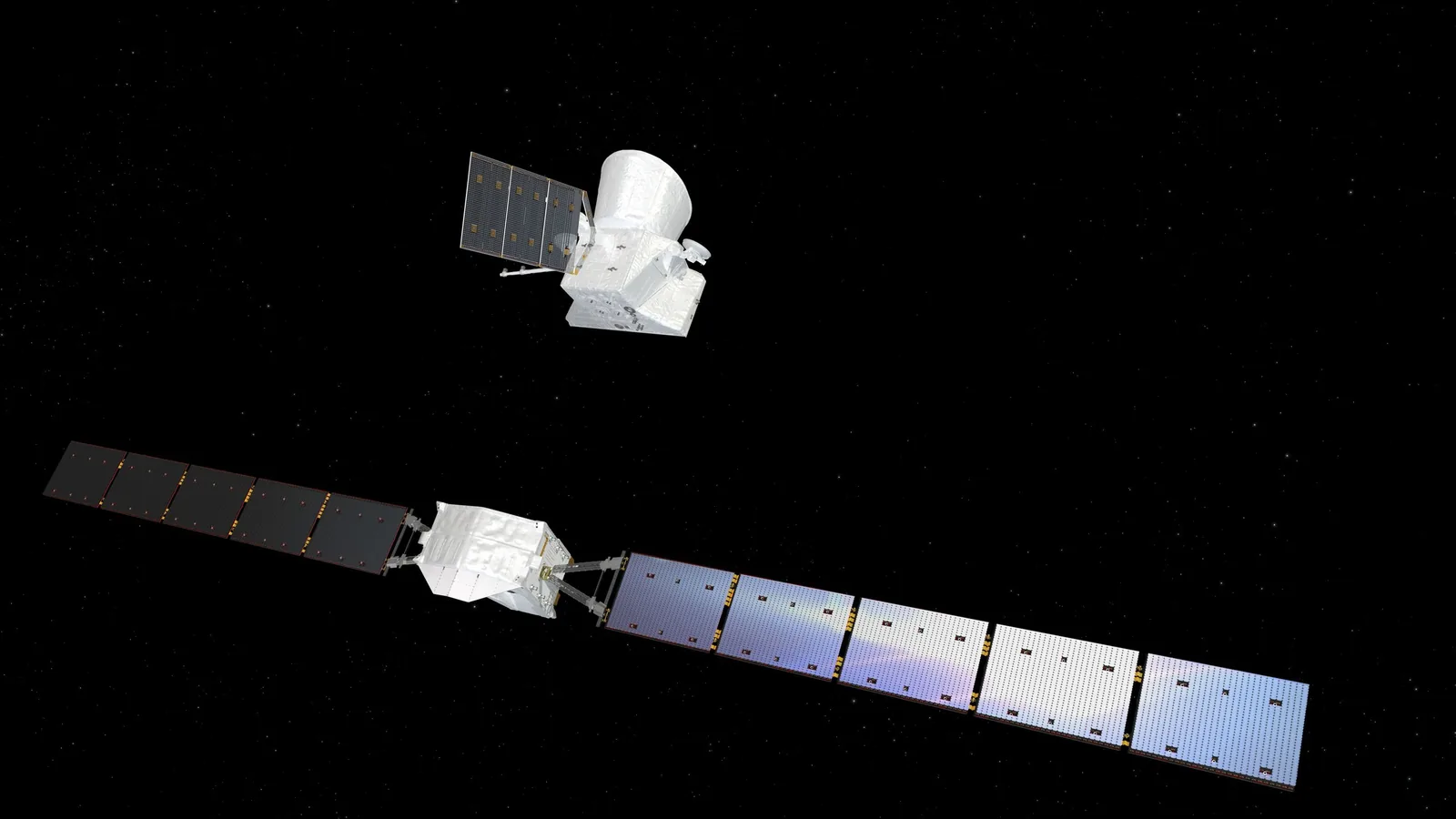
The BepiColombo mission is poised to commence its long-anticipated arrival at Mercury, the solar system's innermost planet. Launched in October 2018, the spacecraft has undertaken an extensive and circuitous journey, which is now nearing its conclusion. On Thursday, September 3, 2026, BepiColombo's two primary science orbiters, one managed by the European Space Agency (ESA) and the other by the Japan Aerospace Exploration Agency (JAXA), will separate from their power and propulsion module. This significant event is scheduled to occur around 8 a.m. EDT (1200 GMT) and will be broadcast live.
The live webcast, provided courtesy of ESA, will commence at 7:45 a.m. EDT (1145 GMT). ESA plans to pause the broadcast briefly at 8:30 a.m. EDT (1230 GMT) before resuming an hour later to cover the critical phase of acquiring communication signals from the newly independent orbiters. These communication links are anticipated to be established no earlier than 9:53 a.m. EDT (1353 GMT), according to ESA officials. The webcast will document this process along with initial spacecraft status checks, concluding between 10:15 and 10:45 a.m. EDT (1415 to 1445 GMT).
Preparing for Orbit Insertion
The separation marks merely the initial step in BepiColombo's intricate Mercury arrival sequence. The two science orbiters—ESA's Mercury Planetary Orbiter (MPO) and JAXA's Mercury Magnetospheric Orbiter (MMO, nicknamed Mio)—will not be gravitationally captured by Mercury until November 21, 2026. On that date, the duo will still be physically connected. Should all systems perform as expected, the MPO will release Mio into its final orbit on December 9 or December 10. This orbit will be highly elliptical, ranging from 367 miles (590 kilometers) to 7,233 miles (11,640 km) from Mercury. The MPO itself is scheduled to enter its designated orbital path, an ellipse with altitudes between 298 miles and 932 miles (480 by 1,500 km), on March 10, 2027.
The scientific operations phase of the BepiColombo mission, named in honor of the Italian mathematician and engineer Giuseppe "Bepi" Colombo, is slated to begin on April 6, 2027. This research period, expected to last at least one Earth year, promises intriguing and valuable data. The MPO will focus on mapping Mercury, while Mio will investigate its magnetosphere. Their combined efforts aim to unravel the mysteries of "the least explored planet in the inner solar system," as stated in an ESA mission description.
"Among several investigations, BepiColombo will make a complete map of Mercury at different wavelengths," the ESA officials explained. "It will chart the planet's mineralogy and elemental composition, determine whether the interior of the planet is molten or not, and investigate the extent and origin of Mercury’s magnetic field." This ambitious space mission represents a significant step in understanding the unique characteristics of Mercury, a planet long overshadowed by its proximity to the Sun and the challenges it presents for observation.