
BepiColombo Mission Reaches Mercury After 8-Year Journey
Two spacecraft from the ESA and JAXA's BepiColombo mission are nearing Mercury after an eight-year voyage. Set to begin observations in April 2027, the probes aim to unravel the planet's long-standing mysteries.

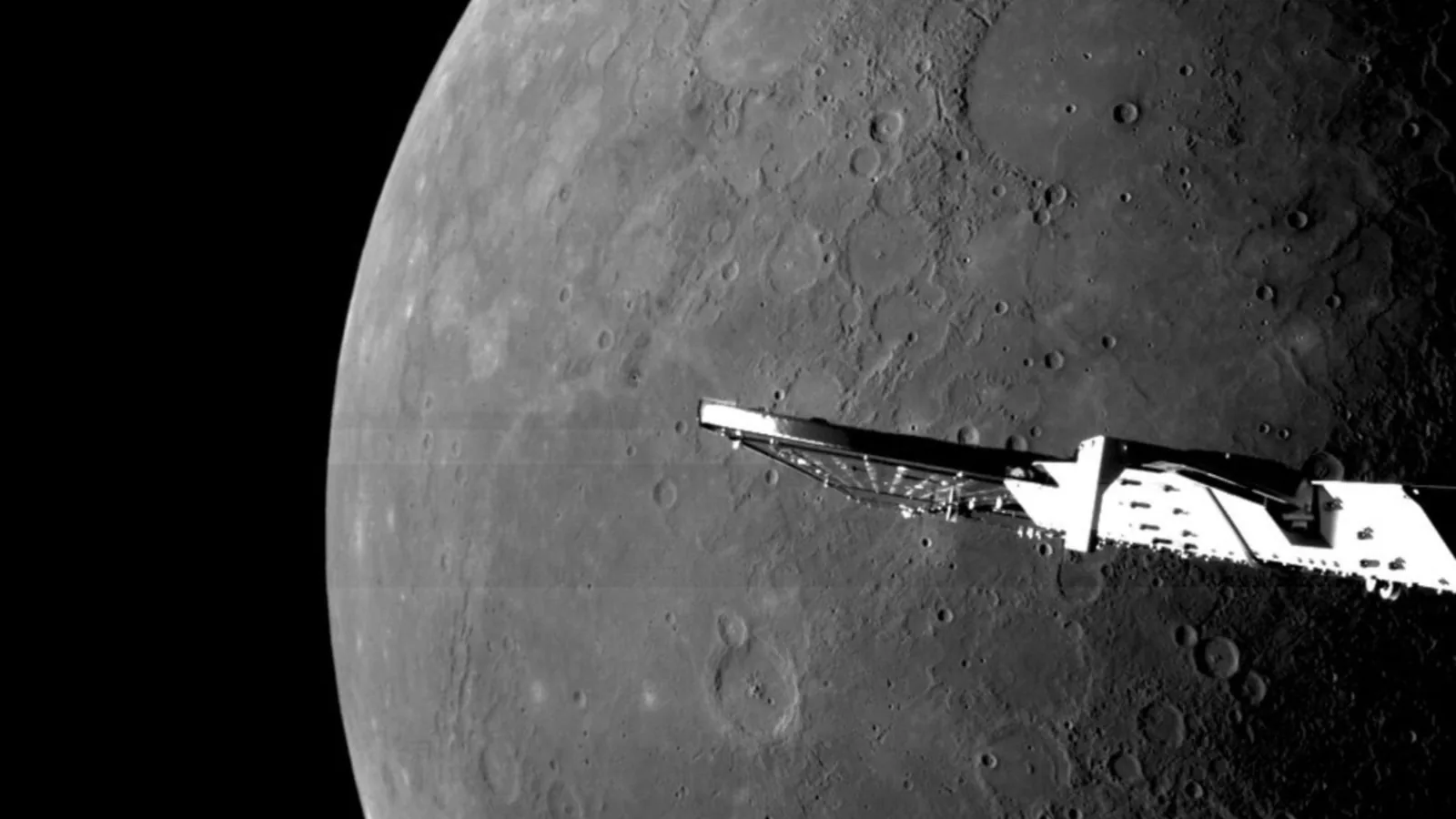
The BepiColombo mission, a collaborative effort between the European Space Agency (ESA) and the Japan Aerospace Exploration Agency (JAXA), is on the cusp of commencing its scientific investigations of Mercury. Launched in October 2018, the mission's two specialized spacecraft have completed an eight-year journey through the inner solar system. A critical maneuver is scheduled for September 3, 2026, involving the separation of the science payloads from their transit modules. By April 2027, these sophisticated probes are expected to begin a comprehensive study of the solar system's smallest and least-explored planet, aiming to solve long-standing puzzles about its formation and composition.
Mercury holds a unique position in our solar system as the planet closest to the Sun, yet it remains one of the most enigmatic worlds. Historically, it has been visited by only two prior missions: NASA's Mariner 10, which conducted flybys in 1974 and 1975, and NASA's MESSENGER spacecraft, which orbited the planet from 2011 to 2015. Mariner 10 provided humanity's first close-up views, revealing a heavily cratered surface and confirming the presence of a tenuous atmosphere and a magnetic field. "It really gave us our first close-up view of Mercury," Sean Solomon, a planetary scientist at Columbia University, told Space.com. "But it left a lot of pages blank." MESSENGER significantly expanded our knowledge, mapping the entire surface and discovering features like bright, steep-sided "hollows" and a higher-than-expected abundance of volatile elements. However, even MESSENGER could not fully answer questions regarding Mercury's assembly or the offset of its magnetic field's center.
Unveiling Mercury's Secrets
The BepiColombo mission is specifically designed to address these lingering questions. Comprising two distinct orbiters, the Mercury Planetary Orbiter (MPO) from ESA and the Mercury Magnetospheric Orbiter (Mio) from JAXA, the mission will gather complementary data. The MPO will focus on the planet's surface and interior, equipped with 11 instruments to map terrain, analyze mineral composition, study volcanic deposits, investigate the mysterious hollows, and observe the interaction between Mercury and the solar wind. "I think being able to see new data come out about Mercury is going to be so fantastic," said Rachel Klima, a planetary geologist at the Johns Hopkins University Applied Physics Laboratory. "The planet, she says, is "just so weird and beautiful and interesting."
The Mio spacecraft will turn its attention to Mercury's surrounding environment, including its magnetosphere, wispy atmosphere, and the dust particles present in its orbital path. Notably, both orbiters carry instruments capable of measuring the planet's magnetic field. This dual observation capability will allow scientists to study different regions of the magnetic field simultaneously, a significant improvement over previous single-point measurements. While some instruments have already gathered preliminary data during the mission's cruise phase and flybys, the majority of scientific operations will commence after the planned spacecraft separation in December 2026. Scientists anticipate a surge in new discoveries once the probes are in their operational orbits.
Planetary scientists like Solomon are particularly eager to see detailed imagery of Mercury's southern hemisphere, an area that MESSENGER could not observe with the same clarity as the northern regions. The prospect of identifying water ice deposits in permanently shadowed craters is a key objective. "I expect that will explode once they go into orbit," Solomon remarked regarding the potential for new research. Furthermore, Klima highlighted the importance of the MPO's advanced mineral mapping capabilities. Unlike MESSENGER, which relied on detecting iron-rich materials, the MPO's instruments can identify a wider range of elements, potentially shedding light on the planet's formation processes and, by extension, the evolution of the entire solar system. This mission promises to elevate Mercury from its status as an overlooked terrestrial planet to a subject of intense scientific scrutiny, revealing details that could reshape our understanding of planetary science.