
BepiColombo Spacecraft Nears Mercury After 9-Year Journey
The BepiColombo mission's two spacecraft separated from their cruiser on Thursday, beginning the final approach to Mercury. The joint European-Japanese mission launched in 2018 and will begin orbiting the planet in November.

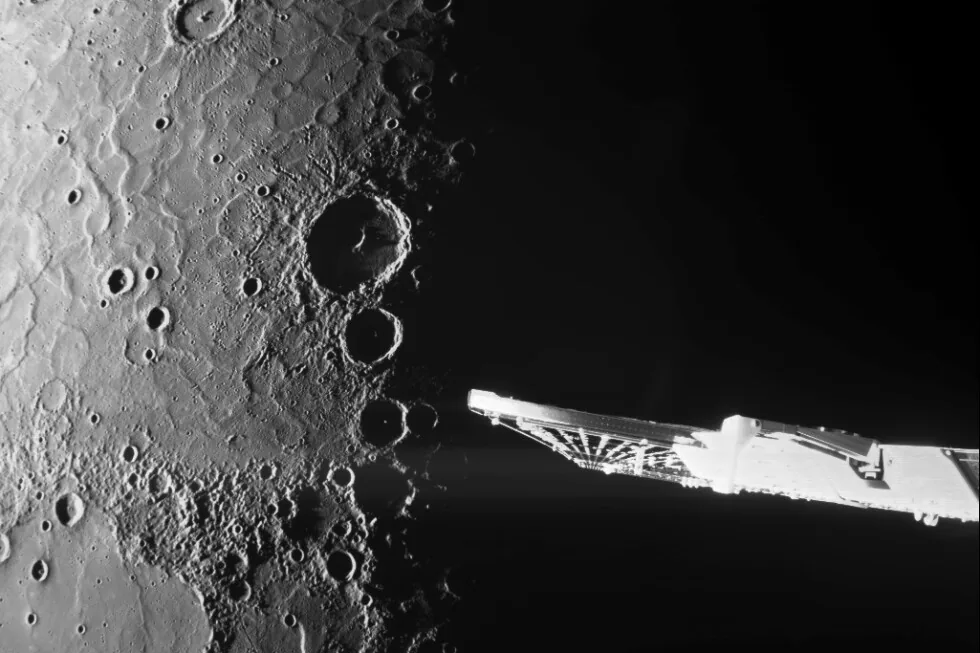
Two spacecraft on a nearly decade-long mission to explore Mercury successfully detached from their mother ship Thursday, entering the final phase of their journey to the solar system's innermost planet. The linked European and Japanese probes, collectively known as BepiColombo, separated as planned, with controllers at the European Space Agency's control center in Germany confirming the crucial maneuver via radio signals from over 124 million miles away.
“It’s a brilliant moment,” said Geraint Jones, lead project scientist. If the mission proceeds as expected, the conjoined spacecraft will enter orbit around Mercury in November. Following this, they will split in December to conduct independent mapping and studies of the entire planet from varying altitudes. As of Thursday's separation, BepiColombo still had 2 million miles (3.3 million kilometers) to cover before reaching its destination.
Launched in 2018, the BepiColombo mission honors the Italian mathematician Giuseppe Colombo, who played a role in NASA’s Mariner 10 mission to Mercury in the 1970s. Until now, only NASA’s Messenger spacecraft has undertaken an in-depth exploration of the enigmatic and intensely hot planet, which is slightly larger than Earth's moon. “How tiny Mercury is and still it holds some of the biggest mysteries of our solar system,” mission manager Santa Martinez commented earlier this week, emphasizing the scientific significance of the planet. Jones added, “There’s a huge amount still left to be learned.”
Studying a Planet of Extremes
Throughout its complex, roundabout route, BepiColombo has already traveled more than 6 billion miles (10 billion kilometers). The mission required nine planetary flybys, including a crucial maneuver past Earth in 2020 and several with Venus, to gradually reduce its velocity and allow Mercury's gravity to capture it. The spacecraft's most recent flyby, in January 2025, provided striking images of Mercury’s heavily cratered surface and vast volcanic plains, offering tantalizing glimpses of what scientists anticipate discovering.
Beginning next spring, an array of sophisticated science instruments aboard both the European and Japanese spacecraft will commence detailed studies. These investigations will focus on Mercury's peculiar magnetic field, its dense internal structure, and the geological processes shaping its surface. Particular attention will be paid to surface features known as hollows, or depressions, which scientists theorize are slowly being eroded as minerals vaporize from the rocks due to the intense solar radiation.
Mercury presents a stark world of contrasts. While surface temperatures can soar above 800 degrees Fahrenheit (427 degrees Celsius) on the sun-facing side, the planet's poles remain frigid. Deep, permanently shadowed craters at the poles are believed to harbor water ice, a surprising finding for a planet so close to the sun. The extreme conditions presented significant engineering challenges. Ignacio Tanco, a mission operations chief for the European Space Agency, noted that engineers had to design the spacecraft to endure “extremely punishing” environments. He likened the challenge to “essentially equivalent to operating with a very hot pizza oven running right on your back.”
The BepiColombo mission, with the European Space Agency bearing the majority of its approximately $2 billion (1.7 billion euros) cost, is set to begin its primary science observations in the spring of 2026. These observations promise to unlock crucial secrets about Mercury's formation, evolution, and its role within the solar system.