
Black Hole Star Discovered: Massive Object Reshapes Early Universe Understanding
Astronomers using the James Webb Space Telescope have identified a new class of cosmic object, dubbed a "black hole star," that is 100,000 times the Sun's mass and powered by a black hole.

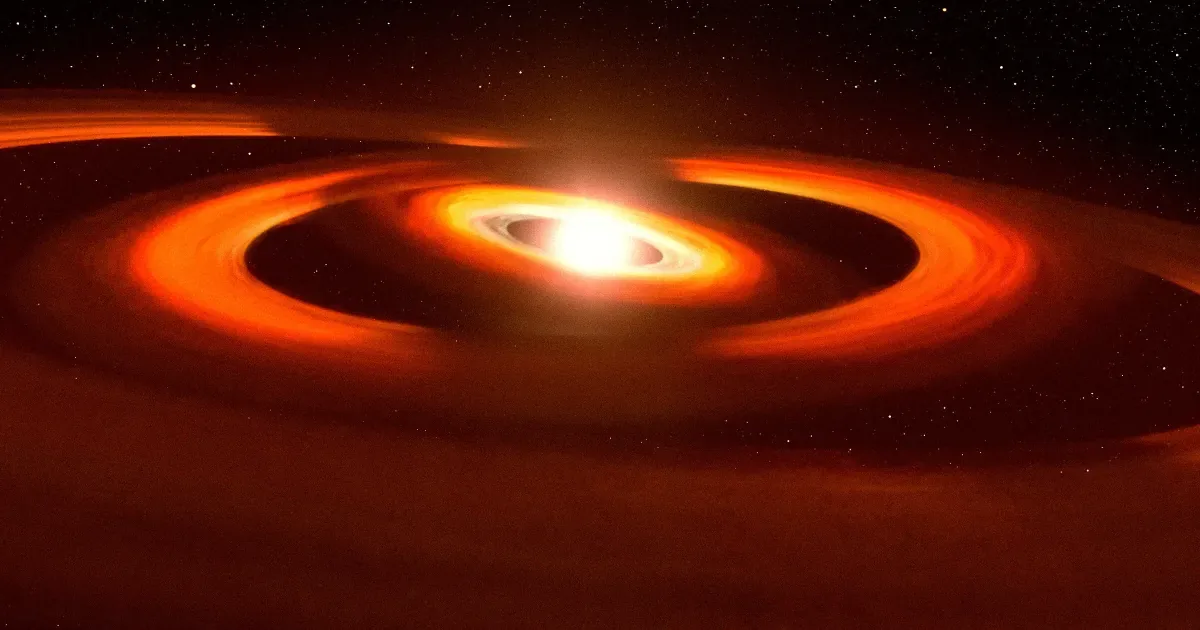
Astronomers leveraging the power of the James Webb Space Telescope have identified an entirely new category of celestial object: a "black hole star." This colossal entity, designated MoM-BH*-1, is approximately 100,000 times more massive than our Sun and is enveloped in an expansive shell of gas. The object's immense size and unique composition have astronomers re-evaluating conditions in the early universe, less than 700 million years after the Big Bang.
Unlike conventional stars, MoM-BH*-1 is not powered by nuclear fusion. Instead, its intense luminosity stems from a central black hole actively consuming surrounding matter. The energy output from this process is staggering, with the black hole at its core releasing 100 billion times more energy than any known star. The discovery, detailed in a new study published in the journal Nature, highlights the potential for exotic objects to exist in the universe's formative stages.
Rohan Naidu, an astronomer at the University of Hawai’i and lead author of the study, expressed astonishment at the find. "It is a very special thing to find an object with no comparison given the vast stores of data on billions of stars, galaxies, and black holes that we have in our archival databases," Naidu stated. "MoM-BH*-1 is one in a billion!" The existence of objects akin to "black hole stars," initially theorized as "quasi-stars" nearly two decades ago, gained renewed attention following the James Webb's initial observations in 2022, which revealed hundreds of unexplained "little red dots" in the early cosmos.
Rethinking Early Universe Objects
These enigmatic crimson objects presented a puzzle for scientists. They were too massive and dense to be typical stars yet too compact to be classified as galaxies, defying established physical models. A critical piece of the mystery was the absence of expected X-ray emissions that would typically accompany supermassive black holes at their centers. However, the hypothesis of a black hole star offered a compelling explanation: an ultra-dense gas shell could effectively obscure these X-rays. The theory gained further traction in May 2026, when another research team reported detecting X-ray signals from one such object, strongly suggesting the presence of a central black hole.
Naidu's team investigated MoM-BH*-1 after observing an unusual dimming of its light at specific wavelengths—a phenomenon usually associated with young stars obscured by dust. However, no dust was detected. Their simulations indicated that a dense hydrogen layer could produce a similar light-filtering effect. The tremendous brightness of the object, they concluded, could be explained by a central black hole. If their findings hold true, it implies that many of the "little red dots" observed by the Webb telescope could also be black hole stars. "Every little red dot is consistent with being a black hole star, embedded in a generic early galaxy," Naidu explained. "But what is special about MoM-BH*-1 is, the black hole star is essentially completely outshining its surrounding host galaxy, such that we’re seeing pure black hole star light." This unprecedented discovery provides crucial insights into the extreme conditions and diverse phenomena present in the universe's infancy, potentially altering our models of cosmic evolution.