
Caltech Robot Completes First Autonomous Space Construction Demo
A Caltech-built robotic system has successfully constructed a structure in space autonomously for the first time as part of a DARPA program.

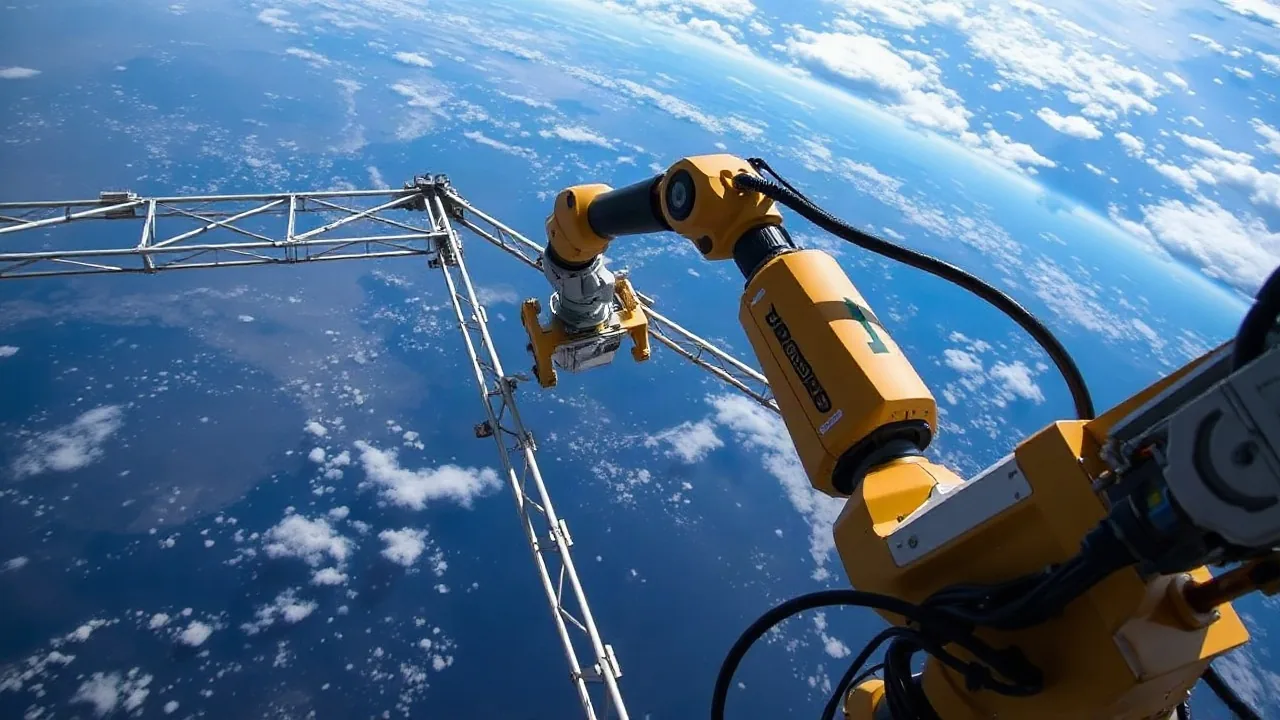
A robotic truss builder conceived and constructed by researchers at the California Institute of Technology has successfully built a structure in space without astronaut intervention for the first time. The autonomous mechanism is part of the Defense Advanced Research Projects Agency, or DARPA, Novel Orbital and Moon Manufacturing, Materials, and Mass-efficient Design program, known as NOM4D. The robotic system uses an autonomous manipulator arm to retrieve struts and joints from nearby dispensers, assembling identical sections of a perimeter truss.
“This is the first time that a structure has been autonomously constructed in space,” says Sergio Pellegrino, the Joyce and Krent Kresa Professor of Aerospace and Civil Engineering and team leader for the project.
Pellegrino heads the Autonomous In-Space Tensioned Reflector Assembly demonstration, called ASTRA. The robotic builder spent six months working in orbit to construct a 1.4-meter-diameter reflector antenna utilizing composite fiber tubes, aluminum joints, and a Kapton reflective surface. According to DARPA, the assembly process resembles putting together a complex Tinkertoy structure, though automating the sequence in an orbital environment presents severe technical hurdles.
Despite encountering time constraints that restricted construction to the initial section of the antenna, the demonstration validated the viability of the concept. The approach is designed to scale up for massive perimeter trusses that could support giant reflective surfaces in orbit.
The Journey to Low Earth Orbit
Early in the morning on March 30, 2026, the ASTRA payload hitched a ride from Vandenberg Space Force Base to low Earth orbit. It flew as one of 10 payloads aboard Momentus Inc.'s Vigoride 7 orbital space vehicle, launched via a SpaceX Transporter-16 mission. Measuring roughly 1 cubic meter, the payload survived the launch carrying two prebuilt truss bays with diagonal supports alongside motorized dispensers holding the remaining components.
Jaden Suh, a former California Institute of Technology postdoctoral scholar who is now an assistant professor at the University of Texas at Austin, expressed deep enthusiasm for the milestone. “As a child, I was super curious about and interested in space structures. Just like many other engineers working in this field, sending your stuff to space is what I've been dreaming of my entire life,” Suh says.
Once operational in orbit, researchers sent commands to the onboard computer via the Vigoride vehicle to release launch restraints, push out the prebuilt bays, and execute the assembly of a third bay. Team members including Charles Sommer, Alan Truong, and graduate student Tara Venkatadri managed the commands and verified outcomes using downloaded photographs.
Scientists aim to deploy large-scale orbital structures like reflector surfaces to serve as massive mirrors for advanced space telescopes or as apertures for large radio frequency antennas. Traditional deployment methods have been restricted by the size constraints of rocket fairings, forcing engineers to either fold structures for launch or manually piece them together during multiple flights. The NOM4D program aims to establish an alternative option by manufacturing and assembling large structures directly in orbit.