
China's Chang'e-7 Mission Targets Lunar South Pole Ice Hunt
China is preparing to launch the ambitious Chang'e-7 mission, aiming to find water ice in permanently shadowed craters at the Moon's south pole. The complex uncrewed mission includes a lander, rover, and a unique hopping probe.

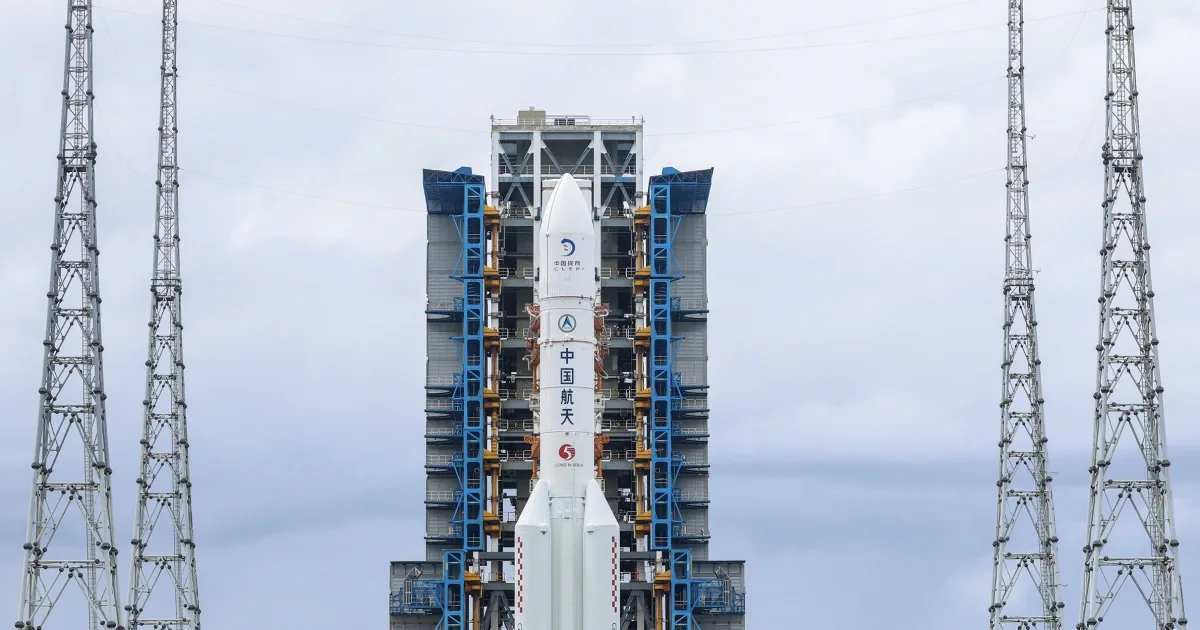
China is set to launch its most advanced lunar mission yet, the Chang'e-7, which will embark on a quest to discover frozen water deposits within the permanently shadowed craters near the Moon's south pole. This uncrewed expedition, named after a mythical Chinese moon goddess, will deploy a sophisticated lander, rover, and an innovative "hopping" probe into one of the solar system's most frigid environments. The mission marks a significant stride toward China's overarching objective of establishing a lasting human presence on the Moon, with plans for a crewed landing before 2030 and the joint development of a research station with Russia by 2035.
The Chang'e-7 spacecraft is slated to lift off from the Wenchang Space Launch Site in the southern island province of Hainan, carried by a Long March 5 rocket. The mission's payload includes a suite of scientific instruments, such as water analyzers, cameras, and radar systems. Following its arrival in lunar orbit, the spacecraft will first survey potential landing zones at the south pole before attempting a descent. A prime candidate location is adjacent to the rim of the Shackleton crater, a depression that remains in perpetual shadow. However, the rugged terrain of the crater's rim experiences almost constant illumination from the Sun. While China has not yet revealed a precise launch date, space analysts anticipate a landing attempt around November 2026.
Exploring the Moon's Deep Freeze
The scientific rationale behind focusing on the Moon's south pole stems from craters that have not been exposed to sunlight for billions of years. Scientists theorize that these frigid regions could function as giant freezers, preserving ancient water and volatile organic compounds. NASA data indicates that temperatures in these shadowed areas can plummet to as low as -203 degrees Celsius (-334 Fahrenheit). The discovery of accessible water is paramount for future lunar bases, as it could supply drinking water, generate oxygen for astronauts, and even be processed into rocket propellant, thereby reducing the reliance on expensive resupply missions from Earth. In stark contrast to most of the Moon's surface, where lunar nights can last as long as 14 Earth days, the high peaks and crater rims near the south pole are bathed in near-constant sunlight. This makes them an ideal setting for a lunar outpost, offering a stable thermal environment and a continuous source of solar power.
China is not alone in its interest in the lunar south pole. The United States, India, and Russia also have their sights set on this region. India's Chandrayaan-3 mission achieved a landing nearby in 2023. In the coming years, NASA's VIPER rover, the European Space Agency's PROSPECT drilling package, and the Japan-India LUPEX rover are all expected to arrive at the Moon's south pole. This intensified activity underscores a growing global race to identify and secure potential water resources on the Moon.
A significant challenge for traditional wheeled rovers involves navigating the steep inclines of lunar crater rims. To overcome this, the Chang'e-7 mission will deploy a novel hopping probe designed to descend into the pitch-black crater floors. This hopper, equipped with a water molecule analyzer, will utilize its small thrusters to navigate into shadowed craters. Upon landing on its six articulated legs, it will then hop back to the sunlit rims for recharging. Details regarding the hopper's weight, engine performance, or flight range remain undisclosed. However, China's state news agency Xinhua has reported that the vehicle is expected to perform at least three hops during its operational period. The data gathered by Chang'e-7 and its planned successor, Chang'e-8 (scheduled for around 2029), will be instrumental for China's crewed landing aspirations by 2030, as these missions aim to lay the groundwork for a permanently inhabited research station.
China's ambitious lunar program and its pursuit of an outpost near the south pole run parallel to NASA's Artemis program, which aims to return humans to the Moon by 2028 and eventually establish a sustained human presence there. The ongoing international efforts highlight the increasing strategic importance of the Moon as a potential platform for scientific research and future space exploration endeavors.