
Crystal Ball Nebula: Dying Star's Ethereal Glow Captured by Gemini North
The Gemini North Telescope has captured a stunning image of the Crystal Ball Nebula, a dying binary star system 1,500 light-years away. The nebula's glowing gas cloud offers a glimpse into stellar evolution.

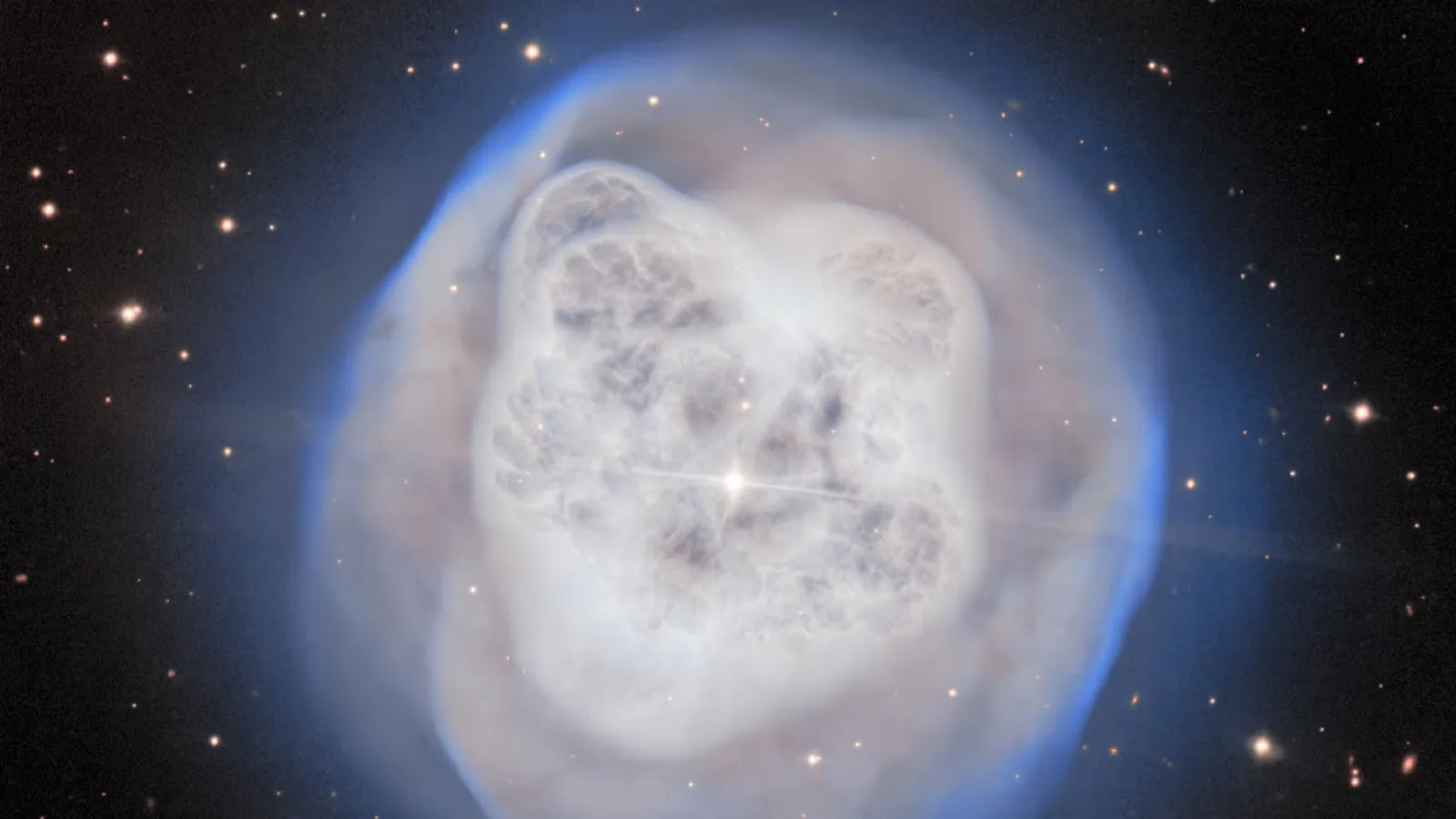
The Gemini North Telescope, situated atop Mauna Kea, Hawaii's highest peak, has captured a breathtaking image of a dying star system resembling a celestial crystal ball. The National Science Foundation's NOIRLab, which manages the telescope, released the image on Thursday. This celestial object, located 1,500 light-years from Earth, is actually a binary star system known as the Crystal Ball Nebula. A light-year, the distance light travels in one year, is equivalent to nearly 6 trillion miles. The nebula's luminous, milky white spherical cloud forms as a star nears the end of its life and sheds its outer atmospheric layers.
The exposed stellar core intensifies the surrounding gas to temperatures reaching tens of thousands of degrees, imbuing the cloud with a haunting, ethereal luminescence. Astronomers theorize that one of the two stars within this planetary nebula, which was once larger than our sun, has reached the end of its stellar lifecycle. The Gemini North telescope observed the nebula, officially cataloged as NGC 1514, last year, with the final color image being processed and completed just last week.
Understanding Stellar Evolution and Nebulae
The creation of the Crystal Ball Nebula offers a poignant visual representation of the final stages of a star's life. When stars with masses similar to or slightly larger than our sun exhaust their nuclear fuel, they expand into red giants before expelling their outer envelopes of gas and dust. This ejected material then forms a planetary nebula, illuminated by the intense ultraviolet radiation emanating from the remaining hot core, known as a white dwarf. The intricate structures and colors observed in nebulae like NGC 1514 provide valuable data for astronomers studying the processes of stellar evolution and the chemical enrichment of the interstellar medium, which is fundamental to the formation of future stars and planetary systems.
This particular binary system presents a unique opportunity for researchers. The presence of two stars complicates the dynamics of mass loss and nebula formation compared to single-star systems. Understanding how these interactions influence the shape and evolution of the nebula can shed light on a less understood pathway in stellar death. The Gemini North telescope, with its advanced capabilities, is well-suited for capturing such detailed observations, allowing scientists to analyze the composition, temperature, and expansion rate of the gas clouds with unprecedented accuracy.
The image serves not only as a scientific tool but also as a profound reminder of the cosmic scale and the dynamic nature of the universe. The approximately 5.5 million residents of Hawaii, and indeed people across the globe, can look up at the night sky knowing that such spectacular celestial events are unfolding across vast distances. The deep space observations contribute to our broader understanding of astrophysics and the origins of elements that make up our world. The Gemini North telescope's commitment to capturing these phenomena underscores the ongoing quest to unravel the universe's mysteries.