
Webb Telescope Reveals Neptune Moon Nereid's Unusual Origin
The James Webb Space Telescope has provided new insights into Nereid, one of Neptune's 16 moons, suggesting its composition differs from expected Kuiper Belt origins and challenging past theories about its formation.

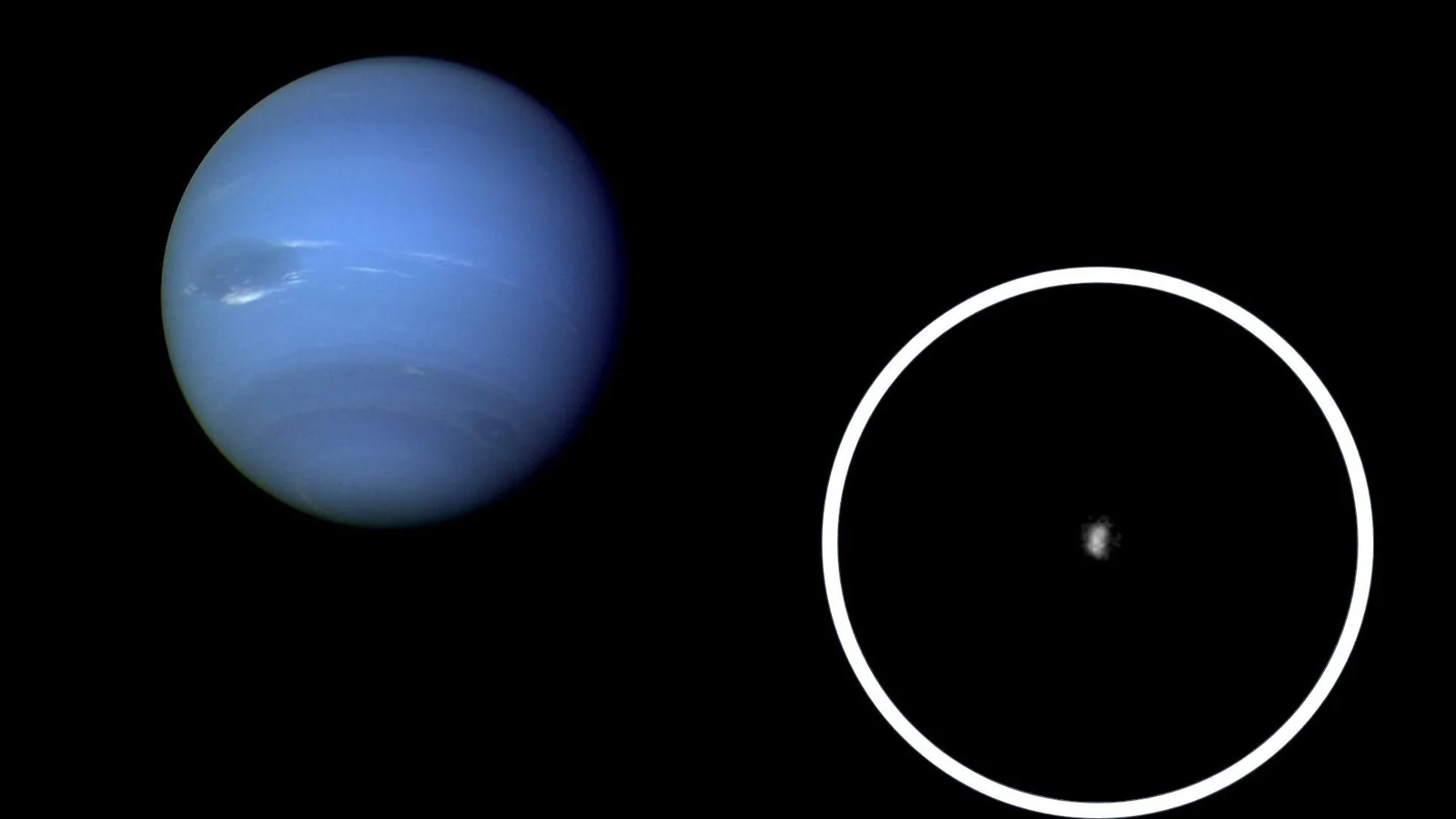
The James Webb Space Telescope (JWST) has delivered surprising new data about Nereid, one of Neptune's 16 known moons, indicating its composition is unlike other celestial bodies from the outer solar system. This discovery, published on May 20, 2026, in the journal Science Advances, challenges the long-held belief that Nereid was captured by Neptune's gravity from the Kuiper Belt, a region of icy bodies beyond the orbit of Neptune.
Matthew Belyakov, a graduate student in planetary science at Caltech and lead author of the study, explained that JWST's advanced observations confirmed Nereid is rich in water ice and provided a detailed spectrum of its reflected light. "What JWST did for Nereid is it confirmed that it had a lot of water ice, and gave us the overall shape of the spectrum [of light]," Belyakov stated in a phone interview. The moon's spectral signature, he continued, significantly diverges from that of known Kuiper Belt objects. The ability to directly compare Nereid's composition with other celestial bodies observed by JWST allowed the research team to make an "apples to apples" comparison, Belyakov noted.
For decades, astronomers generally assumed Nereid, a moon approximately 220 miles (350 kilometers) in diameter, was an object plucked from the Kuiper Belt and gravitationally ensnared by Neptune. This hypothesis was supported by Nereid's highly elliptical orbit, which suggested a tumultuous past, possibly involving capture. However, verifying this theory proved difficult given the complex dynamics of Neptune's extensive moon system, which includes 16 known satellites, most of them small and irregularly shaped, with the notable exception of Triton.
Challenging the Capture Theory
Neptune's moon system is notably different from those of other gas giants like Jupiter and Saturn, which feature many large, regularly orbiting moons. "The trouble at Neptune is that we don't have any regular satellites really, whatsoever," Belyakov remarked. Triton, Neptune's largest moon and comprising 99% of the system's mass, follows a retrograde orbit and is widely accepted as a captured object from the Kuiper Belt, evidenced by its composition resembling Pluto's rather than Neptune's native satellites.
The new study incorporated sophisticated simulations of Triton's capture and its impact on Neptune's original moon system. These simulations suggest that Triton's arrival imparted a significant gravitational disruption, potentially creating an object like Nereid. "Triton gets captured and alters the original system, and creates a Nereid-like object," Belyakov elaborated. This revised theory offers a new perspective on the moon's formation, positing that Nereid may be a remnant of Neptune's original satellite system, reshaped by the gravitational chaos introduced by Triton's capture.
Belyakov and his team, which includes noted moon dynamicist and Caltech professor Konstantin Batygin, are seeking further observational time with JWST to study Nereid at higher resolution. Their initial observations utilized the lowest-resolution mode of JWST's Near-Infrared Spectrograph (NIRSpec) due to high demand for the telescope's time. Securing higher-resolution data could provide even more definitive answers about Nereid's composition and origin, potentially confirming its unique status.
The implications of these findings extend beyond Neptune's system, offering crucial insights into the formation of moons around gas giants, which are the most common type of planet found in the galaxy. "The big picture is that really we don't quite understand how moons around Uranus and Neptune form," Belyakov stressed. Understanding these processes is vital for comprehending planetary system evolution, especially considering the prevalence of Uranus-and-Neptune-sized planets in the universe. Uranus's extreme axial tilt, likely caused by ancient collisions, suggests its original moons were destroyed, while Neptune's system also appears to have lost its first generation of satellites. If Nereid is indeed a surviving relic from the initial moon formation around Neptune, it would represent an invaluable window into the early history of satellite systems and planetary formation in our solar system and beyond.