
Dead Star's End Offers Glimpse Into Our Sun's Future
Astronomers observed the Helix Nebula, a dead star's remains, dispersing into the galaxy, providing a rare look at how stellar material returns to the interstellar medium, a process our own sun will undergo.

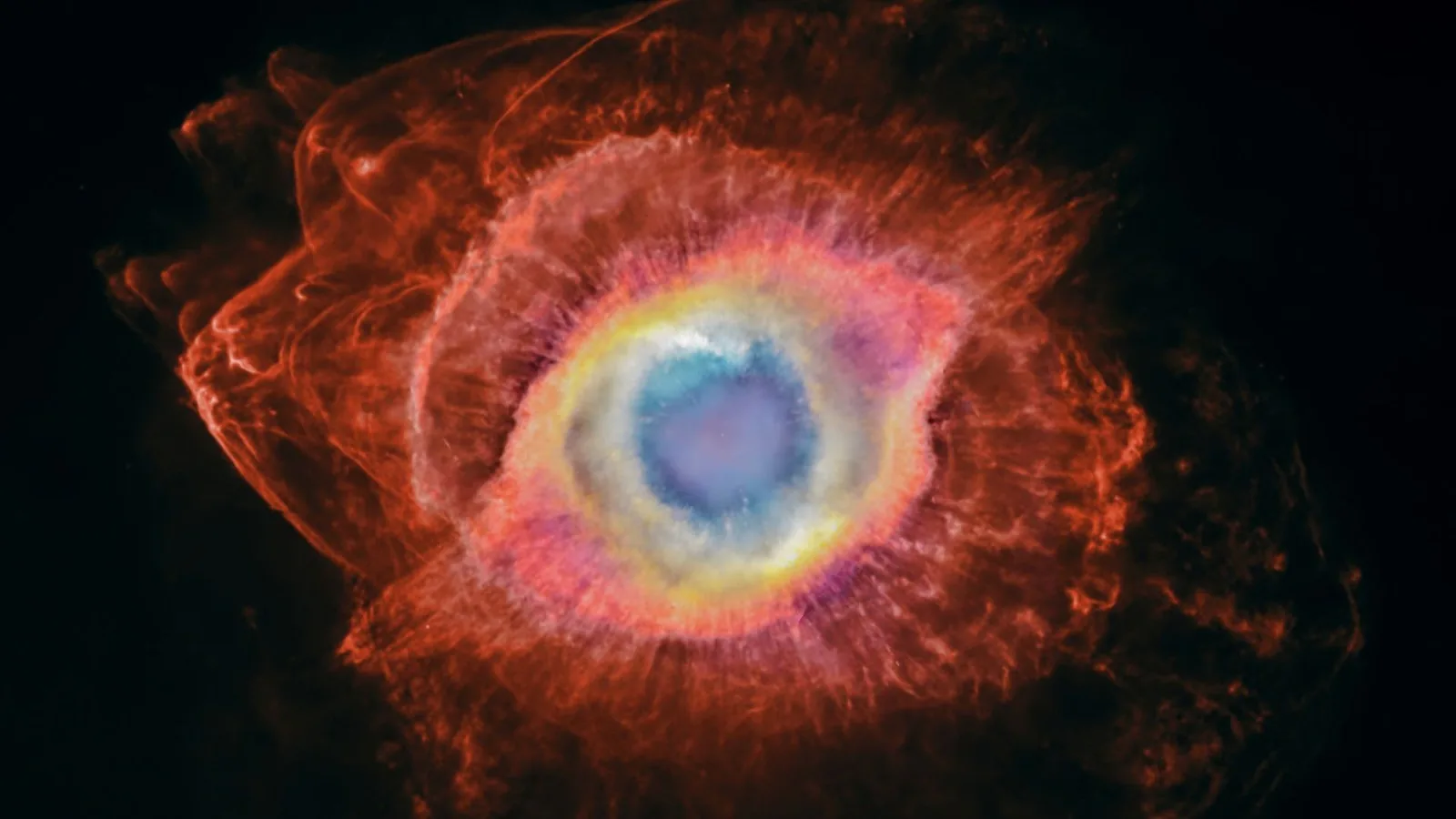
Astronomers have captured an unprecedented view of a dead star’s remnants being recycled into the interstellar gas of the galaxy, a phenomenon that offers a profound glimpse into the eventual fate of our own sun. The Helix Nebula, located approximately 650 light-years away in the constellation Aquarius, serves as a cosmic example of this final stellar act.
Stars, much like our sun, embark on a life cycle that spans millions or billions of years. When a sun-like star exhausts the hydrogen fuel in its core, it begins a dramatic transformation. The core contracts, increasing the temperature of the star's outer layers, which then ignite their own fusion reactions. This process causes the star to expand into a red giant before eventually shedding its outer layers to form a beautiful planetary nebula, such as the Helix Nebula. The star's core collapses into a dense white dwarf.
As a planetary nebula expands, its material gradually disperses into the interstellar medium (ISM), enriching the cosmic clouds from which the next generation of stars will form. While the concept was understood, scientists had never directly witnessed the precise moment when these stellar remnants merge back into the vastness of space until now. “We are seeing material shed near the end of a star's life being broken apart and returned to the galaxy,” said Pieter van Dokkum of Yale University, who led the study. “That hand-off — from recognizable stellar debris to the diffuse gas between the stars — has been very difficult to observe.”
Observing the Cosmic Recycling Process
The groundbreaking observation was not the result of a targeted search but rather a serendipitous discovery during the calibration of a new astronomical instrument. The team, utilizing the El Sauce Observatory in Chile, was testing the Modular Optical Telephoto Hyperspectral Robotic Array (MOTHRA). This sophisticated instrument, designed to scrutinize the night sky for faint gas signatures in the Milky Way, requires initial calibration using well-known celestial objects.
“We thought we were taking a calibration image of one of the best-known nebulas in the sky,” explained Roberto Abraham of the University of Toronto. “Instead, we found this extraordinary network of bow-shaped structures. It was immediately clear that the faint outer Helix was telling us a story that had largely been missed.” These structures, observed in the outer halo of the Helix Nebula, are known as bow shocks. They form when clumps of gas ejected from the nebula plow through the surrounding interstellar medium, akin to the waves created by a boat's prow moving through water.
The bow shocks revealed a progression: those closer to the central white dwarf were large and sharply defined, while those further out became smaller, fuzzier, and more fragmented. This indicates that as the expelled stellar material travels deeper into the ISM, it becomes increasingly eroded and absorbed. The researchers estimate that these material clumps survive for approximately 10,000 years after entering the ISM before being completely shredded and reintegrated.
This direct observation provides crucial evidence for how elements forged within stars are returned to the cosmos. These enriched interstellar clouds are the birthplace of new stars and planetary systems. Our own solar system, including Earth, formed about 4.6 billion years ago from elements created by previous generations of stars.
The findings underscore the cyclical nature of the universe. In about five billion years, our sun will undergo a similar process. As its hydrogen fuel depletes, it will swell into a red giant and then shed its outer layers, forming its own planetary nebula. “Far in the future the sun will go through a similar process and its material will enter the same cycle,” van Dokkum stated. The elements and molecules that constitute everything on Earth will eventually be returned to the Milky Way, potentially contributing to the birth of new star systems and, perhaps, new forms of life.