
Deep Partial Lunar Eclipse to Illuminate Americas Skies
Stargazers in the Americas are poised for a spectacular celestial event as a near-total lunar eclipse will see 96% of the moon darkened. Visible Thursday night into Friday, this deep partial eclipse follows a recent solar eclipse.

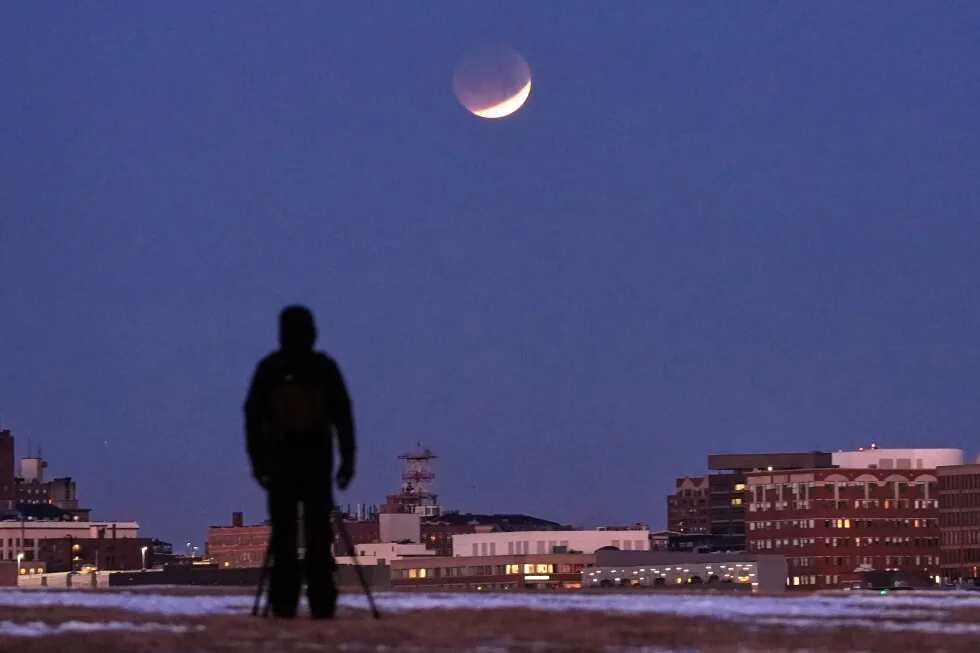
The Americas are set to witness a stunning astronomical display Thursday night into Friday as a deep partial lunar eclipse occurs, darkening nearly the entire lunar surface. This celestial event, with a reported 96% of the moon being obscured by Earth's shadow, promises to be one of the most significant partial eclipses visible to the region in recent times. The event follows closely on the heels of a total solar eclipse that captivated audiences in other parts of the world.
NASA astronaut Jack Hathaway, speaking from the International Space Station, highlighted the exciting era of space exploration. "This is a great time to be part of the space program, right? We’re not slowing down," Hathaway told The Associated Press. This period is particularly notable for lunar interest, with NASA's Artemis II mission having already completed a record-breaking lunar flyby in April, signaling progress toward future crewed missions and the establishment of a lunar base.
A Cosmic Alignment
Eclipses are known to occur in pairs, a consequence of the precise alignment of the sun, moon, and Earth. This upcoming lunar eclipse is the second act in a celestial show that began two weeks prior with a total solar eclipse that traversed Greenland, Iceland, and Spain. The phenomenon occurs because the moon, though much smaller than the sun, is approximately 400 times farther away, creating the illusion that they are the same size in the sky. This remarkable cosmic coincidence allows for such striking visual events.
Unlike the solar eclipse, which had a more geographically limited audience, this partial lunar eclipse will be observable by billions across North and South America, Europe, Africa, and the Middle East, provided weather conditions are favorable. Even astronauts aboard the International Space Station and China's orbiting outpost may catch a glimpse. Commander Jessica Meir of the space station noted the "unique perspective" that space offers for observing cosmic wonders like eclipses and auroras.
During the event, Earth will position itself directly between the sun and the moon, casting its shadow upon our natural satellite. While the alignment will not be perfect enough for a total lunar eclipse, often referred to as a "blood moon," the partial phase alone is expected to last over three hours. The entirety of the eclipse, from the moment the moon enters Earth's faint outer shadow (penumbra) to when it fully exits, will span approximately 5 ½ hours. The peak of the eclipse is anticipated just after midnight Eastern Daylight Time.
An estimated 1 billion people across the United States, Canada, and Central and South America are expected to have prime viewing opportunities for the entire duration of the eclipse. Globally, more than 3 billion individuals, representing 44% of the world's population, will have the chance to witness at least a portion of the event. Those in Europe, Africa, and the Middle East will see the eclipsed moon as it sets, shortening their viewing window, while viewers in Hawaii and the western United States and Canada will see it rising late in the evening.
This marks the second lunar eclipse of the year and the fourth astronomical eclipse overall. A total lunar eclipse was previously visible in March across the Americas, Australia, and eastern Asia. Stargazers will need to wait until New Year's Eve 2028 for the next total lunar eclipse, which will favor observers in Asia and Australia. North and South American audiences will not experience another full lunar eclipse until 2029.