
Deep Partial Lunar Eclipse: Americas to See 96% Moon Coverage
The Americas will have a prime view of a deep partial lunar eclipse on Thursday night into Friday, with up to 96% of the moon expected to be covered by Earth's shadow. This celestial event follows a recent solar eclipse.

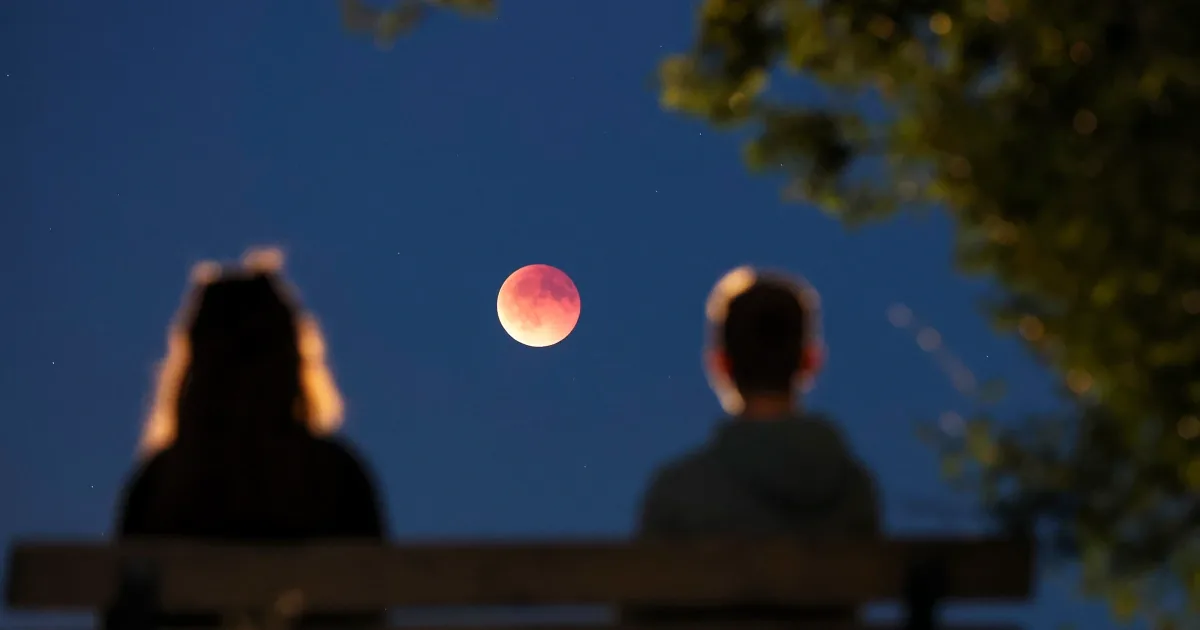
Billions across North and South America, Europe, Africa, and the Middle East will have a front-row seat to a striking celestial display as Earth's shadow engulfs nearly the entire lunar surface on Thursday night into Friday. This deep partial lunar eclipse will see an impressive 96% of the moon obscured, offering a dramatic spectacle for skywatchers, provided conditions are clear.
The event is the second major lunar eclipse this year and follows closely on the heels of a total solar eclipse that captivated audiences in Greenland, Iceland, and Spain two weeks prior. Eclipses are known to occur in pairs, a consequence of the precise alignment of the sun, moon, and Earth. This cosmic dance is made possible by a remarkable coincidence: the moon is approximately 400 times smaller than the sun, yet it orbits 400 times closer, making them appear the same size in our sky.
Unlike the more geographically limited solar eclipse, this lunar event promises a much wider audience. The partially eclipsed moon will be visible across vast swathes of the globe. Even astronauts aboard the International Space Station and China's orbiting outpost may catch a glimpse of the phenomenon, offering a unique vantage point from space, according to Commander Jessica Meir of the ISS. "Space provides a 'unique perspective' for viewing cosmic wonders like eclipses and auroras," Meir stated.
A Shadowed Orb
During the eclipse, Earth will position itself directly between the sun and the moon, casting its shadow onto our natural satellite. While not a total eclipse, the near-complete obscuration of 96% will create a striking visual, often referred to as a "blood moon" due to the reddish-orange hue the moon can take on as it passes through Earth's umbra. The partial phase alone is slated to last over three hours, with the entire event, from the moon entering Earth's faintest outer shadow to its exit, spanning more than five and a half hours. The peak of the eclipse is expected just after midnight Eastern Daylight Time.
Nearly one billion people in the United States, Canada, and Central and South America are positioned for the best views, able to witness the entire progression of the eclipse. Globally, over 3 billion people, or 44% of the world's population, are expected to catch at least a portion of the show. Viewers in Europe, Africa, and the Middle East will see the eclipsed moon setting, shortening their viewing window, while those in Hawaii and the western Pacific will see it rising, marking a late start to the event for those regions.
This eclipse is the second lunar event of 2026 and the fourth celestial alignment involving the sun, moon, and Earth this year. A total lunar eclipse occurred in March, visible to the Americas, Australia, and eastern Asia. However, the next total lunar eclipse will not occur until New Year's Eve 2028, with its visibility centered on Asia and Australia. Stargazers in North and South America will have to wait until 2029 for another full lunar eclipse.
The current era marks an exciting time for space exploration, with missions like NASA's Artemis II lunar flyby in April serving as a prelude to future human landings and base construction. NASA astronaut Jack Hathaway remarked from the International Space Station, "This is a great time to be part of the space program, right? We’re not slowing down." This period of intense lunar interest underscores humanity's ongoing fascination with and commitment to understanding and exploring Earth's closest celestial neighbor.