
Deep-Sea Whale Graveyard Found in Indian Ocean's Diamantina Zone
Scientists discovered an ancient underwater graveyard of whale fossils and active ecosystems in the Diamantina Zone of the Indian Ocean. The find includes 485 sites dating back millions of years.

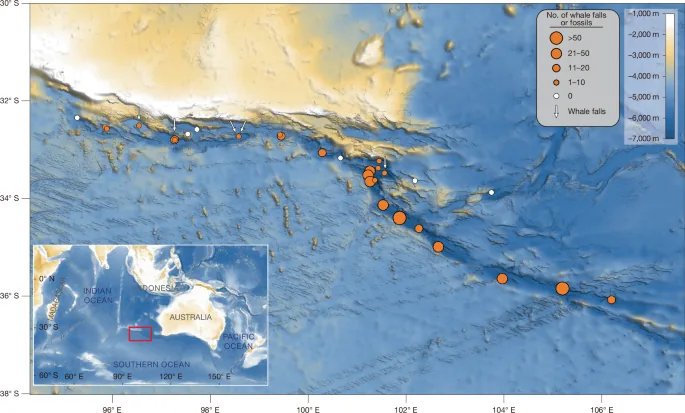
An international team of researchers has uncovered a vast underwater graveyard teeming with whale fossils and active ecosystems in the Diamantina Zone, a deep trench in the Indian Ocean. The discovery, made using the submersible Fendouzhe, includes 485 sites of whale remains, some dating back approximately 5.3 million years. This unprecedented find sheds new light on the unique life that thrives in the extreme conditions of the deep sea.
The expedition, which took place from February 8 to March 17, 2023, explored depths of up to 7,000 meters. During one dive, researchers first encountered whale fossils at 7,002 meters, near the deepest point of the Dordrecht Deep. Subsequent dives mapped the extensive distribution of these remains, revealing an ecological landmark previously undocumented in the region.
Among the discoveries are five active whale falls, where whale carcasses have created specialized habitats supporting diverse marine life. These active sites, found in the sulfophilic stage of decomposition, are covered in microbial mats and bone-eating worms known as Osedax. The deepest active whale-fall community was identified at 6,789 meters on a beaked whale carcass.
The largest carcass found was a 5-meter-long skeleton identified as an Antarctic minke whale (Balaenoptera bonaerensis). The associated fauna across the five active whale falls are remarkably diverse, comprising 35 recognized macrofaunal taxa. These communities are dominated by annelids, crustaceans, and molluscs, with specific species like the chemosymbiotic bivalve Abyssogena southwardae and various Osedax worms forming the core of these ecosystems.
Unique Deep-Sea Ecosystems
The scientific team identified several species potentially new to science, highlighting the unexplored biodiversity of the deep ocean. Notably, the discovery of sea daisies (Xyloplax sp.) at depths of 5,609 meters and 5,634 meters represents the deepest known record for this genus and the first instance of its presence on whale falls. These findings suggest that whale falls can serve as crucial stepping stones for species dispersal across different deep-sea habitats.
The whale falls in the Diamantina Zone are in various stages of decomposition, from active communities to older skeletal remains. Some ancient skeletons, found in the final reef stage, are now colonized by hard-substrate megafauna such as sea anemones and sponges, creating complex artificial reefs in the abyssal plain. The concentration of these whale remains, reaching densities up to 759.5 individuals per square kilometer, raises intriguing questions about the geological and oceanographic processes that might have led to such a unique whale necropolis.
Researchers believe the presence of both baleen and beaked whale remains in this hadal zone is primarily due to the carcasses sinking, rather than evidence of deep-diving behaviors by these species. While beaked whales are known deep-sea predators, baleen whales like the Antarctic minke and sei whale typically feed in much shallower waters. The robust structure of beaked whale rostra likely contributed to their preservation over millions of years, allowing for the formation of this ancient fossil site.
This discovery underscores the importance of deep-sea exploration and the potential for uncovering novel biological insights. The Diamantina Zone, with its extreme depths and unique geological features, continues to reveal secrets about life's resilience and adaptation in Earth's most challenging environments. Further analysis of the collected samples is expected to provide deeper understanding of the evolutionary history and ecological dynamics of these deep-sea communities.