
Doomsday Glacier Melts Aggressively, Scientists Discover New Rate
Scientists have discovered that Antarctica's 'Doomsday Glacier' is melting at a faster and more aggressive rate than previously understood. New research reveals alarming acceleration in ice loss.

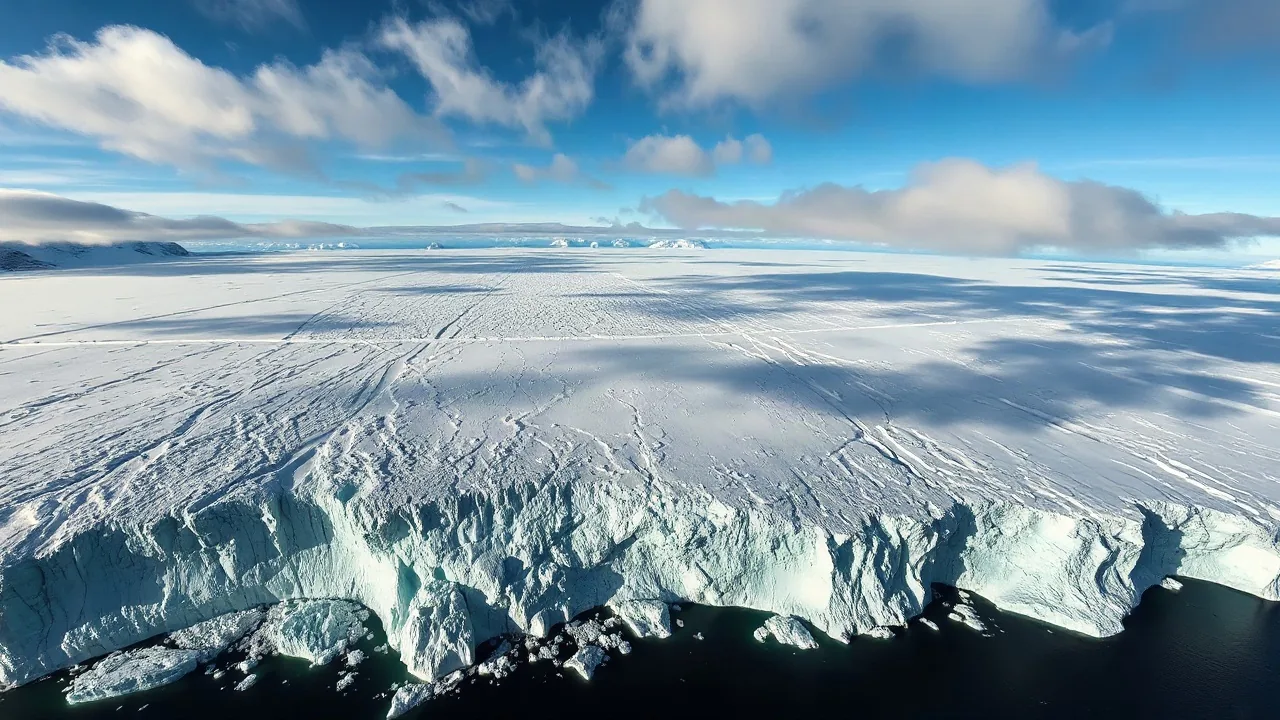
Researchers have unveiled startling new findings regarding the rapid melting of Antarctica's Thwaites Glacier, often dubbed the 'Doomsday Glacier.' Scientists involved in an international research project discovered that warm ocean waters are infiltrating beneath the glacier at an alarming rate, accelerating its disintegration much faster than previously modeled. The expedition, utilizing advanced underwater robotics, collected unprecedented data directly from the glacier's grounding line.
The findings, published in the journal Nature Geoscience on October 16, 2026, indicate that the rate of ice loss from Thwaites has been significantly underestimated. For years, scientists have monitored the glacier's retreat, a process critical to understanding global sea-level rise. However, this latest research provides a stark new perspective on the glacier's vulnerability to warming ocean temperatures.
Accelerated Ice Loss and Ocean Warming
The 2026 International Thwaites Glacier Collaboration (ITGC), a joint effort between the United States and the United Kingdom, deployed the autonomous underwater vehicle 'Icefin' to gather crucial measurements. Icefin navigated the complex sub-ice cavity, a region previously inaccessible to direct observation. The data collected revealed that warm ocean currents are reaching the glacier's base and thinning the ice shelf from below more aggressively than anticipated.
"We knew that warm water was getting to the glacier, but we didn't realize how aggressively it was attacking the glacier," said Dr. Anna Wåhlin, lead author of the study and a professor of oceanography at the University of Gothenburg. "This new data shows that the interface between the ice and the ocean is much more dynamic and vulnerable than we thought."
The implications of this accelerated melting are profound. Thwaites Glacier is roughly the size of Florida and holds enough ice to raise global sea levels by more than two feet if it were to collapse entirely. Its destabilization also acts as a buttress for surrounding glaciers, meaning its collapse could trigger a much larger and faster sea-level rise event across the globe.
The research team specifically identified areas where the glacier's ice shelf is rapidly thinning due to the intrusion of warmer, saltier Circumpolar Deep Water. This water, originating from deeper ocean layers, is now more effectively reaching the glacier's grounding zone – the critical point where the ice lifts off the seafloor and begins to float. The warmer water erodes the ice base, creating cavities and weakening the overall structure.
This discovery underscores the urgent need for more accurate sea-level rise projections. Current models may need to be revised to incorporate these newly understood mechanisms of ice-ocean interaction. The accelerated melting poses direct threats to coastal communities worldwide, necessitating proactive adaptation and mitigation strategies. The fate of Thwaites Glacier is a critical indicator of the broader impacts of climate change on Earth's polar regions and the subsequent consequences for the planet's inhabitants.
The ongoing monitoring and research efforts are vital. Scientists plan to continue deploying advanced technologies to observe the glacier's behavior and refine predictions. Understanding the precise rates and mechanisms of ice loss is paramount for effective climate policy and global preparedness in the face of rising oceans.