
Early Universe Galaxy Death Linked to Cosmic Collisions, Study Finds
Astronomers have identified a massive galaxy in the early universe rapidly losing gas due to powerful winds, a process potentially triggered by cosmic collisions and intense star formation. This discovery offers a new explanation for the prevalence of 'dead' galaxies in the early cosmos.

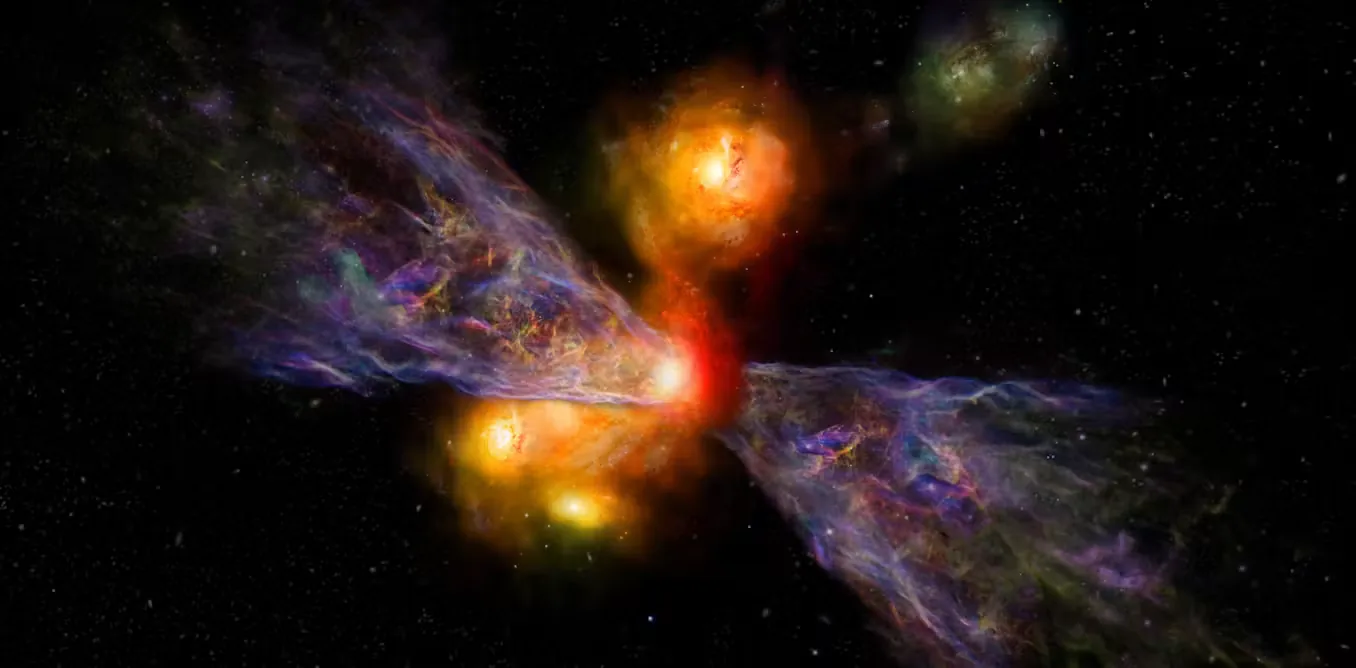
Astronomers have identified a massive galaxy in the early universe that is rapidly losing its gas supply, a phenomenon that could explain why many such galaxies appear "dead" so early in cosmic history. The galaxy, designated CRISTAL-02, is experiencing a powerful "galaxy wind" blasting gas into space, potentially depleting its fuel for star formation in less than 100 million years. This observation, detailed in a new study published in the Monthly Notices of the Royal Astronomical Society, provides a compelling answer to a long-standing mystery about the abundance of large, extinguished galaxies shortly after the Big Bang.
Galaxies are cosmic engines that form stars from clouds of gas. When a galaxy exhausts its gas, star formation ceases, and it is considered "dead." While this is expected for older galaxies, the discovery of numerous large, dead galaxies in the universe's infancy – less than a billion years after its birth – has puzzled scientists since observations from the James Webb Space Telescope (JWST) began in 2022. Theories proposed the early universe might have had stronger dark energy, accelerating galactic growth and death. However, this new research suggests a more direct, albeit dramatic, process: intense galactic winds driven by rapid star formation, possibly fueled by cosmic collisions.
Galaxy winds, streams of gas ejected at high speeds, are primarily caused by two phenomena: supernova explosions from dying stars or outflows from supermassive black holes at galactic centers. Supermassive black holes are thought to drive the most powerful winds capable of expelling gas from massive galaxies. However, observing these winds, especially in distant galaxies, has been historically challenging due to their faintness. The JWST, with its unparalleled sensitivity to infrared light, and the Atacama Large Millimeter Array (ALMA), which detects cold gas, have provided unprecedented views of these early cosmic processes. By combining data from both telescopes, researchers gained a comprehensive look at galaxy winds in the nascent universe.
Galaxy CRISTAL-02: A Case Study in Rapid Death
CRISTAL-02 stood out due to its unusually high rate of star formation, producing stars twice as fast as comparable galaxies. Sensitive observations revealed a massive plume of cold gas extending from the galaxy, nearly its own length. This plume indicates that the galaxy's wind is ejecting gas at a rate double its star formation rate, fast enough to escape the galaxy's gravitational grasp. If this rate continues, CRISTAL-02 could become a dead galaxy in under 100 million years, a mere cosmic blink of an eye. This rapid depletion of fuel is driven by the very star formation that is making the galaxy grow so quickly.
The research team posits that the intense star formation in CRISTAL-02 is likely a consequence of a galaxy merger or collision. In the early universe, galaxies were much closer together, making such interactions far more common than they are today. Studies suggest that around 40% of massive galaxies in the early universe were undergoing mergers. These cosmic pile-ups funnel vast amounts of gas into galactic centers, triggering intense bursts of star formation. Such frenzied growth, as seen in CRISTAL-02, can then lead to powerful winds that prematurely end a galaxy's star-forming life.
This finding challenges the long-held assumption that only supermassive black holes can drive the powerful winds necessary to kill massive galaxies. The study demonstrates that rapid star formation, often a byproduct of galactic collisions, can also generate winds potent enough to strip a galaxy of its gas. If such collisions and subsequent rapid growth were widespread among early galaxies, it would readily explain the large number of dead galaxies observed in the universe's youth. CRISTAL-02 serves as a crucial case study, illustrating how galaxies could "live fast and die young" in the chaotic early cosmos.