
Astronomers Detect Potential Exomoon Companion to Brown Dwarf
Scientists have identified a massive, gas-giant like object orbiting a brown dwarf, potentially marking the first detection of an exomoon. The discovery faces naming challenges due to its unusual orbit.

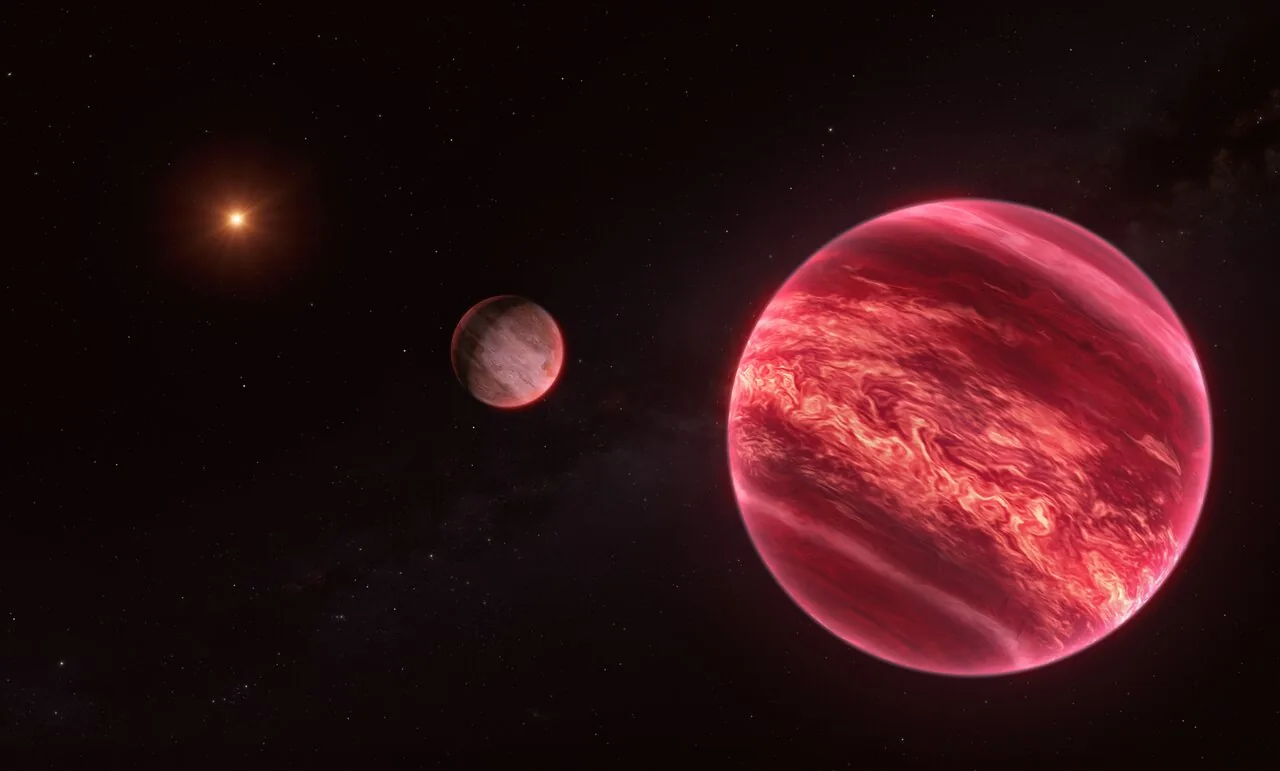
Astronomers utilizing the European Southern Observatory's Very Large Telescope (VLT) in Chile have announced compelling evidence for a massive natural satellite orbiting a celestial body far beyond our solar system. This potential exomoon, detected in the CD-35 2722 system, could be the first such discovery, though its unique orbital configuration presents challenges for traditional astronomical classification.
The finding was detailed in a paper published in the journal Nature, led by ESO student Kevin Hoy. The object in question is described as a giant gaseous body orbiting a highly massive companion, which itself is several times the mass of Jupiter. The central star of the CD-35 2722 system is a brown dwarf, an object too massive to be classified as a planet but too small to sustain nuclear fusion like a star. This brown dwarf is more than 30 times the mass of Jupiter. The newly detected object, at least as massive as Jupiter, orbits this brown dwarf.
The research team, including collaborator Alice Zurlo of Universidad Diego Portales, employed the CRIRES+ spectrograph. They measured subtle wobbles in the brown dwarf's motion, a technique known as radial velocity, which was instrumental in the 1995 discovery of the first exoplanet. Hoy described the system's arrangement as significantly different from our own solar system, noting that standard terminology for planets and moons does not neatly apply.
Challenges in Defining and Naming Exomoons
Zurlo characterized the find as a significant celestial body circling a much larger companion. However, the term 'exomoon' itself lacks a universally accepted definition within the scientific community. This ambiguity highlights the evolving nature of our understanding of celestial mechanics and object classification as more diverse systems are discovered. The discovery of over 6,000 exoplanets to date underscores the vastness and variety of planetary systems beyond our own.
This detection method sidesteps the limitations of the transit method, which relies on observing a planet passing in front of its star. The radial velocity technique is particularly adept at identifying massive satellites. This is one reason why the first plausible detection is a gas giant rather than a smaller, rocky body akin to moons in our solar system, such as Europa. Future observations with instruments like ESO's Extremely Large Telescope, currently under construction, are expected to provide higher-resolution data and potentially identify smaller exomoons and exoplanets.
The difficulty in definitively labeling this object underscores the need for updated scientific frameworks. The European Southern Observatory itself acknowledged the lack of an official definition for exomoons in its release. While this finding is tentative, it represents a significant step in the ongoing quest to understand the diversity of moons and planetary companions across the galaxy. Earlier this year, a separate team had reported hints of a satellite in the HD 206893 system, but that detection was not as firm.