
Earth's Dinosaur-Era Crust Rolled Over Multiple Times
New research suggests Earth's crust has experienced multiple "rolls" or tilts, significantly altering its orientation, even during the age of dinosaurs. These geological shifts may still be ongoing.

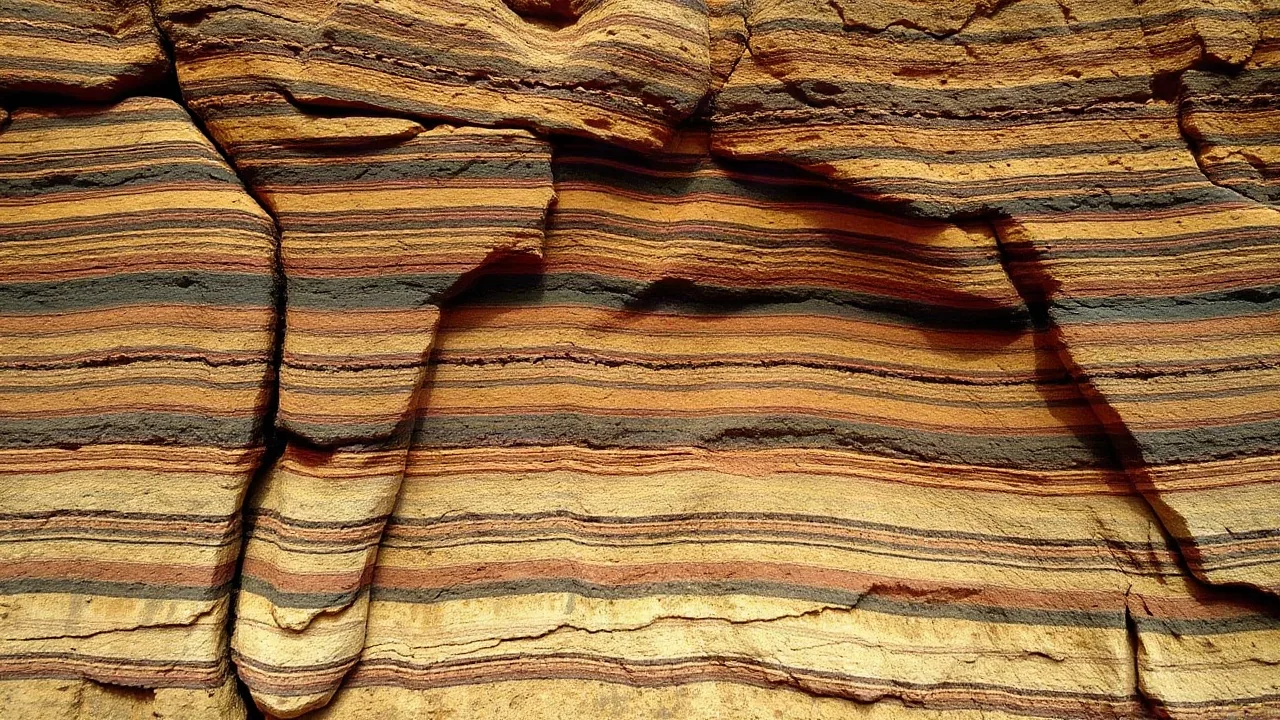
Scientists have uncovered compelling evidence that Earth's crust has not maintained a stable orientation throughout its history, revealing that the planet's outer shell has repeatedly rolled over. These dramatic geological events, which significantly altered the planet's tilt and geographic poles, occurred multiple times, including during the Mesozoic Era when dinosaurs roamed the Earth.
The findings, published in the journal Nature Geoscience, challenge previous assumptions about Earth's long-term stability. Researchers analyzed geological records, including the magnetic orientation of ancient rocks, to reconstruct the planet's past movements. They discovered that not only did these "true polar wander" events happen, but they were more substantial and frequent than previously understood.
A Shifting Global Landscape
During these massive crustal shifts, the entire outer shell of the Earth, including the continents and oceans, appears to have moved relative to the planet's rotational axis. This means that locations once near the equator could have migrated towards the poles, and vice versa. The period between 800 and 550 million years ago is identified as a time of significant instability, but the new data extends these events into the age of dinosaurs, approximately 250 to 66 million years ago.
"The Earth has undergone several major crustal rearrangements in its past," stated Dr. Joseph Meert, a geophysicist involved in the research. "These aren't just small wobbles; we're talking about the entire surface of the planet reorienting itself." The implications of such shifts are vast, affecting climate, sea levels, and the distribution of life across the globe.
The research team used sophisticated modeling techniques to understand the mechanics behind these rolls. They posit that uneven distribution of mass within the Earth, particularly changes in mantle convection and the formation or breakup of supercontinents, could trigger these large-scale reorientations. For instance, the rapid formation or shedding of massive ice sheets, or the accumulation of hot, buoyant material in the mantle, can shift the planet's center of mass, forcing the crust to adjust.
Understanding these past geological upheavals is crucial for a comprehensive view of Earth's evolution. These ancient events help explain patterns of ancient climate zones, the distribution of fossils, and the long-term geological processes that continue to shape our planet today. The discovery that these events occurred even during the time of the dinosaurs provides a new temporal framework for geological and paleontological studies.
Furthermore, the study suggests that such crustal reorientations might not be confined to the distant past. While the rate may have slowed, the underlying geological forces are still active. This opens up questions about the potential for future shifts and their impact on modern civilization. For scientists studying paleomagnetism and Earth's deep history, these findings necessitate a re-evaluation of existing models and a deeper dive into the planet's dynamic past.