
New Models Suggest Earth Could Survive Sun's Death
New research using advanced stellar models indicates Earth might escape engulfment by the expanding sun. While Mercury and Venus face destruction, our planet could shift to a wider orbit and survive.

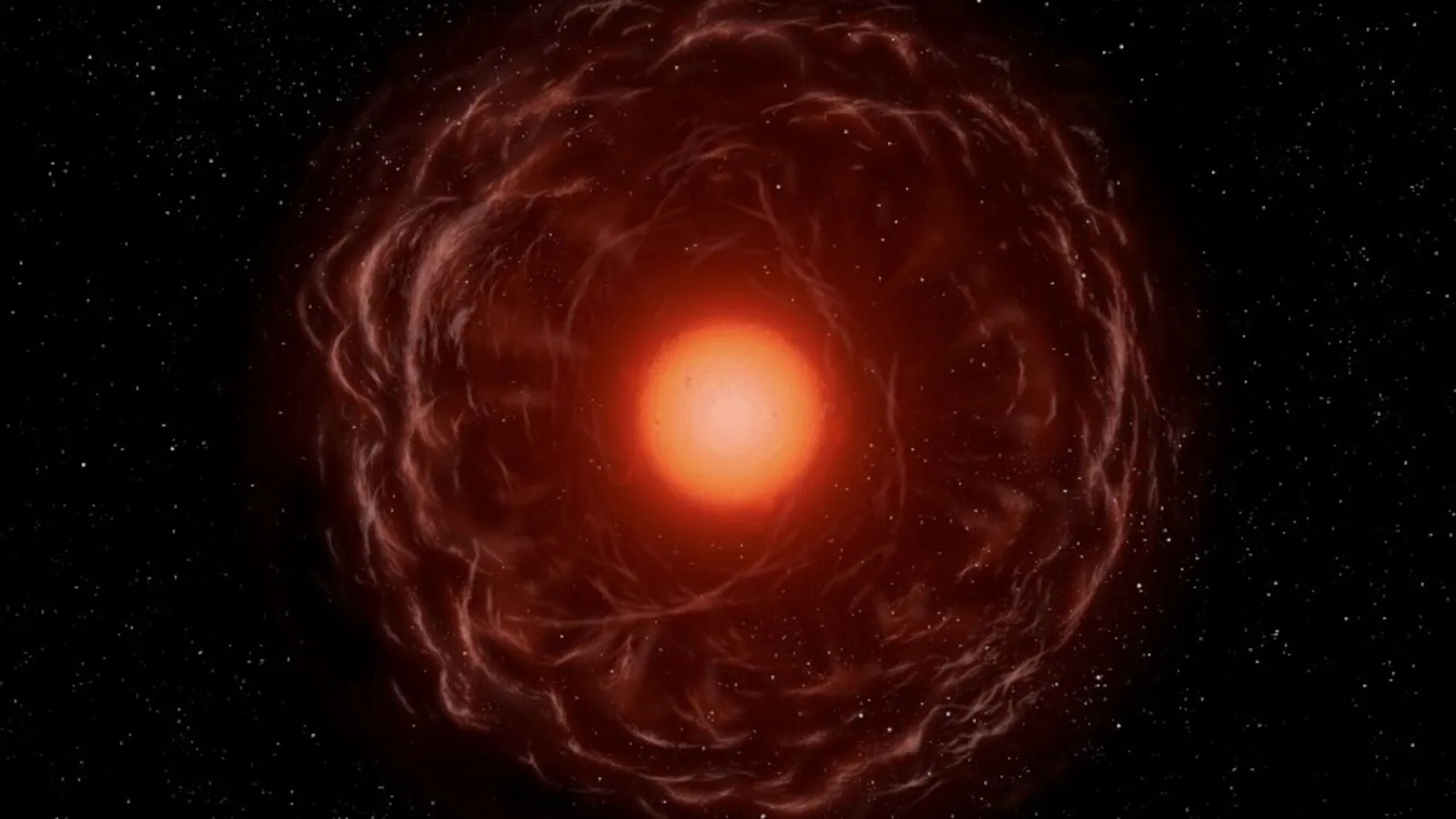
Earth may yet endure the sun's eventual demise, escaping fiery engulfment even as the star consumes its inner planets, according to cutting-edge models. This new research offers a potential reprieve for our planet, which scientists previously believed was doomed to be incinerated billions of years from now when the sun transforms into a red giant. The sun, a yellow dwarf star, is expected to live for roughly 10 billion years. However, in approximately 5 billion years, it will exhaust the hydrogen fuel in its core, initiating hydrogen fusion in its outer shell. This process will cause it to expand dramatically into a red giant and subsequently an even larger asymptotic giant branch (AGB) star, before its ultimate end as a white dwarf.
A recent study, published in the journal Astronomy & Astrophysics on June 19, 2026, employed sophisticated stellar evolution models and observations of a nearby dying star to re-evaluate Earth's ultimate fate. As the sun enters its final evolutionary stages, Earth will be subjected to a tug-of-war between two powerful, competing forces—a cosmic scenario likely experienced by countless worlds across the vast expanse of time.
As the sun swells to hundreds of times its current size, enhanced tidal forces will draw Earth closer to our rapidly expanding and unstable star. Simultaneously, the surging sun will expel its outer layers into space via stellar winds. This mass loss will reduce the sun's gravitational pull, potentially allowing Earth to migrate outward into a more distant orbit, the new models suggest.
A Delicate Cosmic Balance
"The fate of Earth depends on a delicate balance between these two effects," explained Mats Esseldeurs, a doctoral candidate at KU Leuven's Institute of Astronomy in Belgium and the study's lead author. "If tidal interactions dominate, Earth is engulfed. If mass loss dominates, Earth escapes to a wider orbit."
Previous scientific investigations have yielded uncertain conclusions, often due to differing assumptions regarding solar mass loss, tidal forces, and planetary interactions within the evolving inner solar system. Consequently, it remained unclear whether Earth could survive both of the sun's giant phases before the star eventually collapses into a dense white dwarf.
Adding a glimmer of hope, astronomers have previously identified intact planetary bodies orbiting white dwarfs. Conversely, some white dwarf systems are known to be littered with the fragmented remnants of their destroyed planetary systems. To gain insight into our solar system's potential future, researchers examined L2 Puppis, a dying giant star located 200 light-years away in the constellation Puppis, which bears similarities to our own sun's past.
Estimates suggest L2 Puppis might be losing as much as one-millionth of its solar mass annually, expelling a dusty disk that is believed to host a planet between 12 and 16 times the mass of Jupiter. The research team also conducted advanced gravitational calculations, informed by the internal structure and dynamics of evolved stars. These calculations modeled the orbital evolution of the inner solar system and the sun's complete lifespan, from its nascent stages to its final phase as a quiescent white dwarf.
Based on these observations of L2 Puppis' mass loss rates and the refined stellar evolution models, the researchers project that Earth will likely survive by shifting to an orbit just beyond the expanding sun's outer radius. "The largest uncertainty no longer comes from the tidal calculations, but from how much mass the future sun will lose," Esseldeurs stated. "Observations of sun-like giant stars currently point towards Earth's survival, but we need better observations before we can be certain."
However, even if Earth endures, its inner solar system neighbors will not be so fortunate. The simulations indicate that Mercury and Venus are destined to be engulfed by the intense radiation of our dying star. Further astronomical observations and the refinement of existing models are crucial for a more definitive understanding of our planet's ultimate destiny. For instance, the European Space Agency's PLATO mission, a space telescope designed to detect Earth-like planets around sun-like stars, is slated to launch in 2027. This mission is expected to identify planets orbiting aging stars, providing more accurate data on this potentially vulnerable population.