
Faintest Exoplanet Ever Detected: Beta Pictoris d Found After 11-Year Hunt
Astronomers have finally identified Beta Pictoris d, the faintest exoplanet ever directly imaged. Located 63 light-years away, its discovery resolves questions about its star system's dust disk.

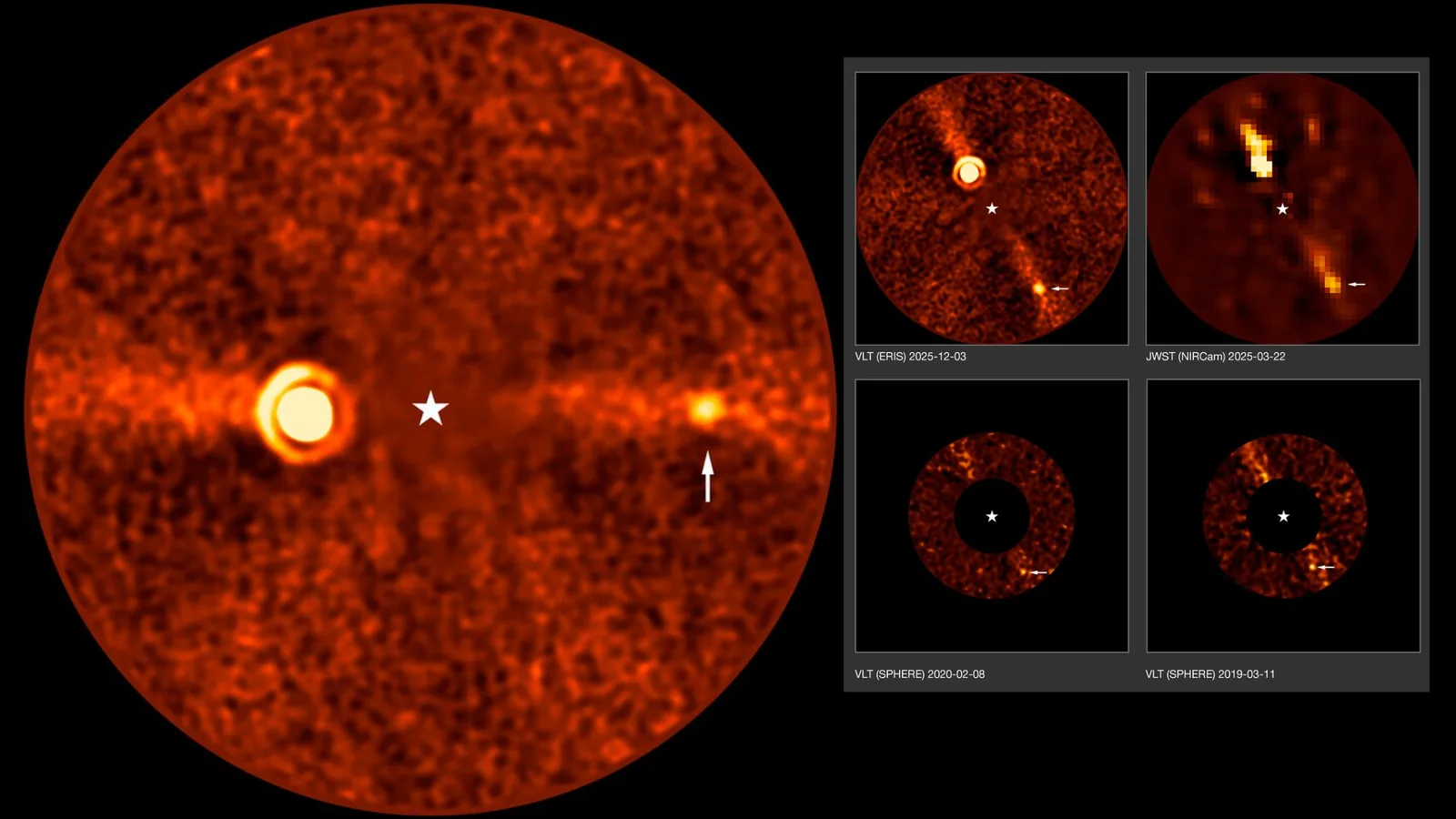
After an eleven-year celestial pursuit, astronomers have successfully detected the exoplanet Beta Pictoris d, the faintest celestial body of its kind ever observed from Earth. Located approximately 63 light-years away in the Beta Pictoris system, this gas giant joins two previously identified planets orbiting the star. Beta Pictoris d is remarkable for being 100 times less luminous than its sibling, Beta Pictoris b, which was the first planet discovered in the system. This challenging detection makes it the faintest exoplanet ever directly imaged, pushing the boundaries of astronomical observation techniques.
Unlike its siblings, Beta Pictoris b and Beta Pictoris c, which are about 10 times the mass of Jupiter and orbit closer to their star, the newly found Beta Pictoris d is more distant and considerably cooler. It also possesses a smaller mass, estimated at around 2.4 times that of Jupiter, positioning it as one of the lightest exoplanets ever directly photographed by a ground-based telescope. "Planet d, it seems, has been playing a game of hide-and-seek with us for over a decade, and only now can we say ‘found you!’" stated Jayne Birkby, a team member and astronomer at the University of Oxford.
Unraveling System Mysteries
The discovery of Beta Pictoris d is significant not only for its observational achievement but also for its role in solving a long-standing puzzle within the Beta Pictoris system. Astronomers had theorized the existence of a disk of dust and debris, believed to be remnants from the planet formation process. The unique mass and position of Beta Pictoris d precisely explain the peculiar shape and location of this debris disk, offering crucial insights into the system's evolutionary history.
The research team, initially focused on studying the known planet Beta Pictoris b, stumbled upon the third planet serendipitously. "This was a serendipitous discovery," explained team co-leader Ben Sutlieff, an astronomer at the University of Edinburgh. "We initially wanted to look more at a known planet in the system, Beta Pictoris b, to see how it changed over time." Their archival data analysis, spanning 11 years, revealed the subtle signature of the third planet.
Directly imaging exoplanets is an exceedingly difficult feat. Out of the more than 6,000 exoplanets cataloged by NASA, fewer than 100 have been discovered through direct imaging. This method requires discerning the faint thermal glow of a planet against the overwhelming glare of its host star. The successful imaging of Beta Pictoris d represents a substantial advancement for this technique, demonstrating its growing capability to detect increasingly faint objects. "The new planet is 100 times fainter than Beta Pictoris b, the famous planet in the same system, making it the faintest exoplanet ever imaged directly from Earth," noted team co-leader and European Southern Observatory researcher Markus Bonse. The Beta Pictoris system now joins the HR 8799 system as only the second known system with multiple directly imaged exoplanets. "Systems with multiple directly imaged exoplanets are the 'holy grails' of discoveries, because they can teach us a lot about what different exoplanets are like in the same formation environment," Sutlieff added.