
Interstellar Space Yields Raspberry Sugar Discovery
Astronomers have detected erythrulose, a sugar found in raspberries, in interstellar space for the first time. The discovery near the Milky Way's center could shed light on the origins of life on Earth.

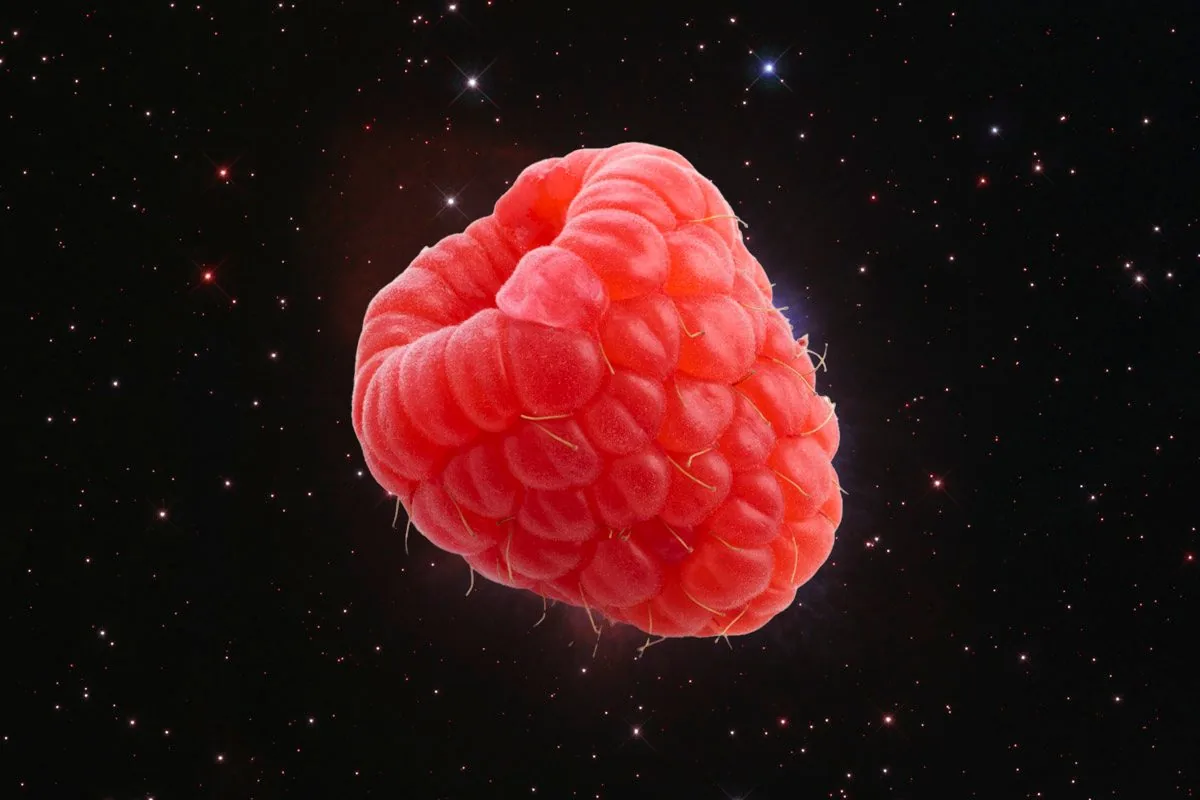
In a groundbreaking discovery, an international team of astronomers has identified the first sugar molecule, erythrulose, ever detected directly within interstellar space. This four-carbon ketose sugar, commonly found on Earth in raspberries and sunless tanning lotions, was found in a giant molecular cloud near the Milky Way's galactic center. The finding offers new insights into the chemical complexity of space and the potential for life's building blocks to form beyond our planet.
The research, led by Izaskun Jiménez-Serra of the Centro de Astrobiología in Spain, utilized data from the 40-meter Yebes radio telescope and the 30-meter telescope at the Institute for Radio Astronomy in the Millimeter Range (IRAM). By analyzing the spectral signatures of light emanating from the molecular cloud G+0.693−0.027, the scientists matched 12 specific light patterns to the known spectrum of erythrulose. This confirmed the presence of the sugar in the vast cosmic expanse, a feat previously unachieved for any sugar molecule.
A Surprisingly Abundant Cosmic Sweetener
Perhaps more astonishing than the detection itself is the apparent abundance of erythrulose. The study revealed that this sugar is present at levels at least eight times greater than simpler, three-carbon sugars, which were notably absent in the same region. This abundance challenges prevailing astrochemistry theories that predict the slow, step-by-step addition of carbon atoms to form larger molecules. "This finding was unexpected, as the prevailing view in astrochemistry is that interstellar molecules grow in size through the sequential addition of carbon atoms," explained Jiménez-Serra, the study's lead author.
The formation pathway for erythrulose in the cold, dark conditions of space remains a subject of investigation. Collaborations with chemists from the University of Extremadura and Radboud University suggest a novel formation mechanism: rather than carbon-by-carbon growth, erythrulose may form within interstellar ices through the fusion of simpler, two-carbon molecules, such as alcohols and aldehydes. This process could efficiently create more complex organic molecules in environments previously thought less conducive to their rapid synthesis.
The implications of this discovery extend to the very origins of life on Earth. Scientists have long puzzled over how life's essential sugars, like ribose and glucose, first appeared on our planet. Laboratory experiments simulating early Earth conditions have suggested that sugars do not form in sufficient quantities to kickstart life. While sugars have been found in meteorites, direct detection in space opens a new avenue. Researchers estimate that between 0.5 to 50 million tons of erythrulose could have been delivered to Earth via asteroid and comet impacts during the 'Late Heavy Bombardment' approximately 4 billion years ago. This cosmic delivery of pre-formed sugars could have provided the necessary raw materials for Earth's early metabolic and self-replicating biological systems to emerge.
"The detection of erythrulose is very exciting because it opens up the possibility of discovering in space other sugars such as ribose, which is part of RNA, and other important molecules for the origin of life," said Carlos Briones, a co-author of the study. This discovery not only deepens our understanding of cosmic chemistry but also provides a compelling link between the interstellar medium and the fundamental building blocks of terrestrial biology, suggesting that life's ingredients may be more widespread in the universe than previously imagined. The team plans further observations to search for other complex organic molecules in similar celestial environments.