
Geomagnetic Storm May Bring Northern Lights to Utah This Week
Utahns may have another chance to witness the aurora borealis as a G3 geomagnetic storm is forecast for Thursday and Friday nights. This strong solar activity increases the likelihood of seeing the northern lights farther from the poles.

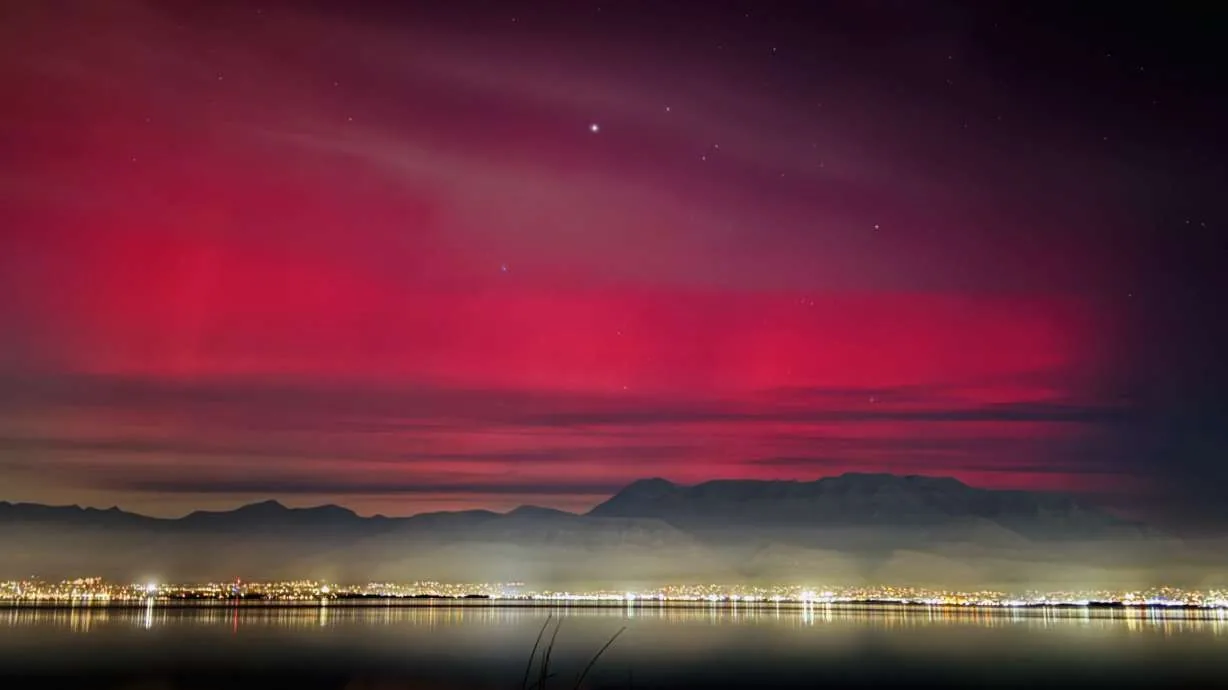
Residents across Utah could be treated to a celestial display of the northern lights on Thursday and Friday nights as a significant geomagnetic storm approaches. The National Weather Service's Space Weather Prediction Center has issued a watch for a G3 (strong) geomagnetic storm, a phenomenon driven by intense solar activity that can disrupt Earth's magnetic field and enhance the visibility of auroras at lower latitudes.
The aurora borealis, commonly known as the northern lights, occurs when charged particles from the sun interact with the Earth's magnetosphere. This interaction excites atmospheric gases, producing vibrant colors that dance across the sky. While typically confined to polar regions, powerful geomagnetic storms can push the aurora's visibility southward, potentially bringing the spectacle within reach for stargazers in states like Utah.
Aurora Potential Across the West
This latest watch signifies one of the most significant alerts issued so far in 2026, following a G4 (severe) storm watch in November that also allowed Utah residents to observe the northern lights. According to the University of Alaska-Fairbanks' Geophysical Institute, the high aurora activity associated with this storm could persist beyond sunset. The Space Weather Prediction Center's projections suggest that the aurora "may be visible" in northern Utah and is "possible" across the remainder of the state. For those hoping to catch a glimpse, some areas might require a camera to capture the display, even if it's not readily apparent to the naked eye.
The potential for viewing extends beyond Utah, with much of Idaho and Wyoming expected to experience the phenomenon. Northern Idaho, along with large portions of Washington and Montana, are particularly likely to see the aurora. While the watch remains in effect through Friday, the Geophysical Institute anticipates a decrease in activity levels by the time the sun sets across the western United States.
Geomagnetic storms are a natural consequence of solar weather, which involves the constant outflow of charged particles from the sun, known as the solar wind. When these particles are ejected in large quantities, especially during solar flares or coronal mass ejections, they can travel towards Earth. If the Earth's magnetic field is oriented correctly, these particles can penetrate deeper into the atmosphere, causing the beautiful auroral displays. Understanding solar activity and its potential impacts is crucial for both scientific research and public awareness, especially given the increasing reliance on space-based technologies.
Scientists at the Space Weather Prediction Center continuously monitor solar activity and forecast potential geomagnetic storms. These forecasts help authorities and the public prepare for possible disruptions to communication systems, power grids, and satellite operations, alongside the more visible effects like the aurora. While this event offers a chance for a spectacular light show, it also serves as a reminder of the powerful forces at play in our solar system.