
Ghana's Lake Bosumtwi: Ancient Meteor Strike Fuels Gold Rush
Ghana's sacred Lake Bosumtwi, formed by a meteor impact 1 million years ago, is now a focal point for accelerated gold mining. The ancient crater's geology continues to yield valuable minerals.

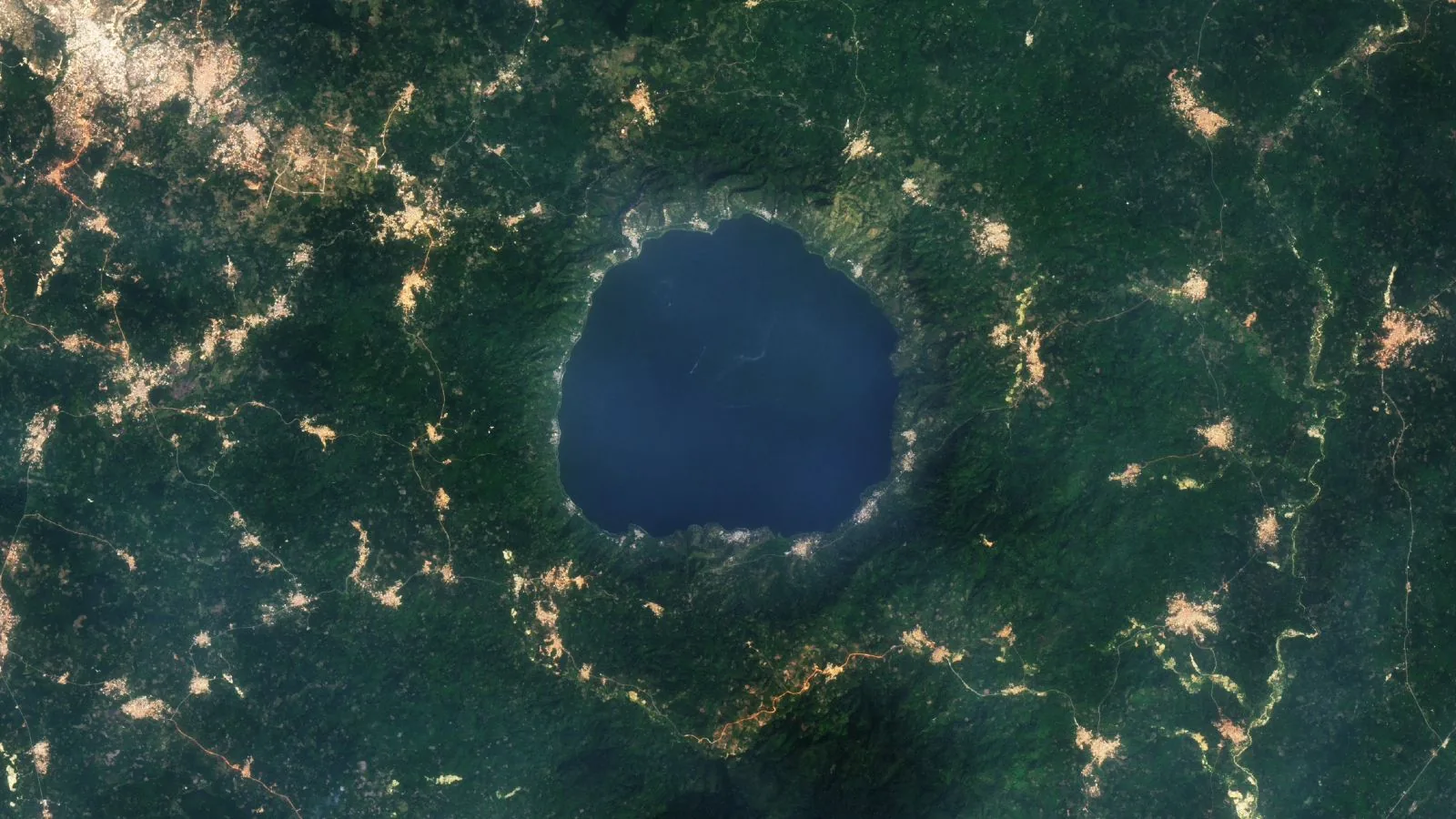
A shimmering satellite view captures the golden veins surrounding Ghana's sacred "lake of souls," Lake Bosumtwi, a body of water carved into existence by a catastrophic asteroid strike approximately one million years ago. Spanning 19 square miles southeast of Kumasi, Ghana's second-largest city, the roughly circular lake is the country's sole natural freshwater source and holds deep spiritual significance for the Indigenous Asante people. Mythology recounts how a hunter's chase led to a small pond swelling into the vast lake we see today, a place where, according to NASA's Earth Observatory, "souls bid farewell to Earth before entering the afterlife." In reality, the lake's origin lies in a violent cosmic collision.
Around one million years ago, a meteor estimated to be about 3,300 feet wide (1 km) slammed into Earth, creating what is recognized as "arguably the best-preserved complex young impact structure known on Earth," according to the International Commission on Geoheritage. The immense force of this impact likely caused widespread devastation. Marian Selorm Sapah, a senior lecturer in Earth Science at the University of Ghana, explained to Earth Observatory that the collision would have produced "a blinding flash of light and an immense fireball [that] would have incinerated life for dozens of kilometers." She added that such an event occurring today would likely obliterate Kumasi.
Satellite analysis has identified material ejected from the impact site forming a raised, lobed pattern known as a "rampart" crater. This distinctive feature suggests the area was saturated with groundwater when the meteor struck, a characteristic more commonly observed on other celestial bodies like Mars and its moons. Studying Lake Bosumtwi offers a unique opportunity to understand the formation of these extraterrestrial craters, Sapah noted.
Ancient Impact Reshapes Landscape and Economy
Beyond its geological and cosmological implications, the meteor strike fundamentally altered Ghana's crust, fracturing it and enabling mineral-rich magma to surface. This geological upheaval created shallow deposits of gold and other valuable elements, which have been extracted for generations. The golden hues visible in recent satellite imagery are a direct result of this ongoing geological process, amplified by intensified mining activities.
In recent years, technological advancements have significantly accelerated the rate of gold mining. A comparative satellite photograph from 2024 starkly illustrates this surge, revealing far more exposed gold due to heightened extraction efforts. The lake itself also presents a greener appearance in this more recent imagery, attributed to increased concentrations of phytoplankton in its waters. "The stark visual evidence of anthropogenic [human-caused] change juxtaposed with a million-year-old geological landmark is striking," Sapah remarked, highlighting the profound interplay between ancient natural forces and contemporary human activity.
The combination of a unique geological formation, significant mineral wealth, and a rich cultural heritage makes Lake Bosumtwi a site of international scientific interest and local economic importance. Researchers continue to study the Lake Bosumtwi impact structure for insights into planetary science, while the surrounding communities engage in the age-old practice of extracting its subterranean riches, now facilitated by modern technology. The story of this Ghanaian lake is a compelling narrative of how cosmic events from Earth's distant past continue to shape its present.