
Hubble Image Reveals Stellar Stream, Offering New Dark Matter Clues
An accidental discovery in a Hubble Telescope image has led to the identification of Oyashio, a stellar stream outside our galaxy. This find offers a unique opportunity to study dark matter.

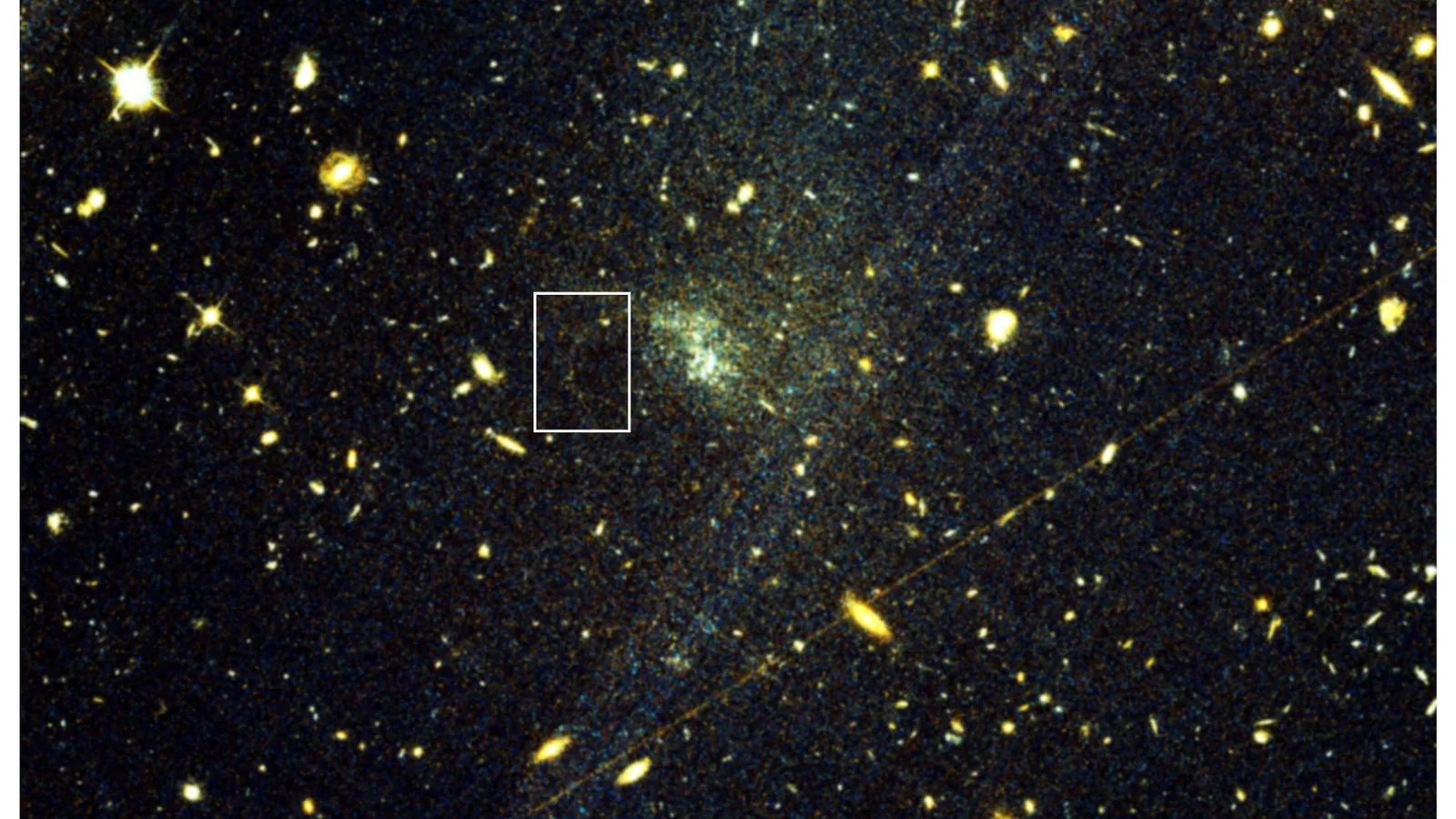
An accidental observation of a Hubble Space Telescope image by former astronomer David Hendel has led to the discovery of Oyashio, a rare stellar stream found outside the Milky Way. The stream, located 115 million light-years away in the dwarf galaxy UGC 9050-Dw1, offers scientists a pristine new laboratory to investigate dark matter, the mysterious substance composing over 80% of the universe’s matter.
Hendel, now working in finance but maintaining a keen interest in astronomy, was commuting by train when an image from a research paper caught his attention. The image depicted UGC 9050-Dw1, an ultra-diffuse galaxy characterized by its sparse stellar population and a significant proportion of dark matter. What stood out to Hendel was a faint ribbon of stars trailing from the galaxy, exhibiting a shared color and curved trajectory. He recognized these features as indicative of a stellar stream being pulled apart from a globular cluster by UGC 9050-Dw1’s gravity.
This observation, if confirmed, marked the first such stream detected outside our own galaxy. "It almost seemed too good to be true," Hendel told Space.com. "At this point I felt the excitement of a discovery to such a degree that I recall looking up and around the train for someone to tell!" Hendel quickly searched existing literature and found no prior documentation of the feature. He then contacted Sarah Pearson, an astrophysics professor at Technical University of Denmark, who became a lead in the collaborative effort to confirm the find. Pearson, along with Ph.D. student Julie Holm from the University of Copenhagen, spearheaded the research, which formally named the stream Oyashio, a Japanese term for a cold ocean current.
A Pristine Cosmic Laboratory
Identifying stellar streams within the Milky Way is common, with around 100 candidates identified. However, finding one associated with another galaxy, particularly a dwarf galaxy, is exceptionally rare. Streams formed from the complete disruption of a dwarf galaxy are easier to spot due to their location in sparser galactic outskirts. Globular cluster streams, however, form deeper within a host galaxy, where their faint light is often obscured by brighter starlight. The discovery of Oyashio was made possible because UGC 9050-Dw1’s inherently low stellar density provided a dim enough background for the faint stream to be visible. "Oyashio's discovery is a very exciting step forward," commented Emily Cunningham, an assistant professor at Boston University who studies stellar streams and dark matter halos. "Using techniques like those described in this paper, we will detect many more streams around other galaxies with upcoming observations from facilities such as the Vera Rubin Observatory and the Nancy Grace Roman Space Telescope."
The researchers believe that a robust catalog of such streams in diverse galactic environments will enable them to identify the subtle gravitational effects predicted from dark matter on smaller scales. "This is one of the most promising avenues for new astrophysical constraints on dark matter's nature," Hendel stated. This discovery offers a cleaner environment for studying dark matter compared to investigations within the Milky Way, which are complicated by the galaxy's complex structure and numerous competing astrophysical forces.
UGC 9050-Dw1 was initially identified in 2017. A subsequent study in 2023, using the same Hubble images where Hendel later found Oyashio, noted a high concentration of globular clusters near the galaxy. This led to the hypothesis that UGC 9050-Dw1 might have formed from the merger of two galaxies approximately 10 billion years ago. The new study, led by Holm and her colleagues, independently verified Oyashio’s existence using archival data from both Hubble and the Canada-France-Hawaii Telescope, ruling out imaging artifacts. The team conducted extensive simulations to match the stream’s observed properties with various models of globular cluster and dark matter distribution. The most successful models provided updated estimates for UGC 9050-Dw1's total mass and its distribution, suggesting a higher dark matter content than initially inferred from its visible stars, aligning with theoretical expectations for diffuse galaxies.
The research paper also addressed alternative explanations, such as random stellar alignments, gravitational lensing, or background dust clouds mimicking a stream. However, the team concluded that none of these scenarios adequately explained the consistent color and alignment of the stars, nor their apparent connection to a progenitor globular cluster. "It was an interesting process in the sense that there wasn't a specific moment where we're like, 'Okay, now we know what it is,'" Holm shared with Space.com. "We started with the assumption that just by looking at it, it looks like it could be something. How many different ways can we try to prove that it can't be?" While acknowledging the slight possibility of a highly coincidental stellar alignment, the researchers emphasized the unlikelihood of all observed features aligning so perfectly without a gravitational cause.
The true value of Oyashio lies in its potential to illuminate the universe’s invisible structure. As a globular cluster disperses over eons, its stars trace the cluster's orbital path, preserving a record of the gravitational forces it experienced. If a small dark matter subhalo passes through this stream, its gravity can perturb the stars and potentially create a gap. "Streams that form from globular clusters are particularly sensitive to these perturbations," Cunningham noted. The challenge remains in definitively attributing such disturbances to dark matter, especially with only one stream as evidence. Unlike streams within the Milky Way, which can be influenced by the galactic bar or nearby galaxies, Oyashio exists in an environment free from such dominant gravitational influences, making any detected perturbations more likely to originate from dark matter. This discovery is a significant step in the ongoing quest to understand the fundamental nature of the universe.