
ISS Astronauts Replace Robot Arm 'Wrist' Joint in Spacewalk Surgery
Two NASA astronauts successfully replaced a critical 200-pound "wrist" joint on the International Space Station's robotic arm during a nearly seven-hour spacewalk. The repair ensures the arm's continued functionality for station operations.

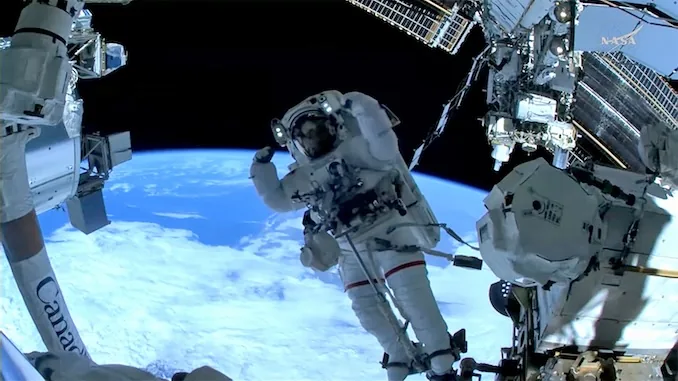
Two NASA astronauts conducted intricate orbital surgery on Tuesday, successfully replacing a damaged 200-pound "wrist" joint on the International Space Station's (ISS) primary robot arm. The seven-hour, 20-minute spacewalk, the third of the year for the station, involved astronauts Jessica Meir and Chris Williams replacing a critical component of the Canadian-built Canadarm2, ensuring its continued operational capability. "That is a good install, you guys. I know that was tough. Wonderful work," communicated mission control, acknowledging the demanding nature of the task. The repair is vital for the arm's ongoing role in station maintenance and cargo operations.
The issue with the 58-foot-long robotic arm was first detected on May 27, when flight controllers at the Johnson Space Center in Houston observed an anomaly. One of the arm's seven joints was drawing excessive current and exhibiting abnormal movement. Following a thorough review of telemetry data and consultations between NASA and experts from the Canadian Space Agency (CSA), which supplied the arm, it was determined that the joint had failed and required replacement. A spare joint, one of two stored externally on the station, was prepared for the complex repair.
"Systems like Canadarm2 were designed from the beginning with replaceable components and were planned with maintenance in mind," stated Bill Spetch, ISS operations and integration manager. "This is no exception." The spacewalk officially commenced at 8:20 a.m. EDT when astronauts Meir, on her fifth spacewalk, and Williams, on his second, switched their spacesuits to battery power after exiting the Quest airlock. Their objective was to detach the arm's "hand" mechanism, known as the latching end effector (LEE), along with two adjacent joints, temporarily stow this assembly, remove the faulty joint, and install the replacement.
Robot Arm Repair Sequence
The intricate operation involved meticulous maneuvering and tool handling. After securing themselves with foot restraints near the stowage platform and positioning the spare joint, Williams and Meir carefully detached the LEE cluster, weighing approximately 900 pounds. This assembly was then secured to a nearby external shelf, creating the necessary access to Joint No. 5, the 200-pound failed wrist component. Four-and-a-half hours into the excursion, the critical task of installing the new joint was completed successfully. "We'll remove the failed joint 5, replace it with the spare joint and then once that's back on the arm, our last major task will be to get that LEE cluster that we temporarily stowed and put it back onto the robotic arm so that we have a fully assembled arm at the end of the spacewalk," explained flight director Fiona Antkowiak during the operation.
Approximately five-and-a-half hours into the spacewalk, the astronauts successfully re-attached the LEE cluster as planned. Shortly thereafter, ground controllers powered up the arm to verify electrical connections through the newly installed joint. "Today we did hear good confirmation that... Canadarm2 has two good strings of power and data to the arm," confirmed NASA commentator Sandra Jones. "So today's wrist surgery was successful." The astronauts then proceeded to collect their tools and return to the airlock. Williams also took custody of the failed joint, which will be returned to Earth for analysis and potential refurbishment.
The Canadarm2 is indispensable for routine ISS operations. It is routinely used to capture approaching cargo ships, such as Northrop Grumman's Cygnus, guiding them into docking ports. The arm also plays a crucial role in moving components and assisting spacewalking astronauts during external maintenance tasks. Despite NASA's plan to deorbit the ISS by 2030, Spetch emphasized that the arm's maintenance will continue unabated. "There's not a time where we say hey, we're just done repairing the arm," he noted. "Overall, the arm is critical for station operations and continued maintenance of it throughout to the end of life." This successful repair underscores the ISS's resilience and the meticulous planning involved in maintaining complex orbital infrastructure.