
ISS Astronauts Return to Station as Air Leak Repairs Pause
Astronauts sheltering in a SpaceX Dragon capsule have been told to return to the International Space Station (ISS) after repairs to an air leak were paused. The leak is in the Russian segment of the orbiting laboratory.

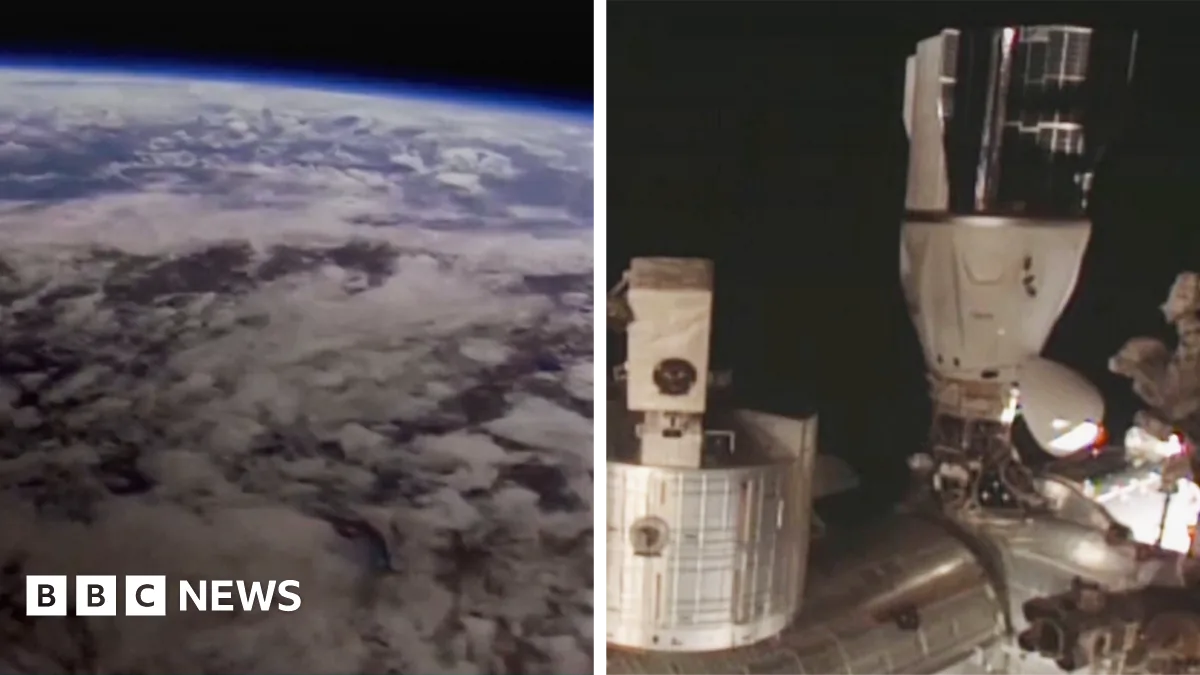
Five astronauts aboard the International Space Station (ISS) have been instructed to leave their SpaceX Dragon "safe haven" and return to the main orbiting laboratory as repairs to a critical air leak were temporarily halted. The astronauts had been sheltering in the docked Crew Dragon spacecraft as a precautionary measure while Russian cosmonauts attempted to fix a persistent leak in the Zvezda service module. The pause in repair efforts allows for further assessment of data and measurements related to the leak.
The decision to move the crew members back to the station comes as Roscosmos, Russia's space agency, paused the scheduled repair work on Friday, June 5. "Roscosmos has paused Friday’s structural repair efforts inside the Zvezda service module transfer tunnel, known as PrK, as more measurements and data is assessed," stated NASA spokeswoman Bethany Stevens. "Given this development, NASA has instructed the crew members inside the Dragon spacecraft to end the safe haven procedures and return to planned operations aboard the International Space Station."
Assessing the air leak situation
The air leak, located in the transfer tunnel (PrK) of the Zvezda module, has been a concern for years. While one of two identified leaks has reportedly been fixed, work to address the second is on hold. Russian state news agencies Interfax and Tass reported that the crew and onboard systems were not in danger. However, the decision to pause repairs signals a need for a more thorough understanding before proceeding.
The International Space Station, a testament to international collaboration in space, has segments contributed by the United States, Russia, Europe, and Japan. This complex structure, spanning the length of an American football field, orbits Earth at speeds of approximately 17,500 miles per hour. Astronauts typically spend around six months aboard the station, conducting scientific experiments and serving as test subjects to understand human adaptation to long-duration spaceflight.
The current situation highlights the station's resilience and the contingency plans in place for emergencies. In the event of a full evacuation, the seven-member crew would split between the docked Soyuz MS-28 spacecraft and the SpaceX Crew Dragon "Freedom." This separation ensures independent escape routes, with the Crew Dragon carrying four astronauts to a splashdown off the U.S. coast and the Soyuz returning the remaining three to the Kazakh steppe. For now, the situation is being managed as a precautionary measure, with NASA and Roscosmos collaborating on a lasting solution.
This is not the first time the ISS has encountered air leaks. Cracks within the Zvezda module have been an ongoing issue for approximately six years. Following the arrival of a Russian cargo ship last month, Roscosmos detected a new, slow pressure drop, prompting the move to attempt a more comprehensive repair beyond previous temporary fixes. The collaborative approach between NASA and Roscosmos is crucial for maintaining the safety and operational integrity of the International Space Station.