
James Webb Telescope Aids Black Hole Discovery, Solving Cosmic Mystery
The James Webb Space Telescope is helping astronomers understand "little red dots," enigmatic objects from the early universe, by studying a unique X-ray-emitting black hole.

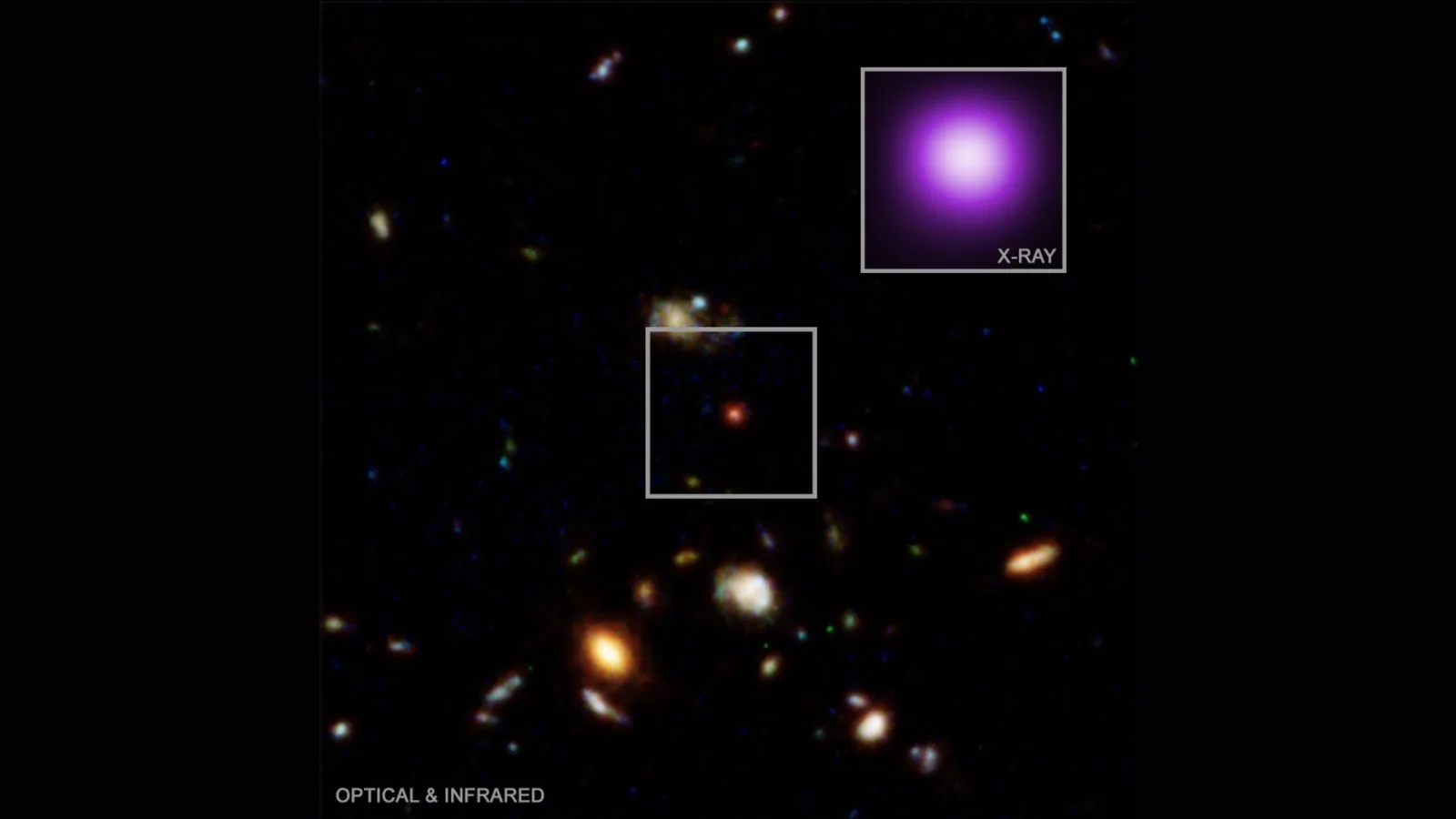
Astronomers using the James Webb Space Telescope (JWST) have identified a unique, X-ray-spewing black hole that could be key to understanding the mysterious "little red dots" (LRDs) observed in the nascent universe. These LRDs, first spotted by JWST in 2022 and found in hundreds more since, are compact, ancient objects from around 600 million years after the Big Bang, appearing red due to extreme redshift from their light traveling across billions of years of cosmic expansion.
The newly detailed object, formally known as 3DHST-AEGIS-12014 but nicknamed the X-ray dot (XRD), had been overlooked in older data from NASA's Chandra X-ray Observatory. Its significance only emerged when JWST observed the same cosmic region. "It is always wonderful to see archival data aid in solving mysteries that were completely unknown when the data were first taken," commented astrophysicist Anthony Taylor of the University of Texas at Austin, who was not involved in the study, highlighting the enduring value of legacy scientific projects.
While the XRD shares similarities with LRDs, its prominent X-ray emissions set it apart. Typical LRDs do not appear to emit X-rays, deepening the puzzle of their nature, especially since active black holes commonly produce X-rays from superheated material. "If little red dots are rapidly growing supermassive black holes, why do they not give off X-rays like other such black holes?" asked co-author Anna de Graaff, an astrophysicist at the Harvard & Smithsonian Center for Astrophysics.
Unveiling a Transitional Phase
Researchers propose that the X-rays from the XRD might be obscured by a dense gas cocoon surrounding its central black hole. As the black hole consumes surrounding gas, it carves openings in this cocoon, allowing X-rays to escape while maintaining the object's reddish appearance—akin to light emanating from a celestial jack-o'-lantern. Lead author Raphael Hviding, an astronomer at the Max Planck Institute for Astronomy in Germany, suggested this object could be the missing link: "This single X-ray object may be — to use a phrase — what lets us connect all of the dots."
This discovery could bolster the theory that LRDs represent a transitional phase in the evolution of young black holes, characterized by rapid gas accretion within a dense gaseous shroud. Such a process might explain how early supermassive black holes (SMBHs) achieved immense masses so quickly after the universe's birth. While LRD-like objects are exceedingly rare in the modern universe, their study is crucial for understanding cosmic evolution. "The short answer is that we don't know" why they are rare today, Hviding noted, suggesting that vast gas reservoirs may have dwindled over time.
Future observatories, like the upcoming Nancy Grace Roman Space Telescope, are expected to survey wider areas of the sky to find such rare, modern analogues, complementing JWST's deep but narrow views. In the interim, the XRD itself warrants further investigation. It might represent an ancient LRD exhibiting a previously unobserved veil of dust, or perhaps something else entirely. Regardless, this distinctive discovery offers a compelling new avenue for unraveling the complex evolution of the universe.