
James Webb Telescope Spots Hidden Exoplanet Beta Pictoris d
Astronomers using the James Webb Space Telescope have discovered Beta Pictoris d, a giant exoplanet previously hidden by its star's dusty disk. This marks a significant advancement in exoplanet detection methods.

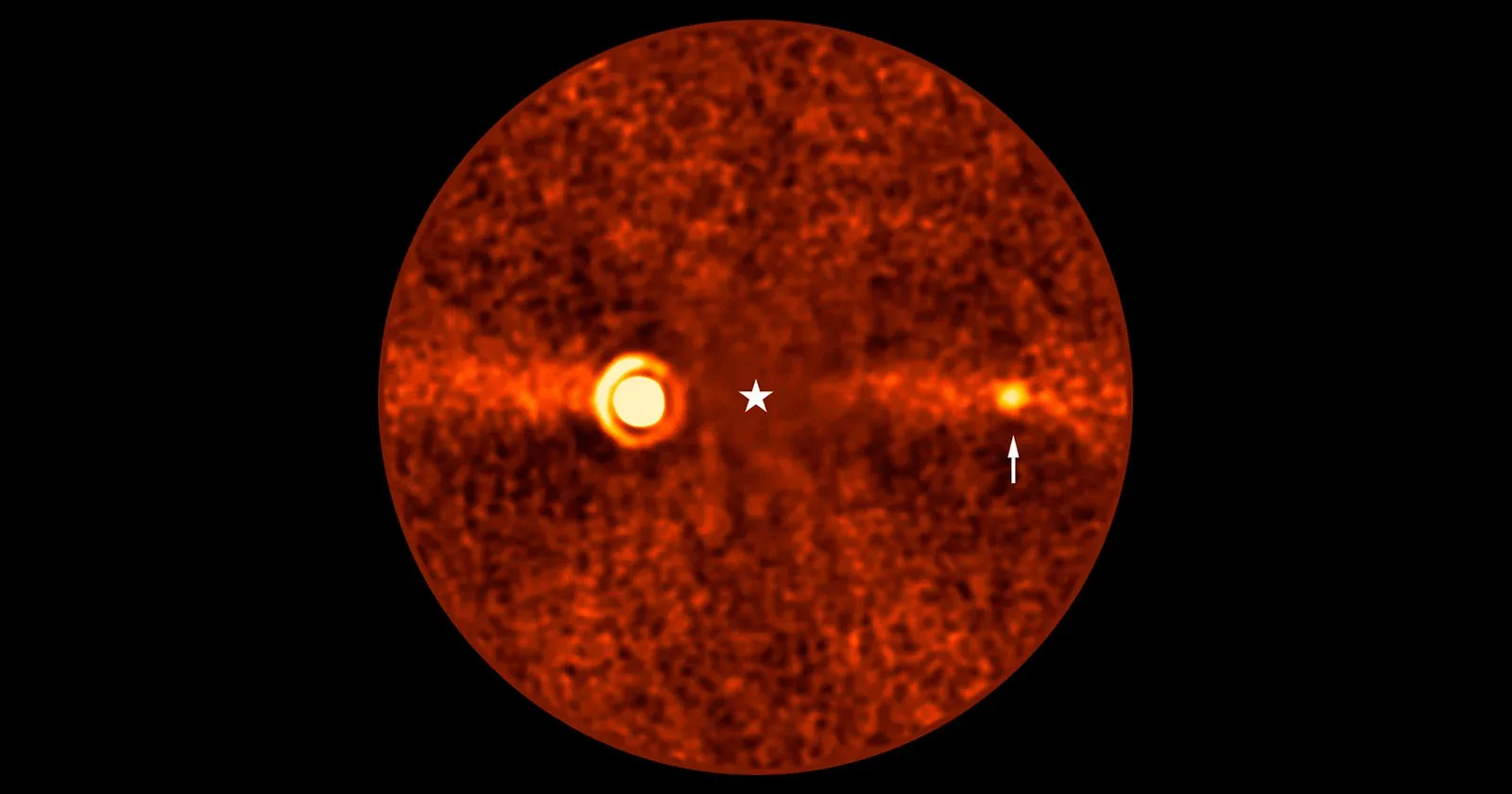
Astronomers have unveiled the discovery of a new giant exoplanet, dubbed Beta Pictoris d, orbiting the nearby star Beta Pictoris, located just beyond our solar system. The finding, made possible by the sophisticated instruments aboard the James Webb Space Telescope (JWST), adds a third known giant planet to a system already celebrated for harboring Beta Pictoris b and Beta Pictoris c. This discovery is particularly noteworthy as Beta Pictoris d was not identified through traditional direct imaging but by detecting a unique chemical signature within its atmosphere, a technique that could revolutionize the hunt for exoplanets.
The Beta Pictoris system has long been a focus for astronomers, making the discovery of Beta Pictoris d a significant development. "The newly identified Beta Pictoris d makes it only the second planetary system known to contain at least three imaged planets," NASA stated. While Beta Pictoris b and c were among the first exoplanets to be directly photographed, Beta Pictoris d remained concealed within the system's dense, dusty debris disk. This disk scatters light from the star, obscuring planets from view using conventional imaging methods.
The breakthrough came unexpectedly during observations intended to study the atmosphere of Beta Pictoris b using JWST's Near-Infrared Spectrograph (NIRSpec). Researchers noticed an anomalous bright signal in the data. "There was an unexpected bright source of light within the Integral Field Unit imaging, but we’ve learned not to trust bright blobs in images," explained Jean-Baptiste Ruffio, a research scientist at the University of California, San Diego, and principal investigator for the initial Webb observations. "They can be instrumental artifacts or other structures in the debris disk. By obtaining a spectrum at the same time as the image, we were able to quickly confirm our suspicions." A spectrum provides detailed information about an object's chemical composition and movement.
Detecting Worlds Through Chemical Fingerprints
Instead of the expected smooth spectrum indicative of light reflecting off cosmic dust, scientists observed distinct absorption lines. These lines pointed to the presence of carbon monoxide, a common component in the atmospheres of giant planets. Further confirmation came from follow-up observations using JWST's Mid-Infrared Instrument (MIRI), which detected water vapor and methane. "A spectrum contains an incredible amount of information," Ruffio elaborated. "You don’t just learn that something is a planet; you immediately begin learning about its temperature, chemistry, and motion."
The existence of Beta Pictoris d was independently verified through collaborative efforts. Researchers Ben Suttlieff of the University of Edinburgh and Markus Bonse of the European Southern Observatory (ESO) utilized the ESO's Very Large Telescope in conjunction with JWST's Near-Infrared Camera (NIRCam). This dual-telescope approach confirmed the exoplanet's presence, underscoring the power of combining different observational techniques. This successful detection method, utilizing spectroscopy to pierce through the obscuring dust, marks the first time an exoplanet has been discovered in this manner. It opens up new avenues for discovering potentially habitable worlds that might otherwise remain hidden from even the most powerful telescopes.
The discovery of Beta Pictoris d highlights the evolving capabilities in the search for extraterrestrial worlds. By moving beyond simple light detection and analyzing the chemical composition of planetary atmospheres, astronomers are gaining unprecedented insights into distant solar systems. This innovative approach promises to expand the catalog of known exoplanets significantly, potentially leading to the identification of planets with conditions suitable for life. The Beta Pictoris system, now known to host at least three giant planets, continues to be a vital laboratory for understanding planetary formation and evolution.