
Jupiter's Bow Shock Accelerates Electrons to Relativistic Speeds
NASA's Juno spacecraft has detected relativistic electrons near Jupiter's bow shock, revealing that upstream transient structures are responsible for extreme particle acceleration. This finding has implications for understanding cosmic rays across the solar system.

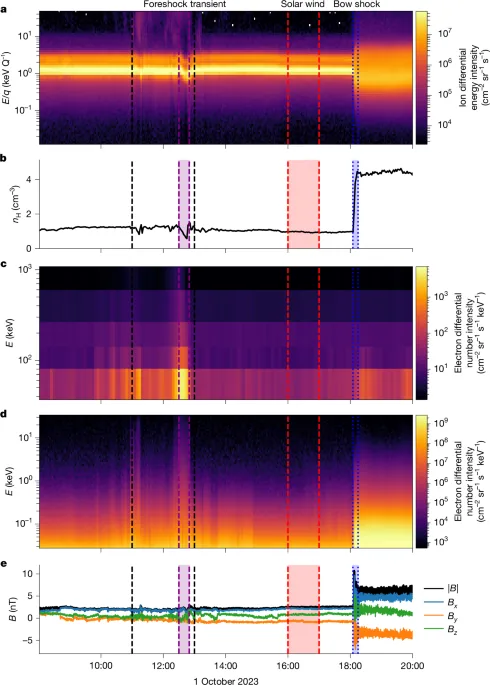
NASA's Juno spacecraft has detected electrons accelerated to near light speed upstream of Jupiter's bow shock, providing direct evidence for a universal mechanism that energizes particles throughout the cosmos. The discovery, made on October 1, 2023, during Juno's inbound trajectory, confirms that dynamic structures in a planet's foreshock region, known as foreshock transients, are potent particle accelerators.
These collisionless shock fronts, prevalent across the universe, are crucial for accelerating particles to relativistic energies, contributing significantly to the cosmic ray population. While the theory of diffusive shock acceleration (DSA) has long explained how particles gain energy by repeatedly crossing shock fronts, a persistent challenge known as the 'injection problem' has limited its scope. DSA is inefficient for particles that are not already energetic enough to outrun the shock, a process heavily influenced by the shock's inclination and strength, aspects not fully understood in all scenarios.
A promising solution has emerged from studying the foreshock—the region upstream of a shock where plasma is influenced by the shock's presence. Under specific geometries where the magnetic field is nearly aligned with the shock normal, these foreshock regions can spawn large-scale structures called foreshock transients. Recent observations of Earth's bow shock have shown these transients accelerating electrons to approximately 1 MeV, demonstrating a powerful synergy of enhanced shock acceleration, particle scattering, and geometric trapping. The resulting particle energy distributions have often followed a specific power-law, consistent with non-relativistic particles undergoing DSA at strong shocks.
Jovian Transient Accelerates Electrons to MeV Energies
These foreshock transients, also referred to by various names like hot flow anomalies (HFAs) within the heliophysics community, are fundamental to plasma physics. They form in diverse environments and scale with the properties of their host system. Observations confirm their presence at multiple planets, including Mercury, Venus, Mars, Earth, Jupiter, and Saturn. Crucially, the physical size of these transients appears to correlate directly with the size of the planet's bow shock. This scaling suggests a potential link between the overall size of a shock system and the maximum particle energy it can produce, a hypothesis supported by numerous simulations.
During its mission, the Juno spacecraft observed a prominent foreshock transient event on October 1, 2023, between approximately 12:30 and 12:50 UTC. This event, located on the duskward flank of Jupiter's bow shock, exhibited characteristics typical of such structures: disruptions in the solar wind, plasma heating, localized density decreases, and distinct magnetic field patterns. Notably, the peak electron energy observed within this transient was an order of magnitude higher than that recorded at the subsequent bow shock crossing. This observation strongly supports the idea that the most efficient particle acceleration to the highest energies occurs within upstream foreshock regions rather than solely at the main bow shock front.
Analysis of the electron energy spectrum, combining data from Juno's JADE and JEDI instruments, revealed a clear signal extending up to 1 MeV. After subtracting the ambient solar wind background, the energetic portion of the electron spectrum closely matched a power law with a spectral index of approximately -1.5. This finding is consistent with recent studies of foreshock transients near Earth and demonstrates the mechanism's effectiveness in accelerating particles to MeV energies within Jupiter's magnetosphere. In contrast, the adjacent bow shock crossing showed increased electron intensity only up to tens of keV, lacking the high-energy tail observed in the transient, further underscoring the transient's role in extreme particle acceleration.
The researchers emphasize that this phenomenon is not unique to Jupiter. By validating the scaling law that connects system size to acceleration region and maximum energy with multi-planetary data, their framework can be extended to astrophysical objects like protostellar jets and supernova remnants. This bridge between heliophysics and astrophysics, using planetary examples, provides an empirically grounded model for estimating maximum particle energy based on the size of shock systems and their surrounding plasma environments. Such insights are vital for understanding the origins and characteristics of the cosmic ray spectrum that permeates the galaxy.