
Jupiter and Venus Align Tonight in Rare Celestial Event
Jupiter and Venus will appear incredibly close in the night sky tonight, June 9. Stargazers can also spot Mercury near the horizon.

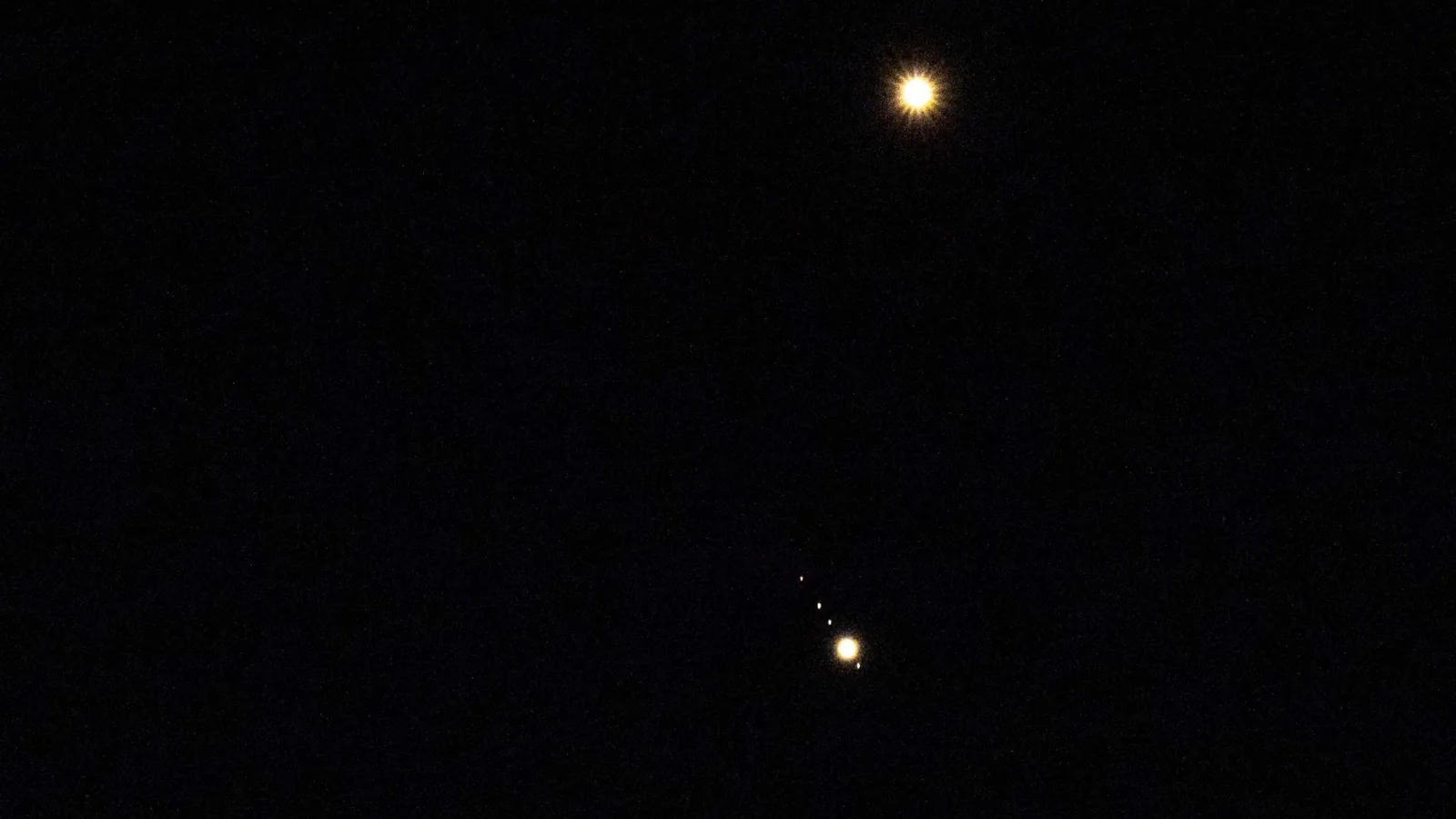
Stargazers across the U.S. are in for a treat tonight, June 9, 2026, as the planets Jupiter and Venus make a striking close approach in the evening sky. This celestial alignment, known as a conjunction, will allow both planets to appear nearly side-by-side, offering a spectacular view. Adding to the cosmic display, the planet Mercury will also be visible, though more challenging to spot, shining close to the western horizon amidst the fading light of sunset.
For those looking up, Venus will be the brighter of the two, appearing less than 20 degrees above the horizon at sunset. Jupiter will be situated to its lower left. Observers might need to hold up two clenched fists at arm's length to gauge the approximate width of two degrees separating the planets. Mercury, being closer to the sun, presents a more difficult sighting. It will appear roughly 10 degrees below and to the lower right of the Venus-Jupiter pair, requiring an unobstructed view of the western sky and ideally some patience.
This close encounter between Jupiter and Venus means they will fit within the field of view of a standard pair of 10x50 binoculars. For those with even modest optical aid, there's a chance to observe Jupiter's four largest moons: Io, Europa, Callisto, and Ganymede. These moons, often referred to as the Galilean moons, will appear as tiny points of light orbiting the massive gas giant.
Planetary movements after the conjunction
Following their close rendezvous on June 9, the planets will continue their orbital dance. In the subsequent nights, Venus will ascend higher into the sky, surpassing Jupiter as it moves towards the constellation Cancer. By June 20, Venus is expected to shine brightly near the open star cluster Messier 44, also known as the Beehive Cluster or Praesepe. Jupiter, conversely, will become progressively more challenging to observe after this conjunction. It will appear incrementally lower on the horizon each night, gradually disappearing into the glare of the setting sun.
The visibility of planets like Jupiter and Venus is a constant reminder of the dynamic nature of our solar system. These celestial bodies are not static points of light but are in perpetual motion, following predictable orbits around the Sun. Conjunctions like the one on June 9 are opportunities for amateur astronomers and casual skywatchers alike to witness these grand cosmic movements. Understanding the orbital mechanics, such as Kepler's laws of planetary motion, helps explain these phenomena and allows astronomers to predict future events with remarkable accuracy.
By early July, Jupiter will likely be too difficult to see due to its proximity to the setting sun. It will remain hidden from view until mid-August, when it will reappear in the eastern sky during the pre-dawn hours. This cycle of visibility and obscurity is typical for planets that orbit closer to the sun than Earth does, or those whose orbits place them frequently behind our planet from our perspective.