
First Twin Star System with Double Supernova Discovery
Astronomers have identified a rare binary star system where both stars likely exploded as supernovas. This groundbreaking discovery sheds new light on the evolution of massive stars.

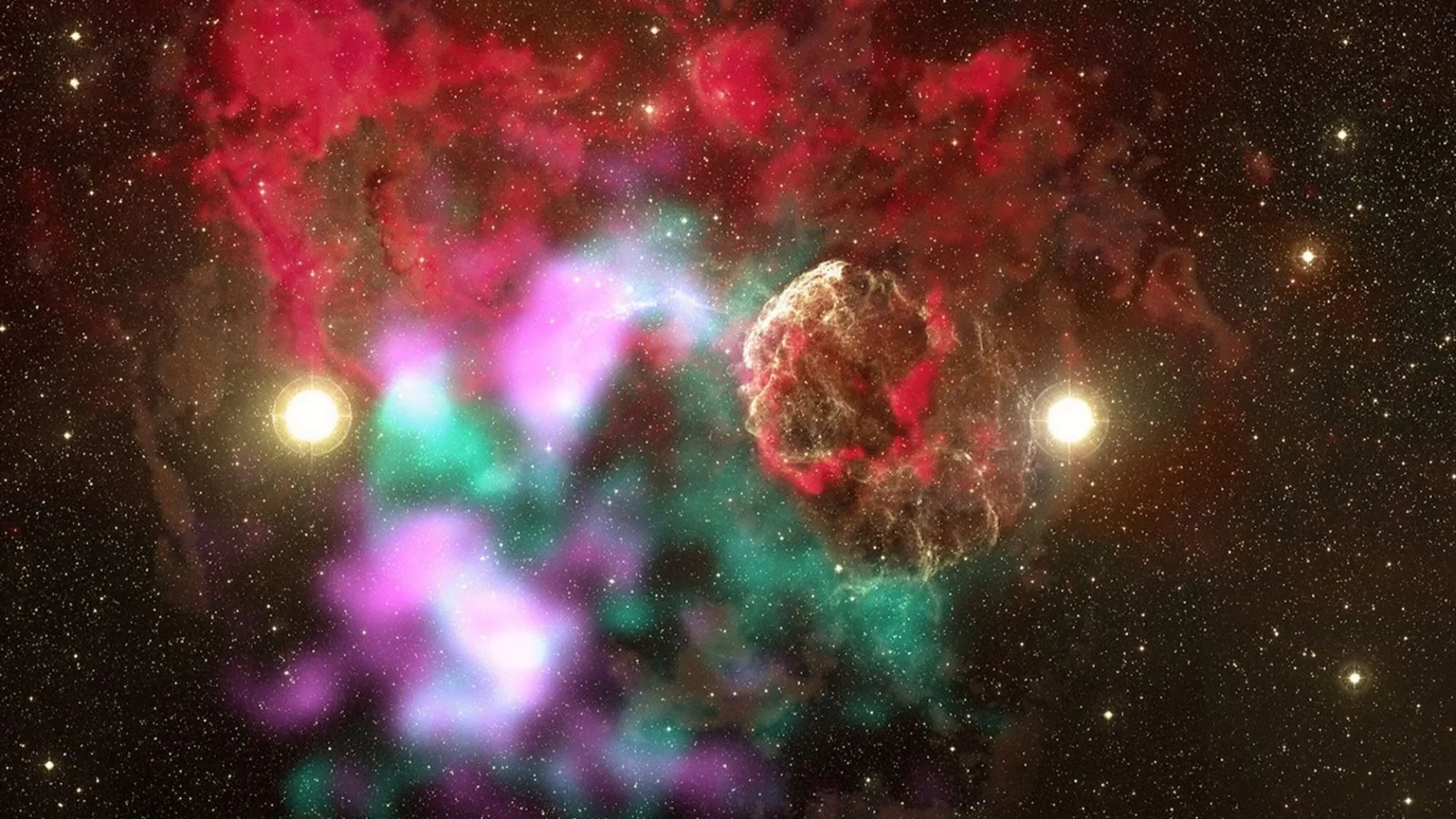
In a potentially historic astronomical find, scientists have identified the first known binary star system where both companion stars are believed to have exploded as supernovas. This celestial duo, reminiscent of the twin suns of fictional Tatooine, challenges previous assumptions about the explosive deaths of massive stars.
While Earth orbits a solitary star, binary systems—where two stars orbit a common center of gravity—are remarkably common, accounting for over half of all stars. This prevalence is even higher among massive stars, making the discovery of a system where both members met explosive ends particularly significant. "When it comes to massive stars, the percentage in multiple systems are even higher," explained Miltiadis Michailidis, lead author of the new study and a postdoctoral fellow at Stanford University.
Massive stars end their lives in colossal explosions called supernovas, brief but brilliant events that can outshine entire galaxies and leave behind vast, expanding clouds of debris known as supernova remnants. While hundreds of these remnants have been cataloged, a binary system featuring two such explosive stellar deaths had remained elusive. "However, this has never been observed, until now," Michailidis stated. He noted that such events might have gone unnoticed if the stars were too close at the time of their explosions, leading to merged remnant appearances, or if one supernova propelled its partner away, obscuring their prior connection.
Unraveling the Mystery of IC 443 and G189.6+3.3
The focus of this new research is the supernova remnant IC 443, approximately 6,000 light-years away in the constellation Gemini, also known as the Jellyfish Nebula. Its well-studied nature is partly due to its interaction with surrounding interstellar gas, creating distinct concentric shell structures. The research team, however, also scrutinized a fainter, previously less understood neighbor: G189.6+3.3. First detected via faint X-ray emissions by the ROSAT mission and later detailed by the Spektrum Roentgen Gamma observatory, G189.6+3.3 also exhibits shell-like features indicative of a supernova remnant.
By analyzing over 16 years of data from NASA's Fermi Gamma-ray Space Telescope, complemented by X-ray, optical, and radio observations, the scientists uncovered compelling evidence. Both IC 443 and G189.6+3.3 were interacting with the same interstellar cloud of hydrogen. This shared environment strongly suggests they originated from very close proximity, with their explosion centers estimated to be only 30 to 50 light-years apart.
The statistical probability of finding two unrelated supernova remnants in such close proximity by chance was calculated to be exceedingly low—roughly one in 1,000. "This suggests that our discovery is in fact the first known binary-star system supernova pair," Michailidis asserted. Further analysis indicates that G189.6+3.3 is the older remnant, originating from an explosion between 20,000 and 110,000 years ago, while IC 443 is younger, dating back approximately 8,000 to 9,000 years. The progenitor stars for both are estimated to have been at least 20 times the mass of our Sun.
This landmark discovery offers an unprecedented opportunity to study the complex dynamics of massive stars in binary systems. Researchers hope that by further examining these two supernova remnants, they can gain crucial insights into how such stellar pairs evolve, interact, and ultimately meet their explosive ends. Understanding the "kick" imparted by one supernova onto its companion star system could be a key area of future study, providing valuable data for astrophysics models.