
Michigan Aurora Watch: Northern Lights Expected Friday
Michigan residents may witness the aurora borealis on Friday, August 28, as NOAA predicts a G1 geomagnetic storm. The lights could be visible overhead in the Upper Peninsula and visible to the north statewide.

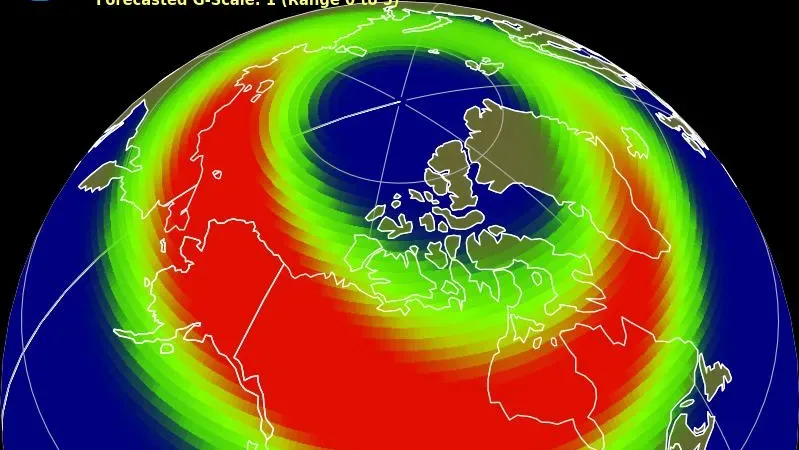
The skies over Michigan could be illuminated by the spectacular aurora borealis this Friday, August 28, according to a forecast from the NOAA's Space Weather Prediction Center (SWPC). Officials issued a G1 geomagnetic storm watch earlier this week, warning of potential disturbances in Earth's magnetic field that could lead to visible northern lights displays.
The forecast suggests the Kp index, a measure of geomagnetic storm severity, could exceed 5 on Friday night. This level of activity has the potential to produce strong aurora borealis visibility, particularly overhead in the Upper Peninsula and visible across the rest of the state to the north. NOAA anticipates minor geomagnetic storm impacts, but advises those looking for a better view to seek out dark sky areas with clear conditions.
Understanding Geomagnetic Storms and Auroras
A geomagnetic storm is essentially a worldwide disturbance affecting Earth's magnetic field, often triggered by solar activity like coronal mass ejections. The Kp index ranges from zero to 9, with higher numbers indicating more severe magnetic disturbances. The predicted Kp index of 5.67 late Friday and early Saturday could even elevate the event to a G2 geomagnetic storm, a step up from the initial G1 watch.
The northern lights, scientifically known as aurora borealis, are a natural light show in the sky, primarily seen in high-latitude regions. They are created when charged particles from the sun, carried by the solar wind, collide with atoms in Earth's upper atmosphere. These collisions excite the atmospheric gases, causing them to emit light of varying colors.
The specific colors of the aurora depend on which gas particles are involved and the energy exchanged during the collision. According to NASA, oxygen atoms typically produce the familiar greenish-yellow hue of the aurora, but can also emit red light at higher altitudes. Nitrogen molecules are generally responsible for blue or purplish-red light. While these displays are beautiful to the naked eye, some of the light emitted, particularly ultraviolet wavelengths, can only be detected by specialized instruments on satellites.
While weather conditions could pose a challenge in some areas, with parts of northern Michigan experiencing a slight chance of rain and clouds expected in the Upper Peninsula and northern regions, the potential for a significant aurora display remains. Those hoping to catch the event are encouraged to check local weather service updates for the clearest viewing opportunities.
For those who may have trouble seeing the faint lights with the naked eye, a tip from the Lansing State Journal suggests using a smartphone camera in night mode. Holding the phone steady while capturing images might reveal auroral activity that is not immediately apparent to the human eye.