
Milky Way's Ancient Past Revealed: Stars Traced to Another Galaxy
Astronomers have identified ancient stars in the Milky Way originating from a distinct, previously unknown galaxy that merged with ours over 12 billion years ago. This discovery refines our understanding of early galactic evolution.

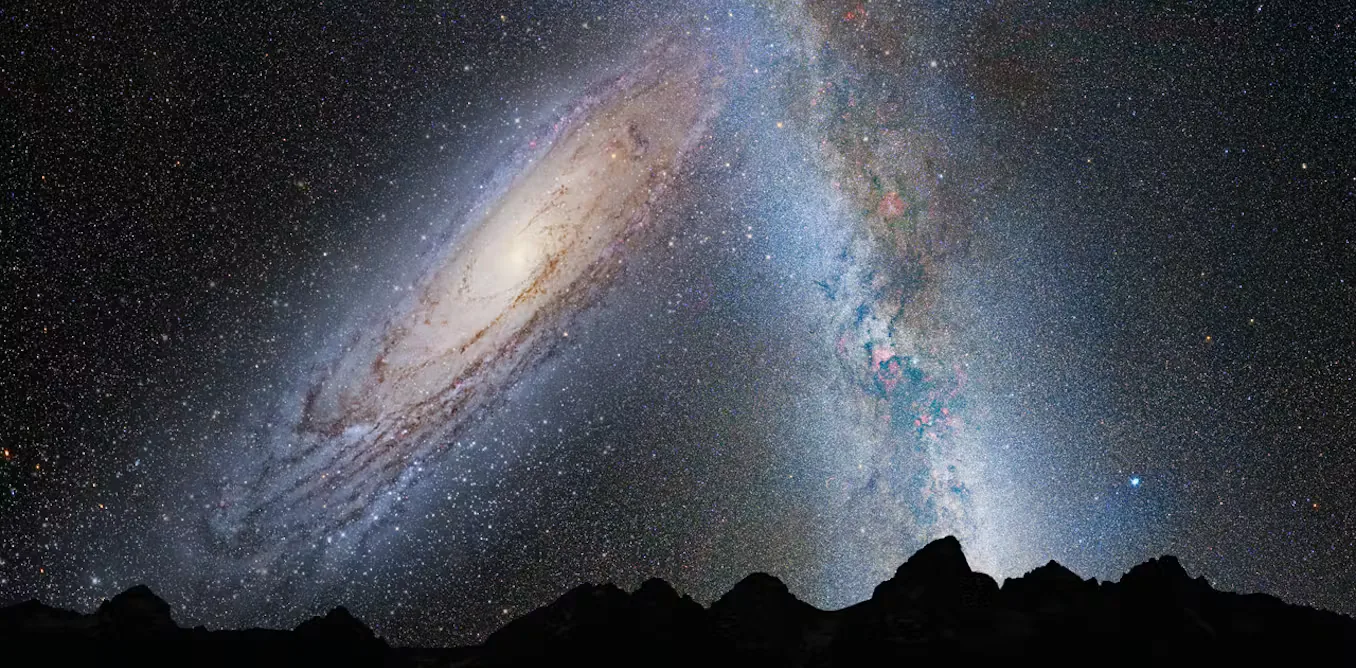
Astronomers have pinpointed ancient stars within our own Milky Way galaxy that originated from a different galaxy, providing a clearer picture of our galaxy's violent formation 12 billion years ago. The study, published in Nature Astronomy and led by astrophysicist Davide Massari, utilized the precise ages of dense star clusters to date a significant ancient merger event, revealing details about the incoming galaxy's size and evolution.
Galaxies, including our Milky Way, grow over billions of years through a process of star formation and mergers with smaller celestial bodies. The Milky Way's history is marked by such events, with its stars acting as a 'fossil record' of galaxies it has absorbed. This year, the 2026 Kavli Prize in Astrophysics recognized pioneering work in uncovering this evidence, highlighting how the Milky Way grew through these mergers. One well-documented merger event involved the Gaia–Sausage–Enceladus galaxy approximately 10 billion years ago.
However, reconstructing events from even earlier periods has proven challenging. The new research focuses on a merger that predates the Gaia–Sausage–Enceladus event, an era when the Milky Way itself was still relatively small. Previous studies had indicated this earlier merger through star populations like 'Kraken' and 'Heracles,' but the latest findings offer unprecedented precision.
Sharpening the View with Globular Clusters
The breakthrough came from analyzing globular clusters, which are extremely dense collections of hundreds of thousands of stars that formed simultaneously. These clusters act as reliable cosmic clocks, allowing astronomers to determine their ages with high accuracy. By combining observations from the Hubble Space Telescope with advanced modeling, Massari's team precisely dated several globular clusters across the Milky Way.
Crucially, they compared these ages with each cluster's metallicity – the abundance of elements heavier than hydrogen and helium. Galaxies become chemically enriched over time as stars form, evolve, and release heavier elements. By mapping age and metallicity, the researchers were able to distinguish the chemical histories of different star populations within the Milky Way. They identified three distinct age–metallicity sequences: one belonging to the early Milky Way itself, another to the Gaia–Sausage–Enceladus merger, and a third linked to this much earlier merger event.
The analysis suggests this progenitor galaxy, now dubbed Low-energy–Kraken–Heracles (LKH), contained approximately 500 million stars – a mass comparable to the later Gaia–Sausage–Enceladus galaxy. The merger is estimated to have occurred about 1.8 billion years before the GSE event, with much of LKH's material incorporated into the Milky Way's core regions.
This discovery is significant because it moves beyond simply cataloging past mergers. The enhanced precision allows scientists to better date and characterize these ancient collisions. By separating the chemical histories of the early Milky Way, LKH, and GSE, researchers can now investigate not just when these galaxies collided, but also their composition and developmental stages prior to the merger. This is particularly valuable for understanding the Milky Way's first few billion years, a period of rapid and substantial growth.
While globular clusters offer an incomplete record – some early galaxies may have formed few or lost their clusters – this approach provides a unique perspective. Modern telescopes like the James Webb Space Telescope can observe distant galaxies from that same epoch, but often without resolving individual stars. The Milky Way, however, offers detailed examination of its surviving stars and clusters from that era. This synergy between observing distant galaxies and analyzing our own is transforming our understanding of galaxy formation in the early universe, turning the Milky Way's blurry past into a detailed cosmic history.