
Nancy Grace Roman Telescope Set for August 30 Launch on SpaceX Falcon Heavy
NASA's Nancy Grace Roman Space Telescope is cleared for launch on August 30, 2026, aboard a SpaceX Falcon Heavy rocket from Kennedy Space Center. The observatory will study exoplanets and dark energy.

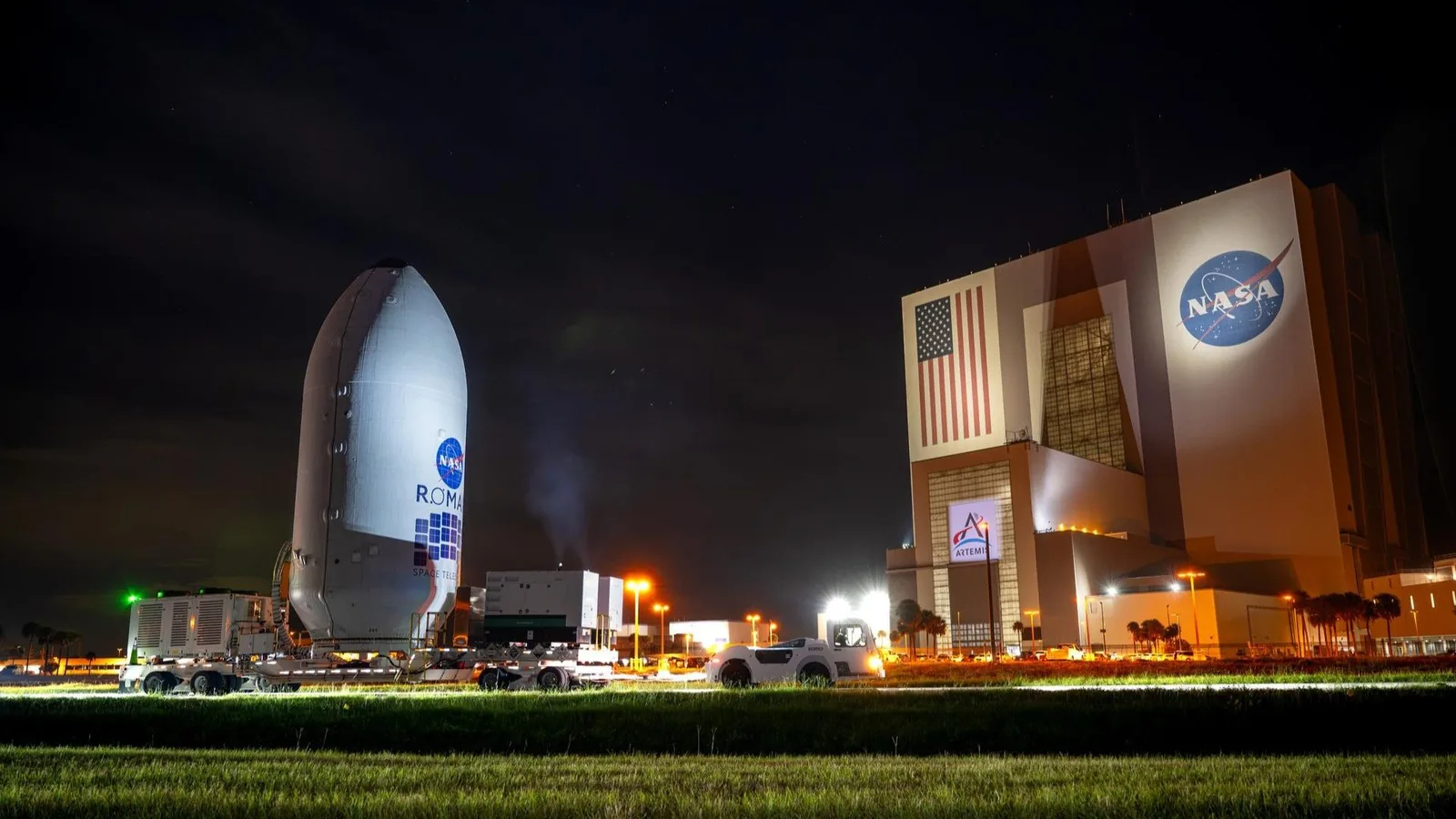
NASA's Nancy Grace Roman Space Telescope has received final approval for its launch, scheduled for Sunday, August 30, 2026. The mission's Launch Readiness Review concluded successfully on August 28, clearing the path for the observatory to lift off from Kennedy Space Center in Florida atop a SpaceX Falcon Heavy rocket. Liftoff is slated for 7:26 a.m. EDT (1126 GMT) from Launch Complex-39A.
The powerful Falcon Heavy rocket will transport the Roman Space Telescope on its journey to the Earth-Sun Lagrange point-2 (L2), a stable gravitational point approximately 930,000 miles from Earth. This distant location will allow the telescope to maintain a persistent orbit, offering unobstructed views of the cosmos for its groundbreaking research.
Weather forecasts for Sunday morning indicate favorable conditions for the early launch attempt, with a low probability of showers or thunderstorms impacting the liftoff window. However, deteriorating weather is expected later in the day, making the Sunday morning slot the most opportune for a successful ascent. A backup launch window is available for Monday, August 31, at 7:22 a.m. EDT.
Roman Telescope's Mission and Capabilities
The Nancy Grace Roman Space Telescope represents NASA's next-generation observatory, poised to make significant contributions to our understanding of the universe. Its primary objectives include the search for exoplanets, utilizing advanced Roman Space Telescope coronagraph technology to directly image planets outside our solar system. Scientists also aim to unravel the mysteries of dark matter and dark energy, two of the most enigmatic components of the universe, which together constitute approximately 95% of its total mass-energy content.
This ambitious mission will build upon the discoveries of previous space telescopes, providing unprecedented data through its wide field of view and advanced instrument capabilities. The observatory is equipped with two main scientific instruments: the Wide Field Instrument (WFI) and the Coronagraph Instrument (CGI). The WFI will capture images of large swathes of the sky, enabling the cataloging of millions of galaxies and the detailed study of galactic evolution. The CGI will be capable of blocking the light from bright stars to directly observe potentially habitable exoplanets, a feat challenging for even the most powerful current observatories.
Roman's journey to its operational orbit at L2 is expected to take approximately one month, followed by a three-month checkout period. Once fully operational, the telescope is designed for a five-year primary mission, with potential for extended operations, allowing ample time for groundbreaking scientific discoveries. The successful encapsulation of the telescope within the Falcon Heavy's payload fairing was completed on August 24, following final fit checks and tests.
The preparation for this significant launch has involved extensive collaboration between NASA and SpaceX. Technicians at Kennedy Space Center have meticulously prepared the observatory, including fueling it with 290 gallons of hydrazine propellant on July 25 and attaching it to its payload adapter in early August. A full launch-day dress rehearsal was conducted on August 20, simulating all aspects of the launch sequence to ensure readiness. The successful completion of the Flight Readiness Review on August 21 formally cleared the observatory for its final launch preparations, including its transport to SpaceX's hangar at Launch Complex-39A and mating with the Falcon Heavy rocket.