
NASA Confirms Exploding Meteor Caused Boston Sonic Boom
An exploding meteor, traveling at 75,000 mph, caused a sonic boom over New England on Saturday afternoon, NASA confirmed. The event lit up the sky and shook homes.

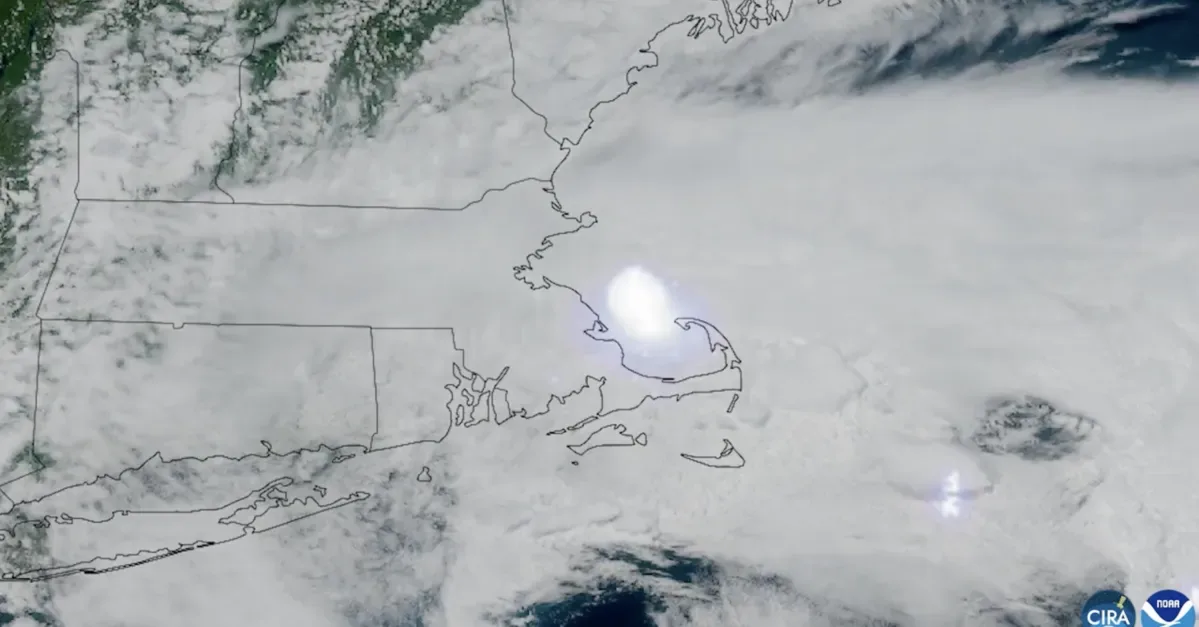
A brilliant fireball streaked across the northeastern U.S. skies on Saturday afternoon, culminating in an explosion that produced a widely felt sonic boom over Massachusetts and New Hampshire, NASA confirmed. The celestial event occurred around 2:06 p.m. ET, captivating observers and causing a moment of brief alarm as residents initially speculated about earthquakes.
The United States Geological Survey (USGS) quickly ruled out seismic activity, identifying the phenomenon as a "widely felt sonic boom from a suspected bolide." NASA corroborated this assessment, describing the event in a statement as a "bright fireball… accompanied by a loud noise." The meteor's trajectory and explosive demise were captured by multiple cameras and even visible in satellite imagery, illuminating the afternoon sky.
According to NASA, the meteor was traveling at an astonishing speed of approximately 75,000 miles per hour. It "appears to have fragmented at an altitude of 40 miles over northeast MA and southeast NH," the agency stated. The energy released during this breakup was estimated to be equivalent to about 300 tons of TNT, an immense force that accounted for the significant audible and physical impact experienced on the ground. The resulting sonic boom rattled homes and drew immediate attention from the public and scientific community.
Understanding Bolides and Meteor Events
This particular celestial visitor was not linked to any known active meteor showers, and NASA's deputy news chief Jennifer Dooren clarified that it was "a natural object and not a re-entry of space debris or a satellite." This distinction is crucial, as it separates natural interplanetary phenomena from human-made orbital objects. Bolides, like the one observed over New England, are exceptionally bright meteors that can produce audible sounds and shockwaves due to their fragmentation at high altitudes. The study of these bolides provides valuable data on the composition and trajectory of near-Earth objects, contributing to ongoing efforts in planetary defense and space science.
The event serves as a reminder of the dynamic nature of our solar system and the constant influx of cosmic material. While most meteors burn up harmlessly in the atmosphere, larger or more fragile objects can break apart spectacularly. The detailed observations collected from this incident, including video footage and eyewitness accounts, will be analyzed by scientists to learn more about the meteor's origin, composition, and the precise mechanics of its atmospheric entry and explosion. Such analyses help refine models predicting the impact potential of future meteors and enhance our understanding of celestial mechanics. The energy signature detected, equivalent to hundreds of tons of TNT, highlights the powerful forces at play even with relatively small celestial bodies entering Earth's atmosphere.
The region affected by the sonic boom stretched across parts of northeast Massachusetts and southeast New Hampshire. Residents shared numerous videos and accounts on social media, describing the startling boom and the brief but intense flash of light in the sky. The clarity of the visual and auditory phenomena allowed for robust scientific analysis, offering a rare opportunity to study such an event in detail. This sonic boom event underscores the importance of widespread sky monitoring and citizen science in documenting and understanding astronomical occurrences. The precise altitude of fragmentation, 40 miles, is higher than typical meteor explosions, suggesting a particularly strong or rapidly disintegrating object. This NASA confirmation brings closure to the speculation that followed the event, solidifying the scientific explanation for the mysterious boom over Boston.