
NASA's Curiosity Rover Captures Mars 'Jellyfish' Anomaly
NASA's Curiosity rover photographed a peculiar shadow resembling a jellyfish on Mars. Scientists believe the anomaly is an artifact caused by cosmic rays hitting the camera's sensor.

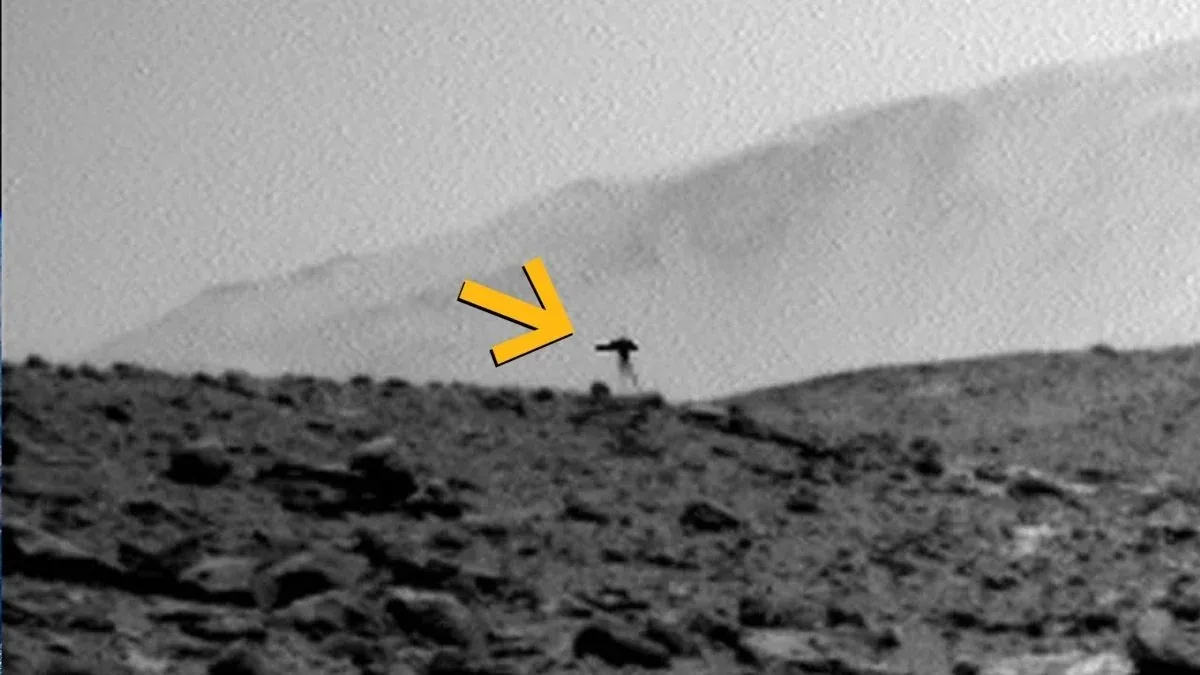
NASA's Curiosity rover has captured an unusual image on Mars featuring a dark, shadow-like object that bears a striking resemblance to a jellyfish with dangling tentacles. The anomaly, spotted on the far left of a Martian landscape photograph, has sparked interest and speculation, though scientists at NASA's Jet Propulsion Laboratory (JPL) suggest a more grounded, albeit cosmic, explanation.
The peculiar formation was imaged by Curiosity on August 20, 2023. While the initial photograph presents a ghostly silhouette against the Martian terrain, a closer look at the rover's imaging capabilities reveals the likely cause. Curiosity routinely captures multiple images of the same scene within seconds of each other. In this instance, two earlier images of the exact same location, taken just 13 and 25 seconds prior to the "jellyfish" photo, show no trace of the unusual shape. This temporal discrepancy strongly indicates the phenomenon occurred within the rover's camera system rather than on the Martian surface.
Cosmic Rays vs. Martian Life
The leading hypothesis attributes the "jellyfish" to a cosmic ray strike. Mars, unlike Earth, lacks a substantial global magnetic field and possesses a much thinner atmosphere—only about 0.5 percent the mass of Earth's. This leaves surface-level instruments like those on Curiosity more exposed to high-energy charged particles originating from deep space. These cosmic rays constantly bombard the planet.
When a cosmic ray interacts with the sensitive silicon detector of a camera, it can create a temporary glitch, or artifact, in the resulting digital image. These artifacts can manifest in various ways, often appearing as bright white spots or streaks, akin to tiny laser pointer marks. However, they are not exclusively bright; in some documented cases, black artifacts have also been observed, originating from similar sensor events.
Justin Maki, an imaging scientist and systems engineer at NASA's JPL, noted in 2014 that "in the thousands of images we've received from Curiosity, we see ones with bright spots nearly every week." While this specific "jellyfish" artifact appeared dark, the principle remains consistent with the known behavior of cosmic ray impacts on camera sensors. The fact that the anomaly is visible in only one frame, disappearing in subsequent shots of the same scene, aligns perfectly with the transient nature of such events.
This phenomenon is not unprecedented for the Mars rover missions. Both Curiosity and its companion rover, Perseverance, have encountered numerous intriguing geological formations and light anomalies on the Martian surface over their operational years. Past "discoveries" have included objects resembling human femurs, mushrooms, and even surprisingly geometric shapes, most of which were eventually identified as ordinary rocks shaped by Martian geological processes. However, the "jellyfish" incident highlights a different category of anomaly—one originating not from the planet's geology, but from the interaction of interplanetary phenomena with the sophisticated technology used to explore it.
While a cosmic ray is the most plausible explanation for the spectral "jellyfish," NASA's imaging team has not definitively confirmed this specific event. Without their formal analysis, other minor camera or processing glitches cannot be entirely ruled out. Nevertheless, the evidence strongly suggests that the enigmatic shape was an ephemeral event within the camera's sensor, rather than an actual biological or geological entity on the Martian surface. The discovery serves as a fascinating reminder of the challenges and surprises inherent in space exploration and the constant interplay between distant worlds and the technology we use to study them.