
NASA Taps Katalyst Space to Rescue Swift Observatory From Earth's Atmosphere
NASA is employing Katalyst Space Technologies to boost the orbit of the Swift Observatory, which is in danger of burning up in Earth's atmosphere due to solar storms. The mission aims to prevent the satellite's premature demise.

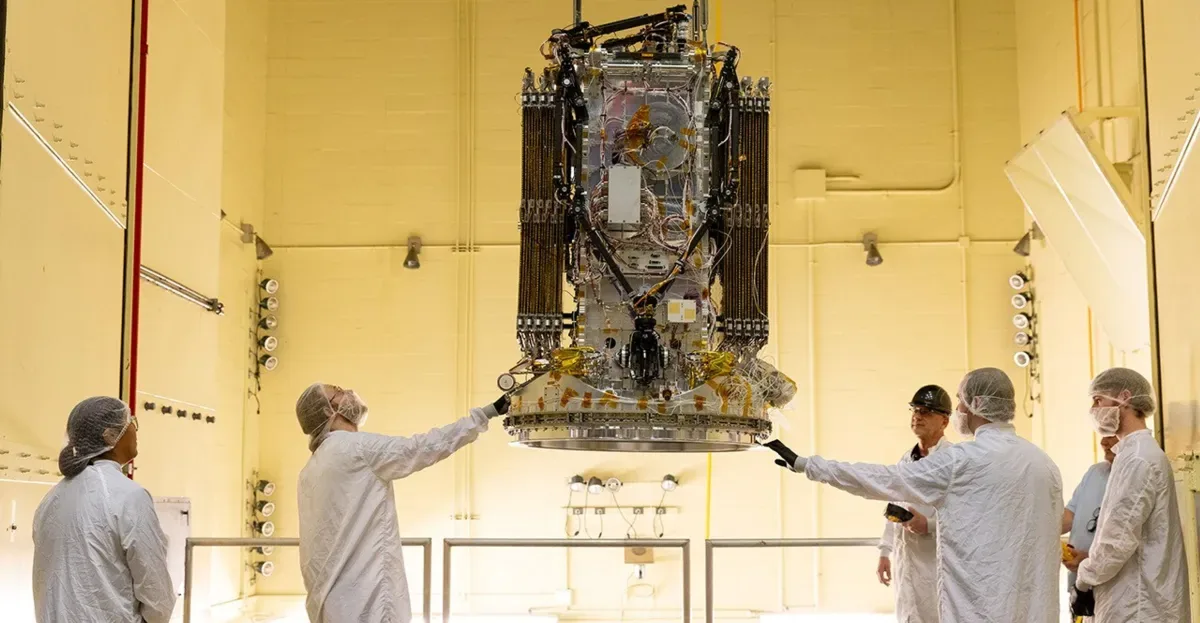
NASA has partnered with Katalyst Space Technologies in an urgent mission to prevent the Neil Gehrels Swift Observatory from a fiery demise in Earth's atmosphere. Launched in 2004, the observatory's orbit has been significantly lowered by recent solar storms, placing it at a critical altitude of 224 miles. Without its own propulsion system, Swift is unable to correct its descent, prompting NASA to act swiftly. The mission, a collaboration costing $30 million, saw Katalyst's Link spacecraft launch on Friday with the explicit goal of intercepting and lifting Swift by approximately 150 miles to its original orbital path.
The urgency stems from Swift's precarious orbital decay; NASA estimates the observatory would be too low to salvage by October 2026. Katalyst Space Technologies, a relatively new player in satellite servicing, has undertaken the complex task of developing and launching a three-armed spacecraft capable of docking with and repositioning Swift in a remarkably short nine-month period. This accelerated timeline highlights the critical nature of Swift's scientific contributions and the agency's commitment to preserving its operational capacity. The $500 million Swift Observatory, a vital tool in astrophysics, primarily focuses on studying gamma-ray bursts, phenomena that offer profound insights into the universe's earliest moments.
A Race Against Orbital Decay
The successful deployment of the Link spacecraft marks a significant achievement for Katalyst Space Technologies, demonstrating its capability in rapid satellite servicing. The delicate operation requires precise maneuvering at extreme speeds to meet Swift, which is traveling at thousands of miles per hour. The three-armed capture mechanism is designed to gently grasp the observatory without causing damage, then provide the necessary thrust to push it into a higher, more stable orbit. This rescue mission underscores the growing need for orbital debris mitigation and satellite servicing solutions as more hardware populates Earth's orbit. NASA's reliance on private sector innovation like Katalyst's for such critical tasks reflects a broader trend in space operations.
Gamma-ray bursts, the primary targets of the Swift Observatory, are the most luminous electromagnetic events in the universe. Studying these bursts helps astronomers understand the evolution of stars, the formation of black holes, and the conditions present in the early cosmos. The data collected by Swift over its nearly two decades of operation has been instrumental in advancing cosmological models and our understanding of extreme astrophysical phenomena. Losing such a valuable scientific instrument prematurely would represent a significant setback for the field of astronomy.
The challenges are multifaceted: not only must Link rendezvous with Swift in space, but it must also execute the orbital boost accurately. The $30 million investment is a fraction of the cost of building and launching a replacement observatory, making this a cost-effective solution for NASA. The success of this mission could pave the way for similar interventions for other aging satellites in low Earth orbit, enhancing the longevity and utility of expensive space assets. The collaborative spirit between NASA and companies like Katalyst is crucial for addressing the evolving landscape of space exploration and utilization.