
NASA Images Reveal SpaceX Rocket's Moon Crater After Impact
NASA's Lunar Reconnaissance Orbiter captured detailed before-and-after images of a crater created by a SpaceX rocket's impact on the Moon. The crater, measuring 60 feet wide, shows streaks of excavated material.

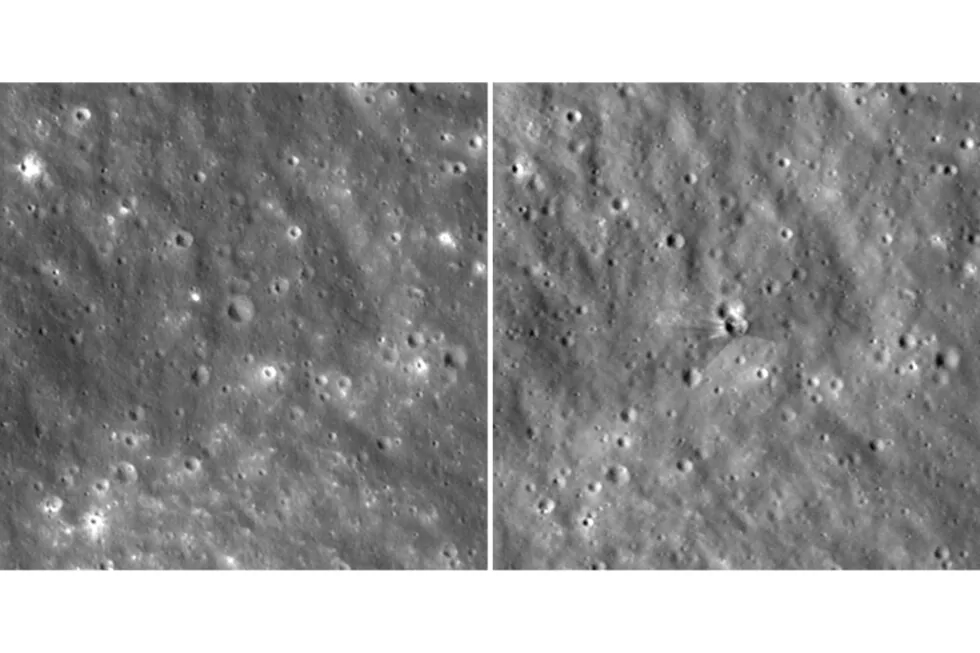
NASA has released striking before-and-after imagery from its Lunar Reconnaissance Orbiter (LRO) spacecraft, offering the clearest view yet of the lunar surface crater left by a SpaceX rocket's intentional impact. The images, shared on Tuesday, document the aftermath of the Falcon rocket's upper stage colliding with the Moon on August 5, 2026, at an estimated speed of 5,400 mph (8,700 kph). The rocket stage had been in space for over a year before its lunar demise, having launched a pair of private moon landers carrying scientific experiments and a small rover in 2025 as part of NASA's broader initiative to foster commercial lunar exploration.
Scientists analyzing the LRO data estimate the newly formed crater to be approximately 60 feet (18 meters) in diameter and less than 10 feet (3 meters) deep. The impact site is characterized by distinct dark and bright streaks radiating outwards, reminiscent of butterfly wings. According to NASA, the darker streaks are composed of excavated material that was exposed to eons of solar wind, cosmic rays, and micrometeorite impacts, altering its surface appearance. Conversely, the brighter rays highlight freshly disturbed regolith and rocks ejected from deeper within the lunar soil.
The LRO spacecraft observed the impact site about a week after the collision, orbiting approximately 60 miles (96 kilometers) above the Moon's surface and traveling at a mile per second. To capture the necessary imagery, mission controllers had to precisely maneuver the orbiter, tilting its cameras to focus on the crash area. The LRO, which has been circling the Moon since 2009, completes a lunar polar orbit every two hours. Its ability to observe specific locations is dependent on the Moon's rotation and the orbiter's orbital path, meaning it took six days for the impact scene to come into a suitable viewing window after the event.
Lunar Exploration and Observation
South Korea's Danuri spacecraft was the first to provide photographic evidence of the SpaceX rocket impact, sending back initial images shortly after the event. This latest observation by the LRO further enhances the scientific community's understanding of impact dynamics on the lunar surface. The NASA orbiter's long-term mission is crucial for mapping the Moon's topography, identifying potential resources, and assessing landing sites as the space agency prepares for the return of astronauts to the lunar surface under the Artemis program. The data collected contributes significantly to both scientific research and the logistical planning for future human missions.
The controlled crash of the SpaceX rocket stage was not an anomaly but a deliberate scientific maneuver. Such impacts provide valuable data points for understanding the Moon's composition and subsurface structure. By studying the ejected material and the resulting crater morphology, researchers can infer properties of the lunar regolith at various depths. This mission underscores the growing collaboration between government space agencies and private companies like SpaceX in advancing space exploration. The insights gained from this specific impact will inform future missions, including those aiming to utilize lunar resources and establish a sustained human presence.
The deployment of the Lunar Reconnaissance Orbiter, launched in 2009, has been instrumental in supporting NASA's ambitious exploration goals. Its comprehensive data has aided in selecting landing sites for robotic and human missions, locating areas of potential water ice, and characterizing the lunar radiation environment. The detailed imagery of the SpaceX rocket impact crater adds another layer to this invaluable dataset, providing a unique 'ground truth' for impact models and offering a visible testament to the dynamic nature of celestial bodies.