
NASA Moon Base Plan: Permanent Lunar Outpost Aims for 2026 Launch
NASA has unveiled its most detailed plan yet for a permanent lunar outpost near the Moon's south pole, aiming for initial missions to launch by late 2026. This base is intended as a crucial stepping stone for future human missions to Mars.

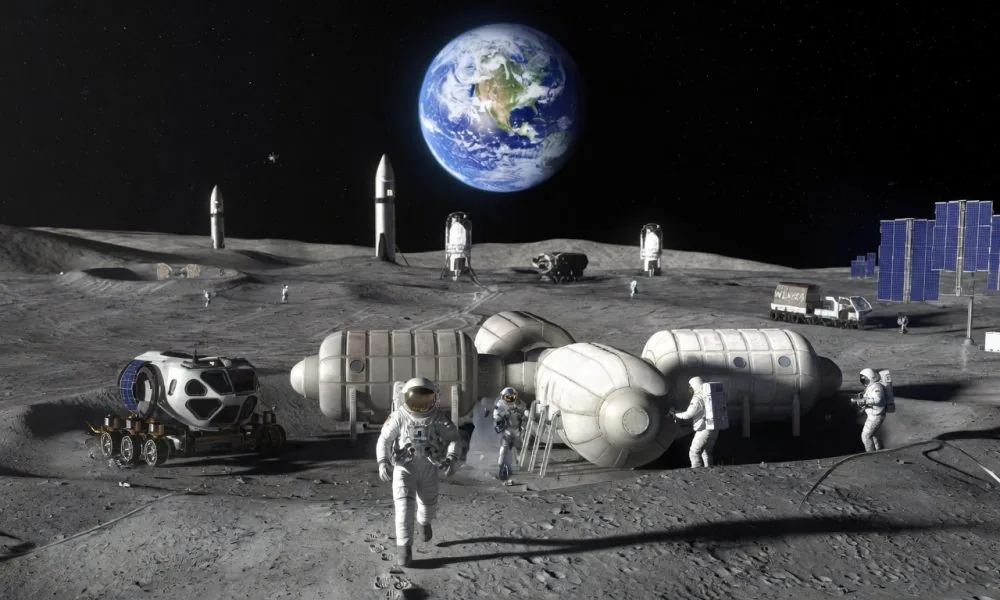
NASA has outlined its most ambitious lunar settlement plan to date, detailing a permanent outpost slated for construction near the Moon's south pole over the next decade. This initiative is designed to serve as a vital stepping stone for eventual human expeditions to Mars. "The Moon Base will be America’s and humanity’s first outpost on another celestial world," stated NASA Administrator Jared Isaacman. He emphasized that each crewed and uncrewed mission will offer valuable learning opportunities as the agency returns to the lunar surface, establishes infrastructure for sustained presence, and hones the skills necessary to thrive in an extremely challenging and hazardous environment.
The comprehensive plan unfolds across three distinct phases, incorporating both robotic and human missions to transport essential equipment, vehicles, and infrastructure to the lunar surface. The initial three base missions are targeted for launch before the conclusion of 2026. Moon Base I, scheduled for fall 2026, will utilize Blue Origin's Blue Moon Mark 1 lander to deliver scientific instruments to the Shackleton Connecting Ridge, the same region designated for Artemis astronaut landings. Following this, Moon Base II will deploy Astrobotic's Griffin lander, carrying over 1,100 pounds of cargo including Astrolab’s FLIP rover, to commence the development of surface mobility systems. Moon Base III is planned to transport the Lunar Vertex science mission aboard Intuitive Machines’ Nova-C Trinity lander to study lunar swirls near the south pole, featuring payloads from the European Space Agency and South Korea.
Lunar Surface Mobility and Infrastructure Development
Significant advancements in surface mobility are also underway. NASA has awarded contracts totaling $219 million to Astrolab and $220 million to Lunar Outpost to develop the initial phase of Lunar Terrain Vehicles (LTVs). Both rovers are slated for deployment to the lunar surface by 2028. Astrolab's crewed rover is expected to weigh approximately 2,000 pounds and achieve speeds exceeding 6 mph, while Lunar Outpost's Pegasus rover will be capable of autonomous operation or remote control at speeds over 9 mph.
In parallel, Blue Origin has secured a contract worth $188 million, with an additional option for $280.4 million, to provide cargo landers specifically designed for rover transport. NASA has also confirmed that Firefly Aerospace has been selected to construct the transport spacecraft for the MoonFall mission, which aims to deploy four survey drones to scout potential Artemis landing sites. This mission is targeted for a 2028 launch.
SpaceX plays a pivotal role in this commercial ecosystem. The company holds the crucial NASA Human Landing System contract, utilizing a Starship-derived lander to transport astronauts to the lunar surface for Artemis IV, currently scheduled for 2028. Prior to this, SpaceX must successfully demonstrate large-scale in-orbit propellant transfer, a process necessitating multiple Starship tanker launches to fuel a single mission. The strategic importance of the water ice reserves at the lunar south pole cannot be overstated; this resource is vital for producing drinking water, breathable oxygen, and rocket propellant, thereby substantially reducing the need for Earth-based resupply. This closed-loop resource system becomes far more feasible if Starship can land and be refueled directly on or near the Moon.
The Moon Base plan serves as the foundational infrastructure connecting NASA's ambitions from lunar exploration to Mars. SpaceX's Starship is currently the only American vehicle contracted to carry humans to either destination. In a separate but significant development, the U.S. Space Force awarded SpaceX a $2.29 billion contract on May 26, 2026, for the development of the Space Data Network (SDN) Backbone. This satellite-based communication system is engineered to maintain real-time connectivity for American military forces globally. The contract mandates the delivery of a fully operational prototype by the end of 2027. The SDN Backbone is described as the essential communication infrastructure for the military's space-based internet, functioning as a robust, low-latency data transport system for the Joint Force.
The Space Force cited commercial innovation as a key factor in selecting SpaceX. "The SDN Backbone leverages the best of commercial innovation and delivers a strong foundation for the SDN mission set — a huge benefit and enabler for our warfighters," commented USSF Col. Ryan Frazier. The network will operate in conjunction with the Space Development Agency's Transport Layer, forming an integrated open architecture to support current and future Department of War missions. This substantial contract positions SpaceX at the core of American military space communications, impacting its potential $1.75 trillion IPO valuation as the company heads toward a public offering as early as June 2026.