
NASA Probe Captures Stunning Mars Views En Route to Distant Asteroid
A NASA spacecraft on a mission to study a distant asteroid captured breathtaking images of Mars during a gravitational assist maneuver. The photos offer a unique perspective of the Red Planet.

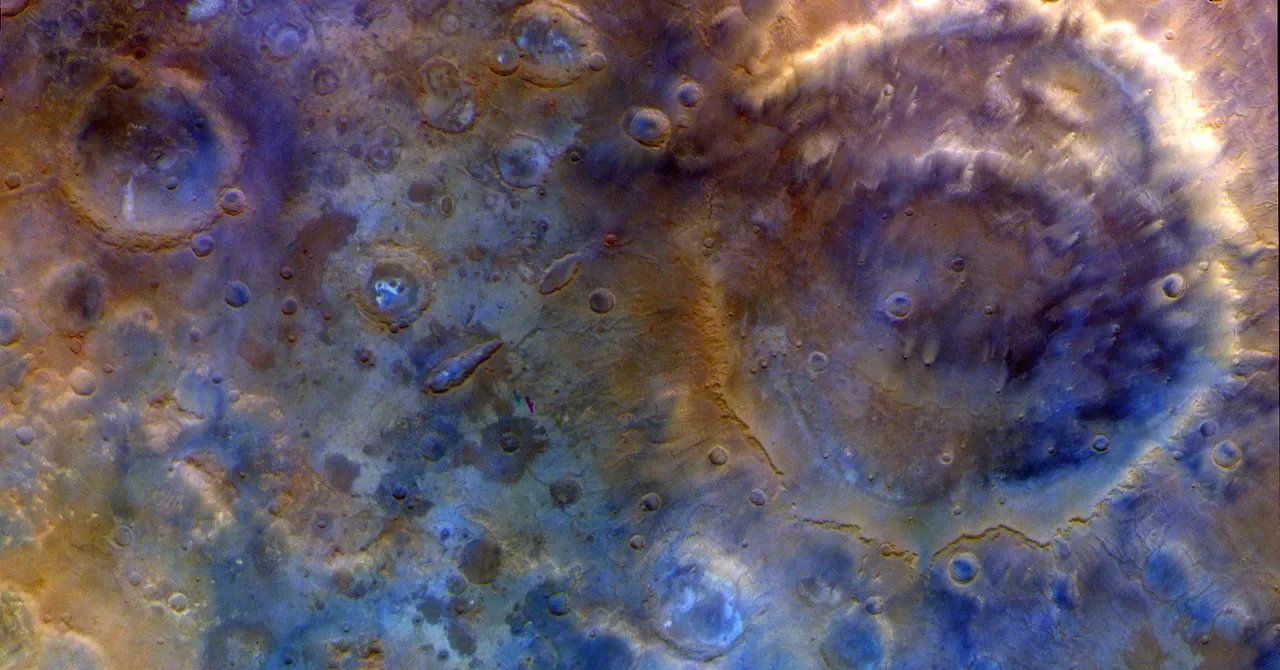
NASA's Psyche spacecraft, currently en route to a metal-rich asteroid, captured a series of stunning images of Mars as it performed a crucial gravitational assist maneuver. The images, released by NASA on May 24, 2026, showcase the Red Planet from a unique vantage point, offering a fresh perspective on its familiar features.
The 2.5-year journey to the asteroid 16 Psyche, located in the main asteroid belt between Mars and Jupiter, involves complex navigation that requires utilizing the gravity of planets to adjust the spacecraft's trajectory and speed. Mars served as the target for this specific maneuver, allowing the Psyche probe to slingshot around the planet, gaining the necessary velocity to continue its long voyage. During this flyby, the spacecraft's navigation cameras were tasked with documenting the encounter, inadvertently producing a remarkable visual record of Mars.
The photographs reveal Mars with striking clarity, highlighting its polar ice caps, vast deserts, and atmospheric haze. While not the primary scientific objective of the mission, these images provide valuable data for calibrating the spacecraft's instruments and offer a beautiful reminder of the celestial bodies encountered during deep space exploration. Scientists at NASA's Jet Propulsion Laboratory (JPL) in Southern California, responsible for managing the mission, expressed delight at the unexpected photographic bounty.
A Mission of Discovery
The primary goal of the Psyche mission is to study the asteroid 16 Psyche, an object believed to be the nickel-iron core of a protoplanet. By studying this unique asteroid, scientists hope to gain unprecedented insights into the formation of rocky planets, including Earth's own core. The asteroid's composition is thought to be similar to Earth's core, making it a prime target for understanding planetary interiors, a subject that has long fascinated geologists and astrophysicists.
Launched on October 13, 2023, the Psyche spacecraft is equipped with advanced instruments designed to analyze the asteroid's surface composition, magnetic field, and gravitational properties. The journey to 16 Psyche is expected to take approximately six years, with the spacecraft scheduled to arrive in 2029. The data collected will help researchers determine if 16 Psyche is indeed the core of an early planet, and if so, how its history compares to that of Earth.
The gravitational assist from Mars is a common technique used in space exploration to conserve fuel and achieve higher speeds. By carefully timing the flyby, mission controllers can use the planet's gravitational pull to alter the spacecraft's path without expending significant amounts of propellant. This maneuver is critical for missions traveling to the outer solar system, where distances are vast and fuel efficiency is paramount. The success of this maneuver for the Psyche probe signifies a major step forward in its ambitious journey across the solar system.
The unexpected Mars images serve as a testament to the ingenuity of NASA's engineering and the serendipitous discoveries that often accompany space exploration. While the scientific community eagerly anticipates the data from 16 Psyche, these breathtaking visuals of the Red Planet offer a moment of awe and appreciation for the cosmos we inhabit. The mission continues its trajectory, carrying with it the hopes of unraveling planetary mysteries billions of years in the making.