
NASA Seeks Volunteers for Yearlong Moon-Mars Simulation Mission
NASA is recruiting four participants for a yearlong simulation of Moon and Mars missions at Johnson Space Center. The program will replicate living and working in space to reduce risks for future astronauts.

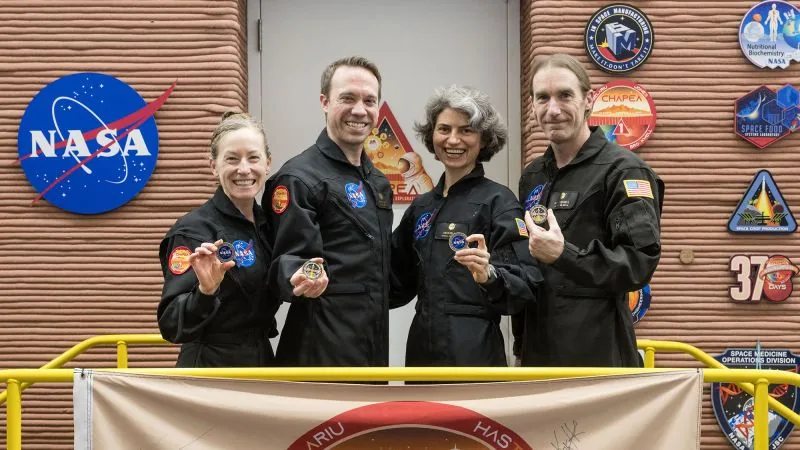
NASA is seeking four volunteers to participate in a groundbreaking yearlong simulation designed to mimic the challenges of living and working on the Moon and Mars. The Moon and Mars Exploration Analog (MMEA) program, set to begin in August 2027 at the Johnson Space Center in Houston, aims to gather crucial data on human performance and psychological adaptation during extended space missions.
The simulation will replicate spacelike conditions within confined habitats, requiring participants to perform astronaut duties such as cultivating crops, managing their health, and practicing simulated spacewalks. This comprehensive yearlong experience is intended to significantly reduce the risks associated with future crewed missions to celestial bodies, according to a NASA spokesperson. "Volunteer research participants contribute greatly to the knowledge base by helping NASA characterize the risks and test countermeasures to enhance human performance during long duration space exploration missions," the spokesperson stated.
Simulating Martian Days and Deep Space Travel
A key focus of the MMEA program will be studying how crews adjust to Martian time. A Martian day, known as a sol, is approximately 40 minutes longer than an Earth day, a discrepancy that could affect sleep patterns, health, and overall performance. Applicants for this demanding role must be U.S. citizens or green card holders, aged between 30 and 55 (though exceptions may be considered), no taller than 6 feet 2 inches, and fluent in English. The commitment extends to 14 months, including 12 months within the simulation habitats and two additional months for pre- and post-mission training.
Prospective participants must also pass rigorous physical and psychological evaluations. Essential qualifications include astronaut-like STEM degrees in fields such as engineering, biological science, physical science, or mathematics, with advanced degrees and military experience also being valuable. Crucially, candidates must have no dietary restrictions and no history of sleepwalking or reliance on sleep aids.
The research will involve two distinct habitats. The initial phase will take place in a 650-square-foot mock spacecraft, simulating the journey from Earth to the Moon or Mars. Four crew members will reside in compact personal quarters, each equipped for living, working, and sleeping, though with distinct facilities from actual spacecraft bathrooms. Following the transit simulation, participants will transition to a 900-square-foot surface facility. Here, they will engage in essential survival tasks, including growing food, monitoring their health, and practicing extravehicular activities (EVAs) in a sandbox designed to emulate planetary surfaces. The final phase involves a simulated return journey to Earth in the same transit vehicle.
These habitats have been utilized in previous NASA research but have been scaled down for the MMEA program to specifically model earlier stages of planetary surface infrastructure. This approach is vital for understanding near-term Moon Base objectives and informing the development of future Martian outposts. While NASA has conducted 28 transit and two surface habitat simulations previously, the MMEA marks the first time these two types of simulations will be integrated into a single, comprehensive study. Previous surface simulations, part of the Crew Health and Performance Exploration Analog (CHAPEA), focused on the health and performance of volunteers in confined settings dealing with Martian environmental challenges.
One former participant, Dr. Nathan Jones, shared his experience from a previous simulation, the Mars Alpha Dune habitat. Jones, who served as the crew's medical officer, described the yearlong confinement as emotionally challenging, particularly missing family events. "It was hard to miss big events like birthdays, holidays, graduations, funerals and weddings," Jones told CNN. Despite the difficulties, the experience solidified his ambition for space exploration and gave him a profound appreciation for everyday phenomena. "In the mission there was no sunshine or wind. So, I found a new appreciation for those kinds of things when the mission completed," he added.