
NASA's Psyche Mission Uses Mars Flyby for Asteroid Journey
NASA's Psyche spacecraft completed a critical flyby of Mars on May 15, 2026, using the planet's gravity as a slingshot. The maneuver is crucial for its mission to reach the metal-rich asteroid 16 Psyche in 2029.

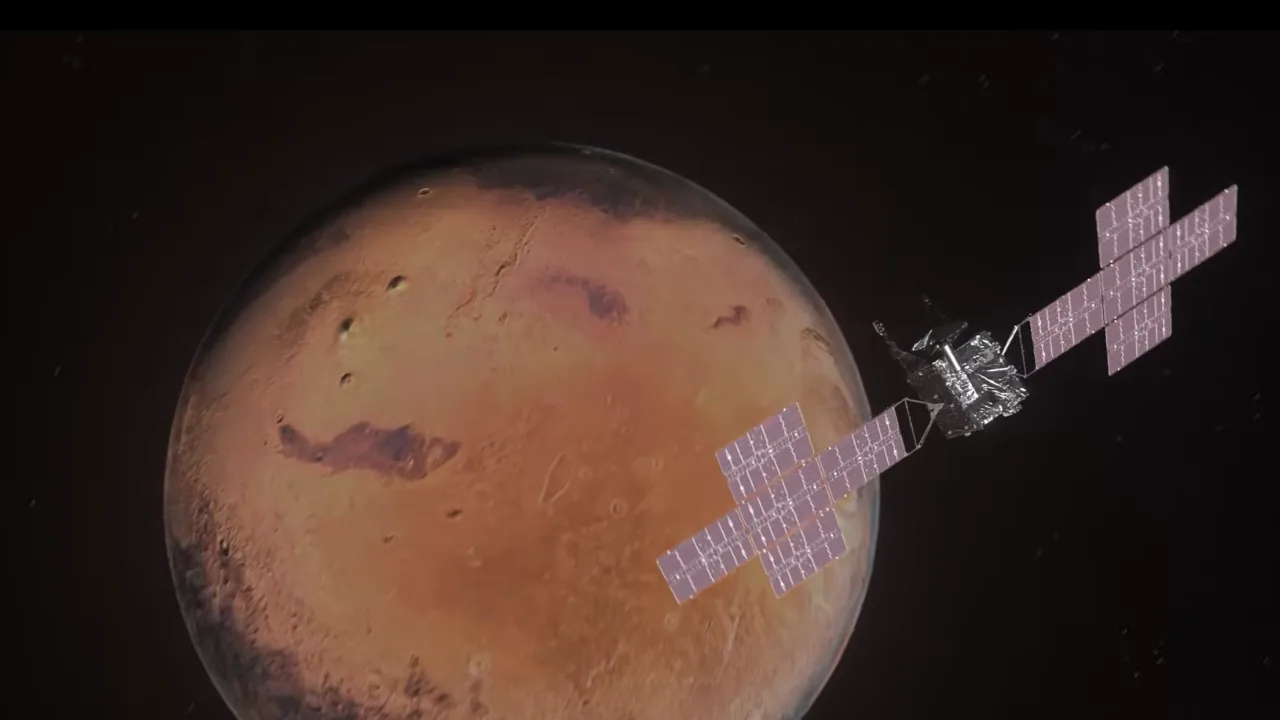
NASA's Psyche spacecraft successfully executed a gravity assist maneuver around Mars on Friday, May 15, 2026, precisely leveraging the Red Planet's gravitational pull to accelerate its journey toward a unique metal-rich asteroid. The spacecraft passed within approximately 2,800 miles (4,500 kilometers) of Mars, a critical step in its multi-year voyage to the asteroid 16 Psyche, located in the main asteroid belt between Mars and Jupiter.
This flyby was not an opportunity to study Mars itself, but rather a sophisticated application of orbital mechanics. By carefully navigating its approach and departure from the Red Planet, the Psyche mission team conserved precious fuel and adjusted the spacecraft's trajectory. This technique, known as a gravity assist or planetary flyby, allows spacecraft to gain speed and alter course by interacting with a planet's motion around the sun. It's a method that has been instrumental in enabling numerous ambitious deep-space missions.
A Celestial Slingshot Saves Fuel
The Psyche spacecraft utilizes solar-electric propulsion, an efficient but low-thrust system that relies on sunlight to convert solar energy into electricity, which then expels xenon gas to generate thrust. While highly effective for long-duration missions, achieving the necessary speed and trajectory changes for the journey to asteroid 16 Psyche solely through its own engines would have required an impractically large amount of propellant. The Mars gravity assist provided an equivalent velocity change of roughly 2 kilometers per second relative to the sun, according to scientific papers detailing the maneuver. This boost is essential for reaching the asteroid in 2029 with the planned fuel reserves.
"It's smart, it's cheap, and it's phenomenally clever… it's a bit like interplanetary billiards," Shadan Ardalan, a NASA scientist involved with the Juno mission, previously described the technique. This maneuver mirrors how spacecraft have historically extended their reach into the solar system. Missions like NASA's Voyager probes famously used gravity assists from multiple planets to tour the outer solar system. Similarly, the Cassini spacecraft relied on flybys of Earth, Venus, and Jupiter to gather the speed needed to investigate Saturn.
Scientists believe that asteroid 16 Psyche, the mission's ultimate destination, may be the exposed metallic core of a protoplanet, a remnant from the early solar system. If confirmed, studying this object could provide unprecedented insights into the internal structure of rocky planets like Earth, material normally hidden deep beneath their surfaces. The mission, which launched in October 2023, is expected to arrive at the asteroid in July 2029, marking a significant milestone in planetary science and our understanding of planetary formation.