
NASA Psyche Spacecraft Captures Mars Images in Gravity Assist
NASA's Psyche spacecraft captured stunning images of Mars during a May 15 flyby. The maneuver used Mars' gravity to accelerate the probe toward its main target, the metallic asteroid 16 Psyche.

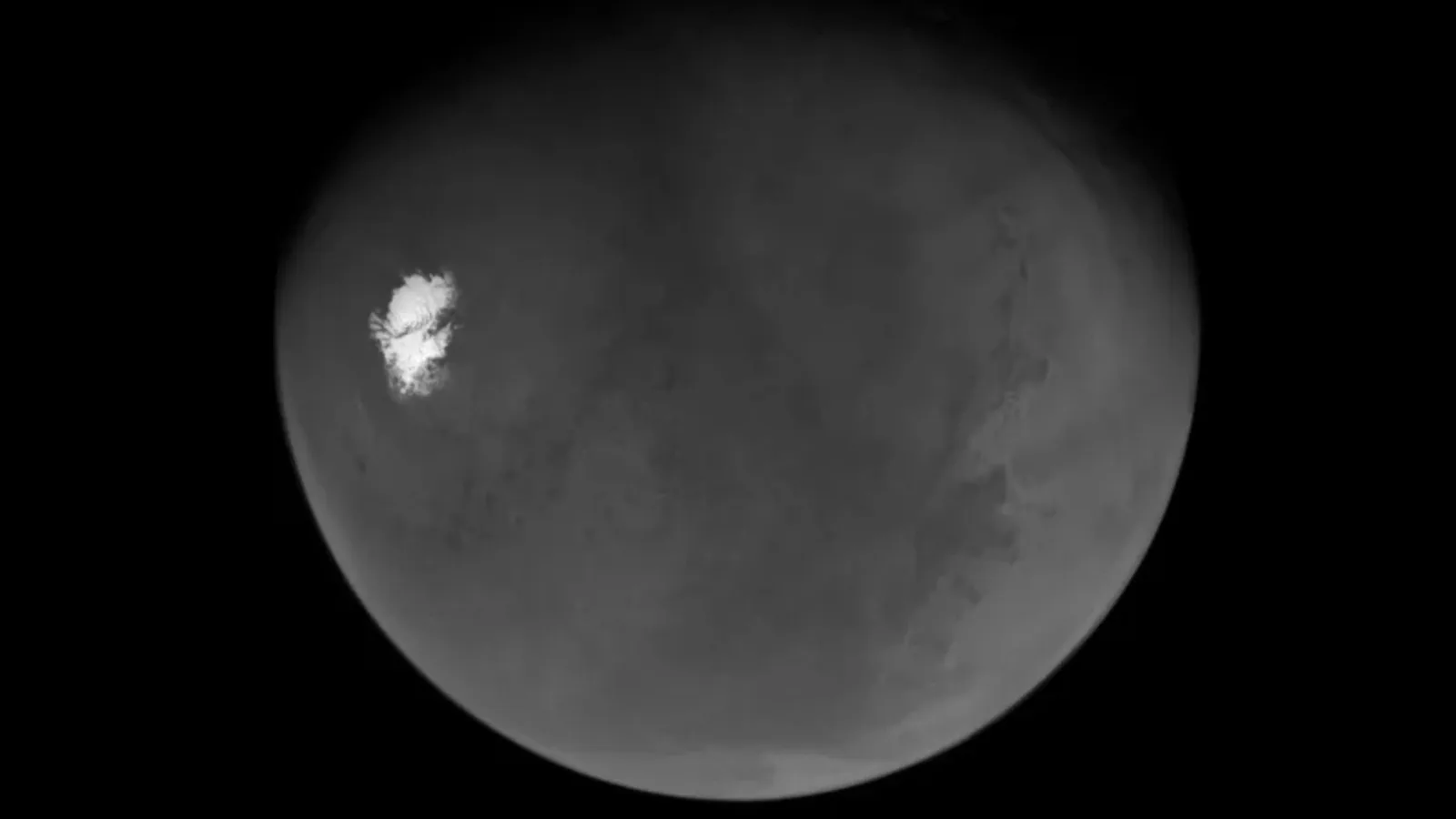
NASA's Psyche spacecraft captured striking new images of Mars during a close encounter with the Red Planet on May 15. The mission utilized the planet's gravity in a precisely calculated maneuver to gain speed and adjust its trajectory toward its ultimate destination: the asteroid 16 Psyche. This cosmic "slingshot" increased the spacecraft's velocity by approximately 1,000 miles per hour.
While performing the gravity assist, which brought it within about 2,900 miles of the Martian surface, mission controllers directed Psyche to photograph Mars from unique vantage points. The resulting images showcase the planet's prominent polar ice caps, intricate surface textures shaped by wind, and numerous crater formations, all rendered in exceptional clarity. These observations were not only for public fascination but also served a critical scientific purpose.
"The flyby provided an excellent opportunity to test and calibrate our scientific instruments before we reach the asteroid," NASA mission scientists stated following the successful encounter. This calibration is vital for the success of the mission, which aims to study an object unlike any other previously explored.
Journey to a Metallic World
Launched in October 2023, the NASA Psyche spacecraft is on an extensive journey spanning 2.2 billion miles. Its target, the asteroid 16 Psyche, resides in the outer asteroid belt. Scientists are particularly intrigued by this asteroid because it is believed to be a remnant of an early planetesimal, potentially the exposed metallic core of a protoplanet that failed to fully form.
The significance of asteroid 16 Psyche lies in its potential to offer unprecedented insights into the formation of rocky planets like Earth. By studying this body, researchers hope to understand how terrestrial planets developed their iron cores billions of years ago. This mission could provide a unique glimpse into the deep interiors of worlds similar to our own, a feat impossible to achieve through traditional planetary science methods.
The asteroid 16 Psyche encounter is anticipated in the summer of 2029. Following its arrival, the Psyche spacecraft will dedicate several years to meticulously mapping the composition and structure of the space rock. The data gathered during this extended observation period is expected to be groundbreaking, potentially confirming whether 16 Psyche is indeed a planetary core fragment. This would revolutionize our understanding of planetary evolution and the conditions present in the early solar system.
The success of the Mars gravity assist is a testament to the meticulous planning and execution by NASA's Jet Propulsion Laboratory, which manages the mission. Each maneuver is critical for conserving fuel and ensuring the spacecraft arrives at its distant target in optimal condition. The data collected during this flyby will also contribute to refining trajectory calculations for the remainder of the journey.