
NASA Swift Observatory Rescue Mission Faces Setbacks Amidst Spacecraft Spin
A critical mission to save NASA's Swift Observatory from reentering Earth's atmosphere has hit turbulence. The rescue spacecraft, LINK, experienced a destabilizing spin, delaying its rendezvous and raising questions about its ability to boost Swift to safety.

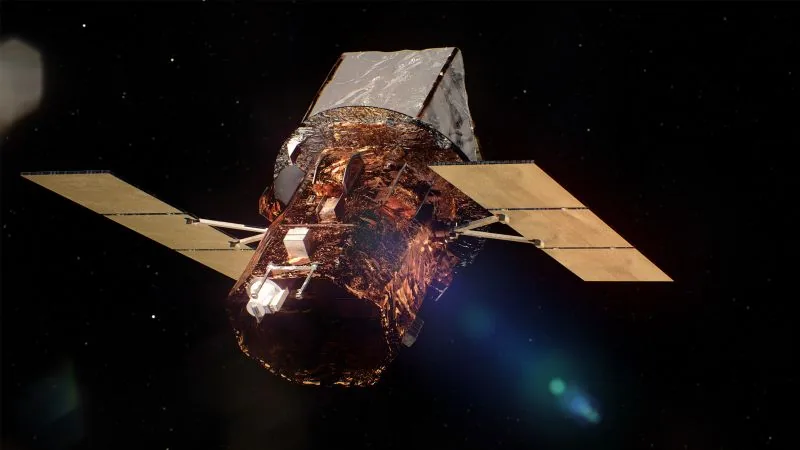
A vital mission designed to prevent NASA's Neil Gehrels Swift Observatory from plummeting back to Earth has encountered unexpected complications, casting uncertainty over the fate of both the aging observatory and its robotic rescuer. The Swift Observatory, a key astrophysics tool in low-Earth orbit for nearly 22 years, is facing a descent due to intensified atmospheric drag caused by solar activity. NASA predicts it could reenter the atmosphere this fall if its orbit drops below approximately 185 miles (300 kilometers).
To avert this, Arizona-based Katalyst Space Technologies was tasked with developing and launching a spacecraft, dubbed LINK, capable of intercepting Swift and reigniting its orbit – a feat required within a demanding nine-month timeframe. LINK successfully launched on July 3 aboard a Northrop Grumman Pegasus XL rocket. However, by July 25, the mission hit a significant snag: LINK began an uncontrolled spin, leading to a temporary loss of communication, according to joint statements from Katalyst and NASA released on July 28.
While engineers have since managed to largely stabilize LINK's rotation, the satellite's planned rendezvous with the Swift Observatory is now delayed, leaving the timeline for the crucial orbit boost uncertain. "I think one of the difficult things to convey is how amazing it is that we’ve gotten this far," stated Shawn Domagal-Goldman, division director of astrophysics at NASA, during a June 17 news conference. "Even if everyone does everything perfectly, there still might be risks that we cannot control ahead of us. I’m just deeply thankful that we’re even giving this a go."
LINK Spacecraft Suffers Operational Issues
Following its successful launch and deployment into orbit, Katalyst's mission control team established communication with the LINK satellite. The initial phase involved several weeks of system checks for LINK's navigation and sensors. Both NASA and Katalyst reported on July 15 that this commissioning process was progressing as planned, with solar arrays deployed and thruster firings initiated.
However, by mid-July, NASA noted some emerging challenges. "The Katalyst team also quickly addressed early communications and attitude control issues seen during flight operations, including an issue with one of the spacecraft’s three reaction wheels," NASA stated in a July 15 update. "After identifying the cause, they implemented flight software patches and operational updates that restored reliable communications and stable attitude control." Katalyst confirmed on July 13 that LINK was halfway through its activation phase.
Despite these early fixes, the situation escalated significantly by July 28. Katalyst announced that LINK had been experiencing a multi-axis spin for three days. NASA elaborated on the problem, revealing that "two of LINK’s three reaction wheels currently are not operable, and there is some loss of functionality in its cold gas thruster system." This development necessitated a reassessment of the rendezvous plans with Swift.
Katalyst responded by devising a strategy to mitigate the spin. Two days later, the company announced it had reduced LINK's spin rate from approximately 9 degrees per second to 4 degrees per second using controlled thruster burns. "Teams also further evaluated LINK’s functionality and determined there are still potential paths forward for a boost," NASA shared on July 31. "NASA is working closely with Katalyst to consider revised, innovative approaches."
As of Wednesday, Katalyst reported further progress in stabilizing LINK. The spacecraft's spin rate has been reduced to 1.47 degrees per second, a speed the satellite will maintain while the team prepares the next steps. "The team used one of LINK’s electric propulsion thrusters to slow the spacecraft down, consuming less than 100 grams of propellant to conserve fuel for the rendezvous and boost phase of the mission," Katalyst stated. A flight software update is planned to restore LINK's orientation control, enabling the necessary maneuvers for orbital alignment.
The original plan involved LINK surveying Swift for optimal grappling points, a step now anticipated to occur a month later than initially scheduled. After successfully securing the observatory, LINK is designed to use its ion thrusters to lift Swift back into a stable orbit over two to three months. The exact impact of this delay on the overall mission remains unclear, but both Swift Observatory and LINK teams acknowledged the inherent risks involved even before launch. "All of this is challenging and risky," said Kieran Wilson, principal investigator for LINK at Katalyst, during a June 17 news conference. "There’s a lot of spacecraft that have had far longer development cycles with far more funding behind them that have failed for mundane reasons."
The Swift Observatory, named for its ability to quickly pivot to observe cosmic events and their afterglows, has been instrumental in studying comets, gravitational waves, and black holes since its 2004 launch. With no immediate replacements planned for its unique capabilities, NASA deemed a rescue mission more cost-effective than abandoning the observatory. Swift is currently not conducting science observations to conserve power, but this could resume in the fall if LINK successfully completes its mission.