
New Crystal Discovered in First Atomic Bomb's Glass After 80 Years
Scientists have identified a never-before-seen crystal structure within trinitite, the glass formed by the 1945 Trinity atomic bomb test. This discovery offers new insights into materials formed under extreme conditions.

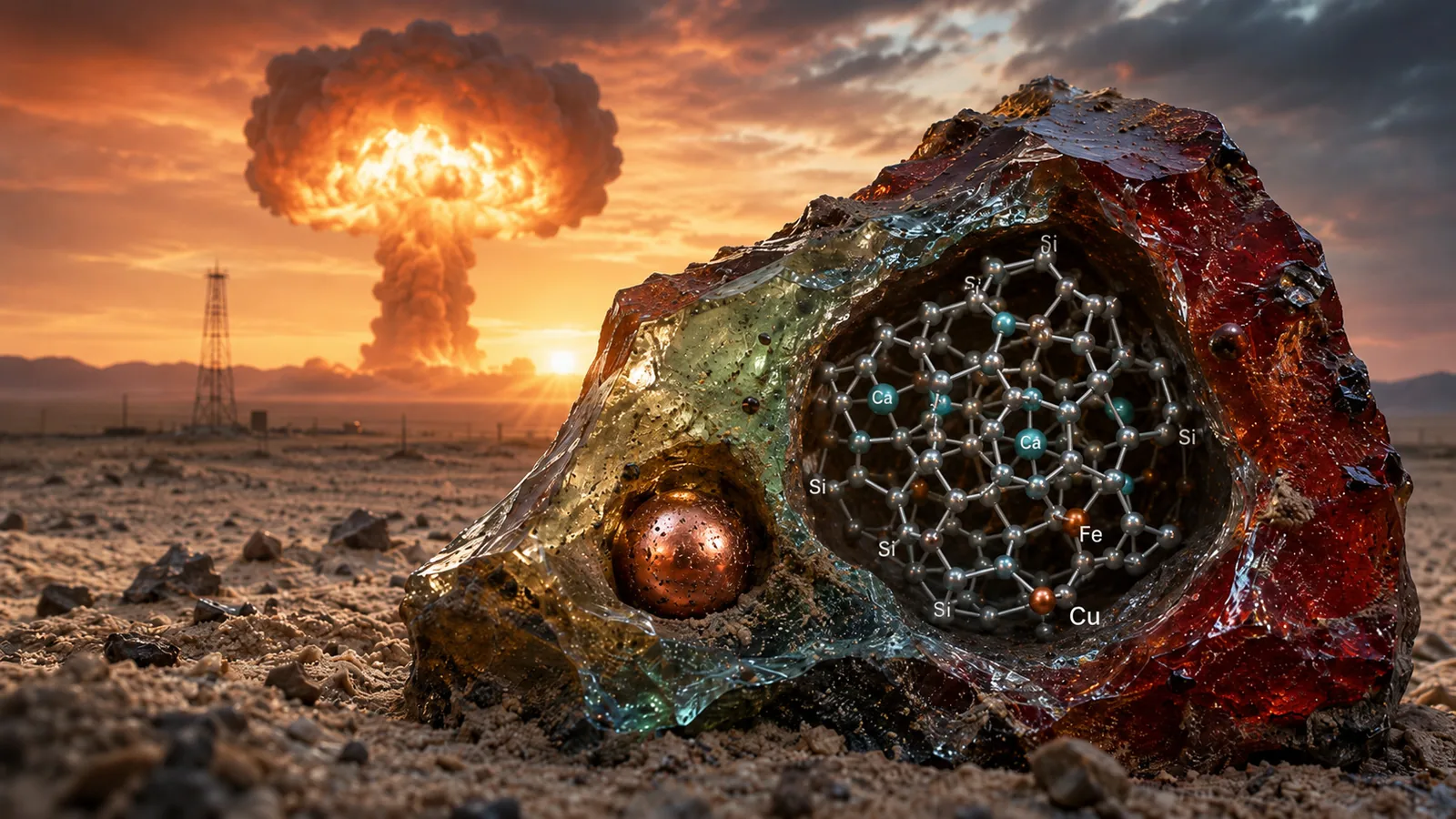
More than 80 years after the world's first atomic bomb detonated in the New Mexico desert, scientists have discovered a previously unknown crystal trapped within the resulting glassy material. The crystal, a calcium-copper-silicon clathrate, was identified in a rare red sample of trinitite, the artificial glass created by the intense heat and pressure of the 1945 Trinity test.
The groundbreaking finding was made by researchers studying a tiny, copper-rich droplet embedded in the trinitite. Using advanced X-ray diffraction techniques, they revealed a unique cage-like atomic structure that has never been observed before, either in nature or in the aftermath of other nuclear explosions. "It's a completely new kind of clathrate crystal — something never seen before in nature or in the products of a nuclear explosion," stated Luca Bindi, a geologist at the University of Florence and co-author of the study, in comments to Scientific American.
The Trinity test, which occurred on July 16, 1945, involved a plutonium implosion device dubbed "the Gadget." The explosion unleashed energy equivalent to approximately 21 to 25 kilotons of TNT, vaporizing the 30-meter steel test tower and surrounding materials. Sand, metal debris from the tower, and other elements were fused together under temperatures exceeding 1,500 degrees Celsius and immense pressure, cooling rapidly to form trinitite.
While most trinitite is a pale green glass, rarer red varieties contain higher concentrations of metals from the test equipment. These red samples are particularly valuable to scientists as they preserve a more detailed chemical record of the blast. The newly discovered crystal is a testament to the extreme, transient conditions generated by the detonation, which allowed atoms to arrange in novel, non-equilibrium configurations before solidifying.
A Unique Structure Born from Extremes
Clathrates are crystalline structures characterized by their cage-like atomic arrangements. In this newly identified crystal, silicon atoms form the primary cage structures, which can be dodecahedral (12-sided) or tetrakaidecahedral (14-sided). Within these cages are calcium atoms, along with trace amounts of copper and iron. This specific composition and architecture represent a novel class of clathrate.
The researchers highlighted that the extreme and fleeting conditions of the Trinity blast—intense heat and pressure lasting mere seconds—created an environment where atoms could assemble into unusual, metastable phases that are inaccessible through conventional laboratory synthesis. "Extreme, transient conditions produced by nuclear detonations can generate solid-state phases inaccessible to conventional synthesis," the study authors noted. This process essentially froze atoms in place before they could settle into more common, stable structures.
The Trinity site continues to be a source of scientific fascination for mineralogists and materials scientists. "The transient extreme conditions of the Trinity test allow for the formation of metastable phases that might not be found in laboratory experiments," explained G. Nelson Eby, a geoscientist at the University of Massachusetts Lowell, who was not involved in the research. "This is an interesting new addition to the clathrate universe." The study of clathrates is relevant to materials science due to their potential applications in energy storage, electronics, and quantum technologies, although the Trinity clathrate itself is too rare and small for such uses.
This is not the first unusual crystal to be found in red trinitite. In 2021, the same research team reported the discovery of a quasicrystal, another type of ordered but non-periodically repeating atomic structure, in similar material from the Trinity test. Quasicrystals were once thought to be impossible, and their discovery expanded the definition of crystalline matter. The first naturally occurring quasicrystal was found in meteorite fragments, suggesting their formation in cataclysmic events.
The newly found clathrate and the previously identified quasicrystal share a similar chemical makeup and were found in close proximity within the trinitite. This led researchers to explore a potential structural relationship between them. However, computational modeling indicated that while related, the clathrate does not appear to be a direct precursor to the Trinity quasicrystal. Instead, they seem to be distinct, albeit related, structures born from the same violent event.
The discovery of these novel crystalline structures underscores the significance of the Trinity test not only as a historical turning point but also as a unique scientific event. "This work underscores how rare, high-energy events — such as nuclear detonations, lightning strikes, and hypervelocity impacts — serve as natural laboratories for producing unexpected crystalline matter," the authors concluded. The Trinity test, though artificial, created a momentary set of conditions that scientists are still learning from, demonstrating how the fundamental rules of matter formation can be altered by extreme forces.