
Northern Lights Possible as M6.9 Solar Flare Triggers CME
A powerful M6.9 solar flare erupted from the sun on Tuesday, launching a coronal mass ejection (CME) toward Earth. The CME could trigger a geomagnetic storm, potentially causing a dazzling Northern Lights display by Friday.

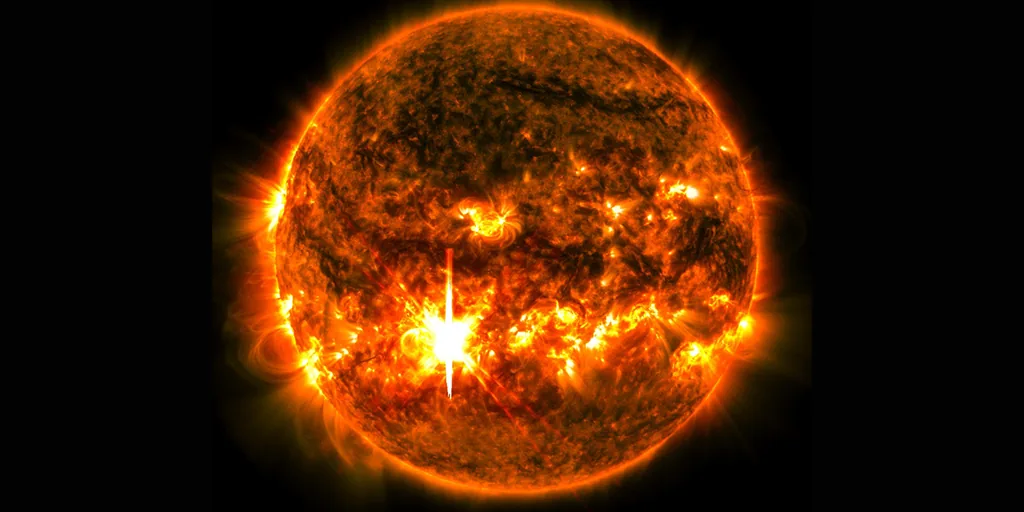
An M6.9 solar flare erupted from the sun on Tuesday morning, sending a coronal mass ejection (CME) hurtling towards Earth. Scientists anticipate the solar event could lead to a geomagnetic storm and a chance for a spectacular Northern Lights display by Friday. The flare's peak intensity occurred at 6 a.m. EDT, releasing a significant burst of energy and particles.
Solar flares are classified into five categories: A, B, C, M, and X, with X being the most powerful. This M6.9 event falls into the second-highest strength category. These energetic eruptions are known to disrupt radio communications, power grids, and navigation systems. They also pose risks to astronauts and spacecraft operating in orbit, according to NASA.
Understanding Solar Eruptions and Their Effects
When the sun experiences a powerful flare, several phenomena can occur. These include a visible flash of light, a radiation storm characterized by high-speed solar particles, and a coronal mass ejection (CME) – a massive cloud of solar material expelled into space. The current CME's trajectory and its magnetic field's interaction with Earth's magnetosphere will determine the precise timing and intensity of any geomagnetic activity.
Early projections suggest that Earth might experience a glancing blow from the CME by Friday morning, potentially between 6 and 7 a.m. EDT. The actual arrival time and the extent of its impact will depend on how the CME's magnetic field interfaces with our planet. If this CME coincides with a high-speed solar wind stream, the combined effect could significantly enhance geomagnetic activity, increasing the likelihood of visible auroras.
While the event offers the potential for a captivating celestial show, viewing opportunities might be limited. Only specific regions in North America are expected to have a clear view of the aurora. For astronomers and skywatchers hoping to witness the Northern Lights, the hope is for a vibrant display of colors painting the night sky.